Thank you for visiting SNEWPapers!
Sign up free
Literary
January 30, 1752
The Virginia Gazette
Richmond, Williamsburg, Richmond County, Virginia
What is this article about?
An essay critiques the common complaints of the elderly against the impudence of youth, attributing disrespect to the follies and vices of age itself. It advises the old to embrace wisdom, moderation, and example over severity to maintain influence and respect from younger generations.
Clipping
OCR Quality
95%
Excellent
Full Text
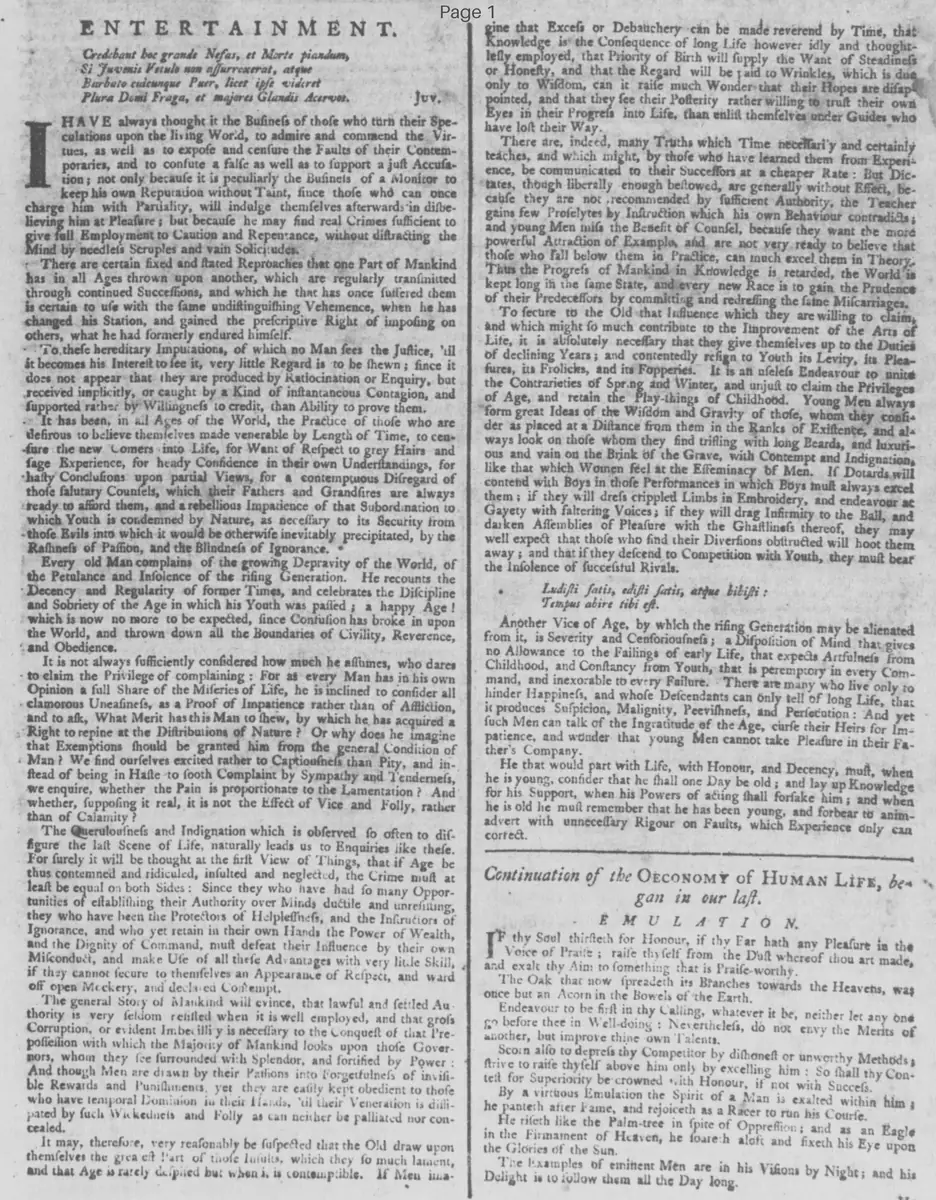
ENTERTAINMENT.
Credebant hoc grande Nefas, et Morte piandum,
Si Juvenis Vetulo non abnuerat, atque
Barbato cuicunque Puer, licet ipse videret
Plura Damo Fraga, et majores Glandis Acervos.
Juv.
I HAVE always thought it the Business of those who turn their
Speculations upon the living World, to admire and commend the Virtues,
as well as to expose and censure the Faults of their Contemporaries, and
to confute a false as well as to support a just Accusation; not only because
it is peculiarly the Business of a Monitor to keep his own Reputation
without Taint, since those who can once charge him with Partiality, will
indulge themselves afterwards in disbelieving him at Pleasure; but because
he may find real Crimes sufficient to give full Employment to Caution and
Repentance, without distracting the Mind by needless Scruples and vain
Solicitudes.
There are certain fixed and stated Reproaches that one Part of Mankind
has in all Ages thrown upon another, which are regularly transmitted
through continued Successions, and which he that has once suffered them
is certain to use with the same undistinguishing Vehemence, when he has
changed his Station, and gained the prescriptive Right of imposing on
others, what he had formerly endured himself.
To these hereditary Imputations, of which no Man sees the Justice, till
it becomes his Interest to see it, very little Regard is to be shown; since it
does not appear that they are produced by Ratiocination or Enquiry, but
received implicitly, or caught by a Kind of instantaneous Contagion, and
supported rather by Willingness to credit, than Ability to prove them.
It has been, in all Ages of the World, the Practice of those who are
desirous to believe themselves made venerable by Length of Time, to censure
the new Comers into Life, for Want of Respect to grey Hairs and Age
Experience, for heady Confidence in their own Understandings, for hasty
Conclusions upon partial Views, for a contemptuous Disregard of those
salutary Counsels, which their Fathers and Grandsires are always ready to
afford them, and a rebellious Impatience of that Subordination to which
Youth is condemned by Nature, as necessary to its Security from those
Evils into which it would be otherwise inevitably precipitated, by the
Rashness of Passion, and the Blindness of Ignorance.
Every old Man complains of the growing Depravity of the World, of the
Petulance and Insolence of the rising Generation. He recounts the Decency
and Regularity of former Times, and celebrates the Discipline and Sobriety
of the Age in which his Youth was passed; a happy Age! which is now no
more to be expected, since Confusion has broke in upon the World, and
thrown down all the Boundaries of Civility, Reverence, and Obedience.
It is not always sufficiently considered how much he assumes, who dares
to claim the Privilege of complaining: For as every Man has in his own
Opinion a full Share of the Miseries of Life, he is inclined to consider all
clamorous Uneasiness, as a Proof of Impatience rather than of Affliction,
and to ask, What Merit has this Man to show, by which he has acquired a
Right to repine at the Distributions of Nature? Or why does he imagine
that Exemptions should be granted him from the general Condition of Man?
We find ourselves excited rather to Captiousness than Pity, and instead
of being in Haste to soothe Complaint by Sympathy and Tenderness, we
enquire, whether the Pain is proportionate to the Lamentation? And whether,
supposing it real, it is not the Effect of Vice and Folly, rather than of
Calamity?
The Querulousness and Indignation which is observed so often to disfigure
the last Scene of Life, naturally leads us to Enquiries like these. For
surely it will be thought at the first View of Things, that if Age be thus
contemned and ridiculed, insulted and neglected, the Crime must at least
be equal on both Sides: Since they who have had so many Opportunities of
establishing their Authority over Minds ductile and unresisting, they who
have been the Protectors of Helplessness, and the Instructors of Ignorance,
and who yet retain in their own Hands the Power of Wealth, and the
Dignity of Command, must defeat their Influence by their own Misconduct,
and make Use of all these Advantages with very little Skill, if they cannot
secure to themselves an Appearance of Respect, and ward off open Mockery,
and declare a Contempt.
The general Story of Mankind will evince, that lawful and settled Authority
is very seldom resisted when it is well employed, and that gross Corruption,
or evident Imbecility is necessary to the Conquest of that Possession with
which the Majority of Mankind looks upon those Governors, whom they see
surrounded with Splendor, and fortified by Power: And though Men are
drawn by their Passions into Forgetfulness of invisible Rewards and
Punishments, yet they are easily kept obedient to those who have temporal
Dominion in their Hands, till their Veneration is dissipated by such
Wickedness and Folly as can neither be palliated nor concealed.
It may, therefore, very reasonably be suspected that the Old draw upon
themselves the greatest Part of those Insults, which they so much lament,
and that Age is rarely despised but when it is contemptible.
If Men will imagine that Excess or Debauchery can be made reverend by
Time, that Knowledge is the Consequence of long Life however idly and
thoughtlessly employed, that Priority of Birth will supply the Want of
Steadiness or Honesty, and that the Regard will be paid to Wrinkles, which
is due only to Wisdom, can it raise much Wonder that their Hopes are
disappointed, and that they see their Posterity rather willing to trust their
own Eyes in their Progress into Life, than enlist themselves under Guides
who have lost their Way.
There are, indeed, many Truths which Time necessarily and certainly
teaches, and which might, by those who have learned them from Experience,
be communicated to their Successors at a cheaper Rate: But Dictates, though
liberally enough bestowed, are generally without Effect, because they are
not recommended by sufficient Authority, the Teacher gains few Proselytes
by Instruction which his own Behaviour contradicts: and young Men miss
the Benefit of Counsel, because they want the more powerful Attraction of
Example, and are not very ready to believe that those who fall below them
in Practice, can much excel them in Theory.
Thus the Progress of Mankind in Knowledge is retarded, the World is kept
long in the same State, and every new Race is to gain the Prudence of their
Predecessors by committing and redressing the same Miscarriages.
To secure to the Old that Influence which they are willing to claim, and
which might so much contribute to the Improvement of the Arts of Life, it
is absolutely necessary that they give themselves up to the Duties of
declining Years; and contentedly resign to Youth its Levity, its Pleasures,
its Frolics, and its Fopperies. It is an useless Endeavour to unite the
Contrarieties of Spring and Winter, and unjust to claim the Privileges of
Age, and retain the Play-things of Childhood. Young Men always form
great Ideas of the Wisdom and Gravity of those, whom they consider as
placed at a Distance from them in the Ranks of Existence, and always look
on those whom they find trifling with long Beards, and luxurious and vain
on the Brink of the Grave, with Contempt and Indignation like that which
Women feel at the Effeminacy of Men. If Dotards will contend with Boys
in those Performances in which Boys must always excel them; if they will
dress crippled Limbs in Embroidery, and endeavour at Gayety with faltering
Voices; if they will drag Infirmity to the Ball, and darken Assemblies of
Pleasure with the Ghastliness thereof, they may well expect that those who
find their Diversions obstructed will hoot them away; and that if they
descend to Competition with Youth, they must bear the Insolence of
successful Rivals.
Ludicri estis, edisti satis, atque bibisti:
Tempus abire tibi est.
Another Vice of Age, by which the rising Generation may be alienated from
it, is Severity and Censoriousness; a Disposition of Mind that gives no
Allowance to the Failings of early Life, that expects Artfulness from
Childhood, and Constancy from Youth, that is peremptory in every Command,
and inexorable to every Failure. There are many who live only to hinder
Happiness, and whose Descendants can only tell of long Life, that it
produces Suspicion, Malignity, Peevishness, and Persecution: And yet such
Men can talk of the Ingratitude of the Age, curse their Heirs for Impatience,
and wonder that young Men cannot take Pleasure in their Father's Company.
He that would part with Life, with Honour, and Decency, must, when he is
young, consider that he shall one Day be old; and lay up Knowledge for
his Support, when his Powers of acting shall forsake him; and when he is
old he must remember that he has been young, and forbear to animadvert
with unnecessary Rigour on Faults, which Experience only can correct.
Credebant hoc grande Nefas, et Morte piandum,
Si Juvenis Vetulo non abnuerat, atque
Barbato cuicunque Puer, licet ipse videret
Plura Damo Fraga, et majores Glandis Acervos.
Juv.
I HAVE always thought it the Business of those who turn their
Speculations upon the living World, to admire and commend the Virtues,
as well as to expose and censure the Faults of their Contemporaries, and
to confute a false as well as to support a just Accusation; not only because
it is peculiarly the Business of a Monitor to keep his own Reputation
without Taint, since those who can once charge him with Partiality, will
indulge themselves afterwards in disbelieving him at Pleasure; but because
he may find real Crimes sufficient to give full Employment to Caution and
Repentance, without distracting the Mind by needless Scruples and vain
Solicitudes.
There are certain fixed and stated Reproaches that one Part of Mankind
has in all Ages thrown upon another, which are regularly transmitted
through continued Successions, and which he that has once suffered them
is certain to use with the same undistinguishing Vehemence, when he has
changed his Station, and gained the prescriptive Right of imposing on
others, what he had formerly endured himself.
To these hereditary Imputations, of which no Man sees the Justice, till
it becomes his Interest to see it, very little Regard is to be shown; since it
does not appear that they are produced by Ratiocination or Enquiry, but
received implicitly, or caught by a Kind of instantaneous Contagion, and
supported rather by Willingness to credit, than Ability to prove them.
It has been, in all Ages of the World, the Practice of those who are
desirous to believe themselves made venerable by Length of Time, to censure
the new Comers into Life, for Want of Respect to grey Hairs and Age
Experience, for heady Confidence in their own Understandings, for hasty
Conclusions upon partial Views, for a contemptuous Disregard of those
salutary Counsels, which their Fathers and Grandsires are always ready to
afford them, and a rebellious Impatience of that Subordination to which
Youth is condemned by Nature, as necessary to its Security from those
Evils into which it would be otherwise inevitably precipitated, by the
Rashness of Passion, and the Blindness of Ignorance.
Every old Man complains of the growing Depravity of the World, of the
Petulance and Insolence of the rising Generation. He recounts the Decency
and Regularity of former Times, and celebrates the Discipline and Sobriety
of the Age in which his Youth was passed; a happy Age! which is now no
more to be expected, since Confusion has broke in upon the World, and
thrown down all the Boundaries of Civility, Reverence, and Obedience.
It is not always sufficiently considered how much he assumes, who dares
to claim the Privilege of complaining: For as every Man has in his own
Opinion a full Share of the Miseries of Life, he is inclined to consider all
clamorous Uneasiness, as a Proof of Impatience rather than of Affliction,
and to ask, What Merit has this Man to show, by which he has acquired a
Right to repine at the Distributions of Nature? Or why does he imagine
that Exemptions should be granted him from the general Condition of Man?
We find ourselves excited rather to Captiousness than Pity, and instead
of being in Haste to soothe Complaint by Sympathy and Tenderness, we
enquire, whether the Pain is proportionate to the Lamentation? And whether,
supposing it real, it is not the Effect of Vice and Folly, rather than of
Calamity?
The Querulousness and Indignation which is observed so often to disfigure
the last Scene of Life, naturally leads us to Enquiries like these. For
surely it will be thought at the first View of Things, that if Age be thus
contemned and ridiculed, insulted and neglected, the Crime must at least
be equal on both Sides: Since they who have had so many Opportunities of
establishing their Authority over Minds ductile and unresisting, they who
have been the Protectors of Helplessness, and the Instructors of Ignorance,
and who yet retain in their own Hands the Power of Wealth, and the
Dignity of Command, must defeat their Influence by their own Misconduct,
and make Use of all these Advantages with very little Skill, if they cannot
secure to themselves an Appearance of Respect, and ward off open Mockery,
and declare a Contempt.
The general Story of Mankind will evince, that lawful and settled Authority
is very seldom resisted when it is well employed, and that gross Corruption,
or evident Imbecility is necessary to the Conquest of that Possession with
which the Majority of Mankind looks upon those Governors, whom they see
surrounded with Splendor, and fortified by Power: And though Men are
drawn by their Passions into Forgetfulness of invisible Rewards and
Punishments, yet they are easily kept obedient to those who have temporal
Dominion in their Hands, till their Veneration is dissipated by such
Wickedness and Folly as can neither be palliated nor concealed.
It may, therefore, very reasonably be suspected that the Old draw upon
themselves the greatest Part of those Insults, which they so much lament,
and that Age is rarely despised but when it is contemptible.
If Men will imagine that Excess or Debauchery can be made reverend by
Time, that Knowledge is the Consequence of long Life however idly and
thoughtlessly employed, that Priority of Birth will supply the Want of
Steadiness or Honesty, and that the Regard will be paid to Wrinkles, which
is due only to Wisdom, can it raise much Wonder that their Hopes are
disappointed, and that they see their Posterity rather willing to trust their
own Eyes in their Progress into Life, than enlist themselves under Guides
who have lost their Way.
There are, indeed, many Truths which Time necessarily and certainly
teaches, and which might, by those who have learned them from Experience,
be communicated to their Successors at a cheaper Rate: But Dictates, though
liberally enough bestowed, are generally without Effect, because they are
not recommended by sufficient Authority, the Teacher gains few Proselytes
by Instruction which his own Behaviour contradicts: and young Men miss
the Benefit of Counsel, because they want the more powerful Attraction of
Example, and are not very ready to believe that those who fall below them
in Practice, can much excel them in Theory.
Thus the Progress of Mankind in Knowledge is retarded, the World is kept
long in the same State, and every new Race is to gain the Prudence of their
Predecessors by committing and redressing the same Miscarriages.
To secure to the Old that Influence which they are willing to claim, and
which might so much contribute to the Improvement of the Arts of Life, it
is absolutely necessary that they give themselves up to the Duties of
declining Years; and contentedly resign to Youth its Levity, its Pleasures,
its Frolics, and its Fopperies. It is an useless Endeavour to unite the
Contrarieties of Spring and Winter, and unjust to claim the Privileges of
Age, and retain the Play-things of Childhood. Young Men always form
great Ideas of the Wisdom and Gravity of those, whom they consider as
placed at a Distance from them in the Ranks of Existence, and always look
on those whom they find trifling with long Beards, and luxurious and vain
on the Brink of the Grave, with Contempt and Indignation like that which
Women feel at the Effeminacy of Men. If Dotards will contend with Boys
in those Performances in which Boys must always excel them; if they will
dress crippled Limbs in Embroidery, and endeavour at Gayety with faltering
Voices; if they will drag Infirmity to the Ball, and darken Assemblies of
Pleasure with the Ghastliness thereof, they may well expect that those who
find their Diversions obstructed will hoot them away; and that if they
descend to Competition with Youth, they must bear the Insolence of
successful Rivals.
Ludicri estis, edisti satis, atque bibisti:
Tempus abire tibi est.
Another Vice of Age, by which the rising Generation may be alienated from
it, is Severity and Censoriousness; a Disposition of Mind that gives no
Allowance to the Failings of early Life, that expects Artfulness from
Childhood, and Constancy from Youth, that is peremptory in every Command,
and inexorable to every Failure. There are many who live only to hinder
Happiness, and whose Descendants can only tell of long Life, that it
produces Suspicion, Malignity, Peevishness, and Persecution: And yet such
Men can talk of the Ingratitude of the Age, curse their Heirs for Impatience,
and wonder that young Men cannot take Pleasure in their Father's Company.
He that would part with Life, with Honour, and Decency, must, when he is
young, consider that he shall one Day be old; and lay up Knowledge for
his Support, when his Powers of acting shall forsake him; and when he is
old he must remember that he has been young, and forbear to animadvert
with unnecessary Rigour on Faults, which Experience only can correct.
What sub-type of article is it?
Essay
What themes does it cover?
Moral Virtue
Social Manners
What keywords are associated?
Old Age
Youth
Generational Conflict
Moral Instruction
Vice Of Age
Wisdom
Respect
Complaint
Literary Details
Key Lines
Every Old Man Complains Of The Growing Depravity Of The World, Of The Petulance And Insolence Of The Rising Generation.
Age Is Rarely Despised But When It Is Contemptible.
It Is An Useless Endeavour To Unite The Contrarieties Of Spring And Winter, And Unjust To Claim The Privileges Of Age, And Retain The Play Things Of Childhood.
Ludicri Estis, Edisti Satis, Atque Bibisti: Tempus Abire Tibi Est.