Thank you for visiting SNEWPapers!
Sign up free
The New Hampshire Gazette
Portsmouth, Rockingham County, New Hampshire
What is this article about?
A letter from Fort William Henry dated March 26 describes French forces under M. de Vaudreuil attempting to assault the British fort from March 19-22, involving artillery fire, failed storms, burning of vessels and structures, and a surrender demand rejected; French withdrew with minimal British casualties.
Merged-components note: Continuation of the account of the attack on Fort William Henry; relabeled the second component from foreign_news to domestic_news as it pertains to events in American colonies.
Clippings
1 of 2
OCR Quality
Full Text
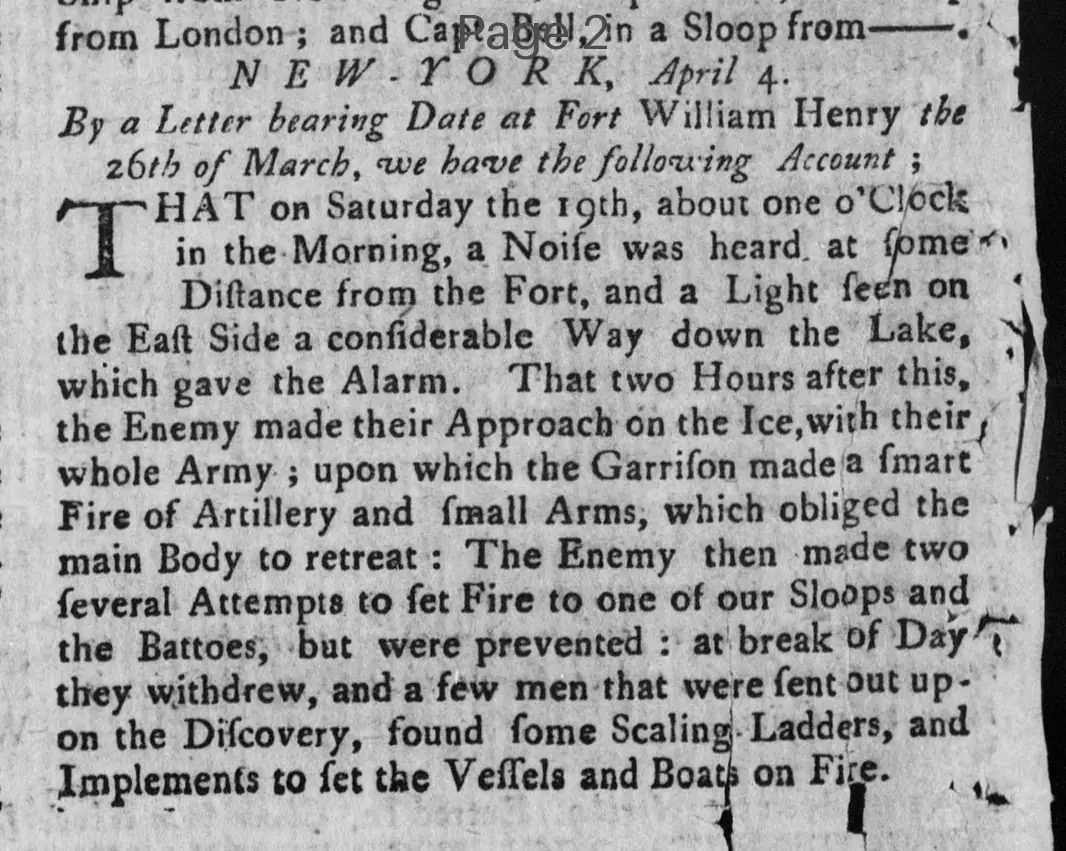
By a Letter bearing Date at Fort William Henry the 26th of March, we have the following Account;
THAT on Saturday the 19th, about one o'Clock in the Morning, a Noise was heard at some Distance from the Fort, and a Light seen on the East Side a considerable Way down the Lake, which gave the Alarm. That two Hours after this, the Enemy made their Approach on the Ice, with their whole Army; upon which the Garrison made a smart Fire of Artillery and small Arms: which obliged the main Body to retreat: The Enemy then made two Several Attempts to set Fire to one of our Sloops and the Battoes, but were prevented: at break of Day they withdrew, and a few men that were sent out upon the Discovery, found some Scaling Ladders, and Implements to set the Vessels and Boats on Fire.
Some of the Enemy that were made Prisoners, in our Army, according to some, consisted of 1610. and according to others, in upwards of 2000 Regulars, Colony Troops, Canadians, and Indians, with 300 Scaling-Ladders, and all the Apparatus for a general Assault.
Soon after their first Retreat, they again appeared on the Lake, and on each Side of it, filing off in large Bodies to surround us, and keeping a smart Fire of Small Arms on the Garrison, who checked their Approach with their Artillery, which obliged them to retire.
The 20th they made an Attempt with their whole Army, to storm the Place, but were again drove back, whereupon they set fire to two Sloops, and burnt almost all our Batteaus; and at Day light withdrew.
About Midday, their Army was seen marching across the Lake, as if returning to Ticonderoga; but presently after some Men came back towards the Fort with a red Flag, upon which we sent an Officer and four Men with another Flag to meet them. One of these Men returned with a Letter from M. de Vaudreuil, Commander of the French Army, directed to the Commanding Officer of Fort William Henry, containing in Substance; That he sent M. Le Chevalier Le Mercier, Commander of the Artillery, to acquaint him with his Resolutions; and that he might give entire Credit to what he should say to him on his Behalf.
In Consequence of which Letter, another Officer was sent to bring in Mon. Le Mercier, blindfolded.
The Summary of his Message was as follows, That Monf. De Vaudreuil was averse to carrying on a War, and regretted much the Miseries that attended it; to prevent which (as we were the Aggressors, in having made Encroachments on H. M. C. M.'s Territories, and built Forts on them) he desired that the Fort might be delivered up in a peaceable Manner: That the Garrison should be allowed all the Honours of War, and be permitted to carry away their most valuable Effects, only begged that something might be left to gratify the Indians, from whom they need be under no Apprehensions, as they had Regulars enough to protect the Garrison from any Violence they might offer. That if we refused to agree with these Terms, they intended immediately to make a general Assault, which, should they succeed, we must take the Consequences, &c.
In answer to this, the Commanding Officer sent Word to the French Commander, that his fixed Resolution Was to defend his Majesty's Garrison to the last Extremity, after which Monier Le Mercier was carried back blindfolded, and soon after their Army was seen to move towards us. Every Thing was ready for a general Assault, and tho' we were sickly, a general Firmness could be discovered by the Behaviour of the Troops, so as to give great Hopes they would do their Parts. The Officers behaved with the greatest Vigilance, Care and Resolution. The Enemy's Fire was soon renewed by some of their detached Parties, whilst the main Body kept at a Distance. - That Night, or early in the Morning, a third general Assault was undertaken, in which they again failed. Upon which they set Fire to three several Store Houses of the provincial Troops, and all the Huts of the Rangers, which burnt with great Violence, but happily did no further Damage.
Monday the 21st at Day break, the Enemy withdrew in their usual Way. Between 9 and 10 it began to Snow and continued so the whole Day and Night; during which Time the Fire on both Sides in a great Measure ceased. The 22nd, early in the Morning, they seemed resolved to burn the Sloop upon the Stocks: They were beat off several Times, but still persevered; and at last, by means of Combustibles and dry Faggots from their Encampment, effected their Design. The Sloop continued blazing until broad Day on Wednesday. A little Time after this the Enemy wholly disappeared.
The Whale Boats, Scows or Gondolas, and Bay-Boats, have escaped the Conflagration. We have had only 7 Men slightly wounded. The Prisoners tell us our Artillery had good Effect.
What sub-type of article is it?
What keywords are associated?
What entities or persons were involved?
Where did it happen?
Domestic News Details
Primary Location
Fort William Henry
Event Date
March 19 22
Key Persons
Outcome
only 7 men slightly wounded on british side; french army withdrew after failed assaults; several sloops, batteaus, store houses, and huts burned.
Event Details
French forces under M. de Vaudreuil approached Fort William Henry on ice on March 19, leading to artillery exchanges and failed attempts to burn vessels. On March 20, a storm attempt failed, vessels burned, and a surrender demand via M. Le Mercier was rejected. Further assaults on March 20-21 failed, with more fires set; enemy withdrew by March 22 after burning a sloop.