Thank you for visiting SNEWPapers!
Sign up free
The Enquirer
Richmond, Henrico County, Virginia
What is this article about?
Editorial criticizes British order detaining American vessels carrying non-US produce, especially to enemy colonies, as violation of neutral rights during war. Discusses lack of prior notice, economic losses, impressment risks, and potential French retaliation, urging remonstrance.
Merged-components note: Continuation of the Enquirer editorial on British encroachments upon American commerce, spanning multiple sections on page 3. Original label commercial; changed to editorial as it is an opinion piece on policy and international trade.
Clipping
OCR Quality
Full Text
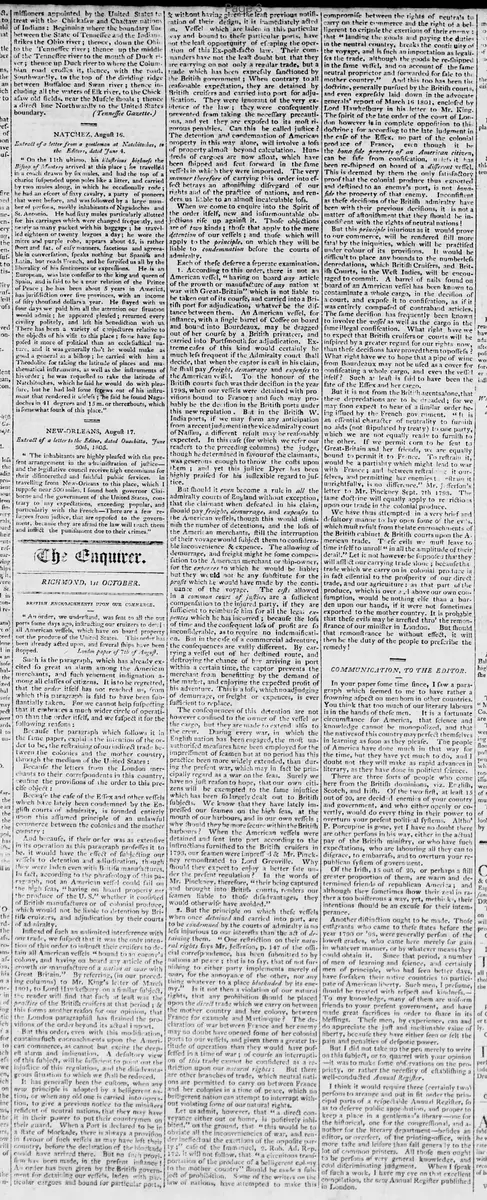
RICHMOND, 1st OCTOBER.
BRITISH ENCROACHMENTS UPON OUR COMMERCE.
"An order, we understand, was sent to all the out-ports some days ago, instructing our cruisers to detain all American vessels, which have on board property not the produce of the United States. This order has been already acted upon, and several ships have been stopped."
London paper of 7th of August.
Such is the paragraph, which has already excited so great an alarm among the American merchants, and such vehement indignation among all classes of citizens. It is to be regretted, that the order itself has not reached us, from which this paragraph is said to have been substantially taken. For we cannot help suspecting that it embraces a much wider circle of operation than the order itself, and we suspect it for the following reasons:
Because the paragraph which follows it in the same paper, explains the intention of the order to be, the restraining of our indirect trade between the colonies and the mother country, through the medium of the United States:
Because the letters from the London merchants to their correspondents in this country, confine the provisions of the order to this precise object:
Because the case of the Essex and other vessels which have lately been condemned by the English courts of admiralty, is founded entirely upon this assumed principle of an unlawful commerce between the colonies and the mother country:
And because, if their order was as extensive in its operation as this paragraph professes it to be, it would have the effect of subjecting our vessels to detention and adjudication, though they were laden even with British manufactures. In fact, according to the phraseology of this paragraph, not an American vessel could sail on the high seas, "having on board property not the produce of the U. S." whether it consisted of British manufactures or of colonial produce. which would not be liable to detention by British cruisers, and adjudication by their courts of admiralty.
Instead of such an unlimited interference with our trade, we suspect that it was the only intention of this order to instruct their cruisers to detain all American vessels bound to an enemy's colony, and having on board any article of the growth or manufacture of a nation at war with Great Britain." By referring, (in our preceding columns) to Mr. King's letter of March 1801, to Lord Hawkesbury on a similar subject. the reader will find that such at least was the practice of the British cruisers at that period; & this forms another reason for our opinion, that the London paragraph has strained the provisions of the order beyond its actual import.
But this order, even with this modification, contains such encroachments upon the American commerce, as cannot but excite the deepest alarm and indignation. A desultory view of this subject, will be sufficient to point out the injustice of this regulation, and the disadvantageous situation to which we shall be reduced.
It has generally been the custom, when any new principle is adopted by a belligerent nation, or when any old one is carried into operation, to give a previous notice to the ministers resident of neutral nations, that they may have it in their power to put their countrymen on their guard. When a port is declared to be in a state of blockade, there is always a provision in favour of such vessels as may have left their country, before the declaration of the blockade could have arrived there. But no such provision has been made, in the present instance!
An order has been given by the British government for detaining our vessels, laden with particular cargoes and bound for particular ports, & without having given the least previous notification of their design, it is immediately acted on. Vessels which are laden in this particular way and bound to these particular ports, have not the least opportunity of escaping the operations of this Ex-post-facto law. Their commanders have not the least doubt but that they are carrying on not only a regular trade, but a trade which has been expressly sanctioned by the British government; When contrary to all reasonable expectation, they are detained by British cruisers and carried into port for adjudication. They were ignorant of the very existence of the law; they were consequently prevented from taking the necessary precautions, and yet they are exposed to its most rigorous penalties. Can this be called justice?
The detention and condemnation of American property in this way alone, will involve a loss of property almost beyond calculation. Hundreds of cargoes are now afloat, which have been shipped and sent forward in the same vessels in which they were imported. The very manner therefore of carrying this order into effect betrays an astonishing disregard of our rights and of the practice of nations, and renders us liable to an almost incalculable loss.
When we come to enquire into the Spirit of the order itself, new and insurmountable objections rise up against it. Those objections are of two kinds; those that apply to the mere detention of our vessels; and those which will apply to the principle, on which they will be liable to condemnation before the courts of admiralty.
Each of these deserve a separate examination.
1. According to this order, there is not an American vessel, "having on board any article of the growth or manufacture of any nation at war with Great-Britain" which is not liable to be taken out of its course, and carried into a British port for adjudication; whatever be the distance between them. An American vessel, for instance, with a single barrel of Coffee on board and bound into Bordeaux, may be dragged out of her course by a British privateer, and carried into Portsmouth for adjudication. Extreme cases of this kind would certainly be much less frequent if the Admiralty court shall decide, that when the captor is cast in his claim, he shall pay freight, demurrage and expenses to the American vessel. To the honour of the British courts such was their decision in the year 1793, when our vessels were detained with provisions bound to France; and such may probably be the decision in the British ports under this new regulation. But in the British W. India ports, if we may form any anticipation from a recent judgment in the vice admiralty court of Nassau, a different result may be reasonably expected. In this case (for which we refer our readers to the preceding columns) the judge, though he determined in favour of the claimants, was generous enough to throw the costs upon them; and yet this justice Dyer has been highly praised for his inflexible regard to justice.
But should it even become a rule in all the admiralty courts of England without exception, that the claimant when defeated in his claim, should pay freight, demurrage, and expenses to the American vessels, though this would diminish the number of detentions, and the loss of the American merchants, still the interruption of their voyage would subject them to considerable inconvenience & expense. The allowing of demurrage, and freight might be some compensation to the American merchant or ship-owner, for the expenses to which he would be liable; but they would not be any substitute for the profit which he would have made by the continuance of the voyage.
The costs allowed in a common court of justice, are a sufficient compensation to the injured party, if they are sufficient to reimburse him for all the legal expenses which he has incurred: because the loss of time and the consequent loss of profit are so inconsiderable, as to require no indemnification. But in the case of a commercial adventure, the consequences are vastly different. By carrying a vessel out of her destined route, and destroying the chance of her arriving in port within a certain time, the captor prevents the merchant from benefitting by the demand of the market, and enjoying the expected profit of his adventure. This is a loss, which no adjudging of demurrage, or freight or expenses, is ever sufficient to replace.
The consequences of this detention are not however confined to the owner of the vessel or the cargo, but they are made to extend also to the crew.
During every war, in which the English nation has been engaged, the most unauthorised measures have been employed for the impressment of seamen but at no period has this practice been more widely extended, than during the present war, which may in fact be principally regarded as a war on the seas. Surely we have no just reason to hope, that our own citizens will be exempted to the same injustice which has been so largely dealt out to British subjects. We know that they have lately impressed our seamen on the high seas, at the mouth of our harbours, and in our own vessels; why should they be more secure within the British harbours? When the American vessels were detained and sent into port according to the instructions furnished to the British cruisers in 1793, our seamen were impressed & Mr. Pinckney remonstrated to Lord Grenville. Why should they expect to enjoy a better fate under the present regulation? In the words of Mr. Pinckney therefore, "their being captured and brought into British courts, renders our seamen liable to those disadvantages, they would otherwise have avoided."
2. But the principle on which these vessels when once detained and carried into port, are to be condemned by the courts of admiralty is no less injurious to our interests than the act of detaining them. "One restriction on their natural rights says Mr. Jefferson, p. 147 of the official correspondence, has been submitted to by nations at peace; that is to say, that of not furnishing to either party implements merely of war, for the annoyance of the other, nor any thing whatever to a place blockaded by its enemy." Is it not then a violation of our natural rights, that any prohibition should be placed upon the direct trade which we carry on between the mother country and her colony, between France for example and Martinique? The declaration of war between France and her enemy may no doubt have opened some of her colonial ports to our vessels, and given them a greater latitude of operation than they would have possessed in a time of war; of course an interruption of this trade cannot be considered as a restriction upon our natural rights: But there are other branches of trade, which neutral nations are permitted to carry on between France and her colonies in a time of peace, which no belligerent nation can attempt to interrupt without violating some of our natural rights.
Let us admit, however, that "a direct conveyance either out or home, is positively inhibited," on the ground, that "this would be to obviate all the inconveniences of war, and render ineffectual the exertions of the opposite party:" case of the Immanuel, 2. Rob. Ad. Rep. 179. it will not follow, that "a circuitous transportation of the produce of a belligerent colony to the mother country" should be made a subject of prohibition. Some of the writers on the law of nations, have attempted to make this compromise between the rights of neutrals to carry on their commerce and the right of a belligerent to cripple the exertions of their enemy: that "landing the goods and paying the duties in the neutral country, breaks the continuity of the voyage, and is such an importation as legalizes the trade, although the goods be re-shipped in the same vessel, and on account of the same neutral proprietor and forwarded for sale to the mother country."
And this too has been the doctrine, generally pursued by the British courts, and even expressly laid down in the advocate general's report of March 16 1801, enclosed by Lord Hawkesbury in his letter to Mr. King.
The spirit of the late order of the court of London however is in complete opposition to this doctrine; for according to the late judgment in the case of the Essex, no part of the colonial produce of France, even though it be the bona-fide property of an American citizen, can be safe from confiscation, unless it has been re-shipped on board of a different vessel This is deemed by them the only satisfactory proof that the colonial produce thus exported and destined to an enemy's port, is not bona-fide the property of that enemy. Inconsistent as these decisions of the British admiralty have been with their previous decisions, it is not a matter of astonishment that they should be inconsistent with the rights of neutral nations!
But this principle injurious as it would prove to our commerce, will be rendered still more fatal by the iniquities, which will be practised under colour of its provisions. It would be difficult to place any bounds to the numberless depredations, which British Cruisers, and British Courts, in the West Indies, will be encouraged to commit. A barrel of nails found on board of an American vessel has been known to contaminate a whole cargo, in the decision of a court, and expose it to confiscation, as if it was entirely composed of contraband articles.
The same decision has frequently been known to involve the vessel as well as the cargo in the same illegal confiscation. What right have we to expect that British cruisers or courts will be inspired by a greater regard for our rights now, than these decisions have proved them to possess?
What right have we to hope that a pipe of wine from Bordeaux may not be used as a cover for confiscating a whole cargo, and even the vessel itself? Such at least is said to have been the fate of the Essex and her cargo.
But it is not from the British agents alone, that these depredations are to be dreaded; for we may soon expect to hear of a similar order being issued by the French government. "It is an essential character of neutrality to furnish no aids (not stipulated by treaty) to one party, which we are not equally ready to furnish to the other. If we permit corn to be sent to Great-Britain and her friends, we are equally bound to permit it to France. To restrain it, would be a partiality which might lead to war with France; and between restraining it ourselves, and permitting her enemies to restrain it unrightfully, is no difference." Mr. Jefferson's letter to Mr. Pinckney Sept. 7th 1793. The same doctrine will equally apply to restrictions upon our trade in the colonial produce.
We have thus attempted in a very brief and desultory manner to lay open some of the evils, which must result from the late encroachments of the British cabinet & British courts upon the American trade. These evils we must leave to time itself to unroll "in all the amplitude of their detail." Let it not however be supposed that they will afflict our carrying trade alone: because that trade which we carry on in colonial produce is in fact essential to the prosperity of our direct trade, and our agriculture: as that part of the produce, which is over and above our own consumption, would be nothing else than a burden upon our hands, if it were not sometimes exported to the mother country. It is probable that these evils may be arrested thro' the remonstrance of our minister in London. But should that remonstrance be without effect, it will then be the duty of the people to prescribe the remedy!
What sub-type of article is it?
What keywords are associated?
What entities or persons were involved?
Editorial Details
Primary Topic
British Encroachments On American Neutral Commerce During War
Stance / Tone
Indignant Criticism Of British Trade Restrictions And Defense Of Neutral Rights
Key Figures
Key Arguments