Thank you for visiting SNEWPapers!
Sign up free
The Daily Alaska Empire
Juneau, Juneau County, Alaska
What is this article about?
In 1949, controversy arises over President Truman's nominee Carl Ilgenfritz, a U.S. Steel VP, for chairman of the Army-Navy Munitions Board. Debate centers on his plan to retain $70,000 steel salary plus $14,000 government pay, sparking Senate opposition over conflict of interest and public confidence, despite support from Defense Secretary Johnson.
Merged-components note: Merged continuation of the Washington Merry-Go-Round editorial from page 1 to page 4; relabeled the page 4 portion from 'story' to 'editorial' to match the overall content.
Clippings
1 of 2
OCR Quality
Full Text
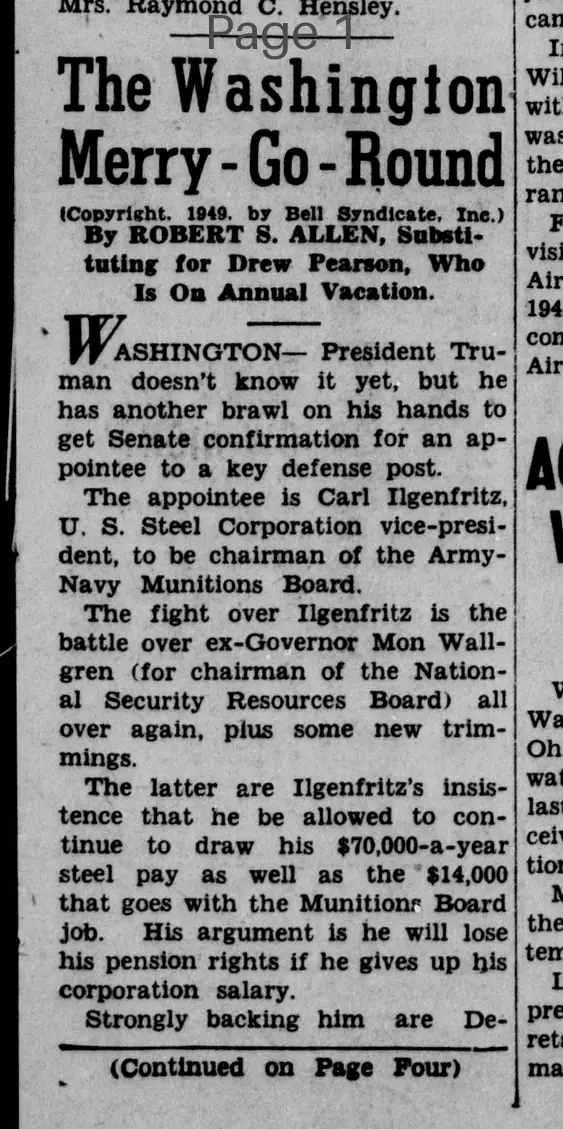
(Copyright, 1949, by Bell Syndicate, Inc.)
By ROBERT S. ALLEN, Substituting for Drew Pearson, Who Is On Annual Vacation.
WASHINGTON—President Truman doesn't know it yet, but he has another brawl on his hands to get Senate confirmation for an appointee to a key defense post.
The appointee is Carl Ilgenfritz, U. S. Steel Corporation vice-president, to be chairman of the Army-Navy Munitions Board.
The fight over Ilgenfritz is the battle over ex-Governor Mon Wallgren (for chairman of the National Security Resources Board) all over again, plus some new trimmings.
The latter are Ilgenfritz's insistence that he be allowed to continue to draw his $70,000-a-year steel pay as well as the $14,000 that goes with the Munitions Board job. His argument is he will lose his pension rights if he gives up his corporation salary.
Strongly backing him are Defense Secretary Louis Johnson, Sen. Millard Tydings, D., Md., chairman of the Armed Services committee, and Sen. Chan. Gurney, N. D., ranking Republican member of the committee. In a stormy appearance before the committee, Johnson stated the proposed extraordinary salary arrangement has President Truman's approval.
As a Senator during the war, the President repeatedly condemned the employment of $1-a-year men.
Leading the fight against Ilgenfritz are Sens. Harry Byrd, D., Va., Lyndon Johnson, D., Texas, and Wayne Morse, R., Oregon. The last two tangled hotly with Secretary Johnson at a closed-door meeting.
"Permitting this man to continue to draw his private salary while working for the government would be unsound public policy," Senator Johnson argued. "It would do more harm than any good the government could possibly get out of Ilgenfritz."
Morse was equally emphatic. He told Johnson:
"Democracy can be no stronger than the confidence of the people in their government. This appointment will shake that confidence to its roots. It is just as important that the man heading the Munitions Board be kept free from suspicion as once it was important that Caesar's wife be kept free of suspicion. As head of this crucial defense agency, Ilgenfritz must be in a position where no finger can be pointed at him on any ground.
"It is indefensible that the head of this board with vast power over steel and other materials of defense should be subsidized by the dominant steel interests of the country. I am not sure that we should permit any man to hold this job who has connections with the steel industry, but I am sure we should not confirm a man who fails to break his bonds with his private industry when he takes this key office."
To these arguments, Secretary Johnson countered with the contention that Ilgenfritz is "indispensable."
"That indispensable doctrine is absurd," snapped Morse. It is ridiculous to say there is only one man for that job out of 150,000,000 Americans. If you will look around, you will find other men just as good who will not insist on salaries from outside sources all out of proportion to what other citizens expect their government to pay them. I will never agree that the patriotism of American businessmen has a price tag on it."
A majority of the Senate committee favors confirmation.
But Byrd and the others have served notice they will wage a bitter floor fight. With the Senate logjammed by a huge stack of unfinished business, the outlook for Ilgenfritz is not promising.
What sub-type of article is it?
What keywords are associated?
What entities or persons were involved?
Editorial Details
Primary Topic
Senate Confirmation Battle Over Carl Ilgenfritz's Appointment To Army Navy Munitions Board
Stance / Tone
Critical Of Dual Salary Arrangement And Conflict Of Interest
Key Figures
Key Arguments