Thank you for visiting SNEWPapers!
Sign up free
Story
January 24, 1940
The Daily Alaska Empire
Juneau, Juneau County, Alaska
What is this article about?
Submarine pioneer Simon Lake, interviewed in Milford, Conn. on Jan. 24, dreams of using commercial submarines to open a shorter, safer Arctic trade route to the Orient via the Northwest Passage under ice, referencing Wilkins' 1931 Nautilus voyage.
Clipping
OCR Quality
98%
Excellent
Full Text
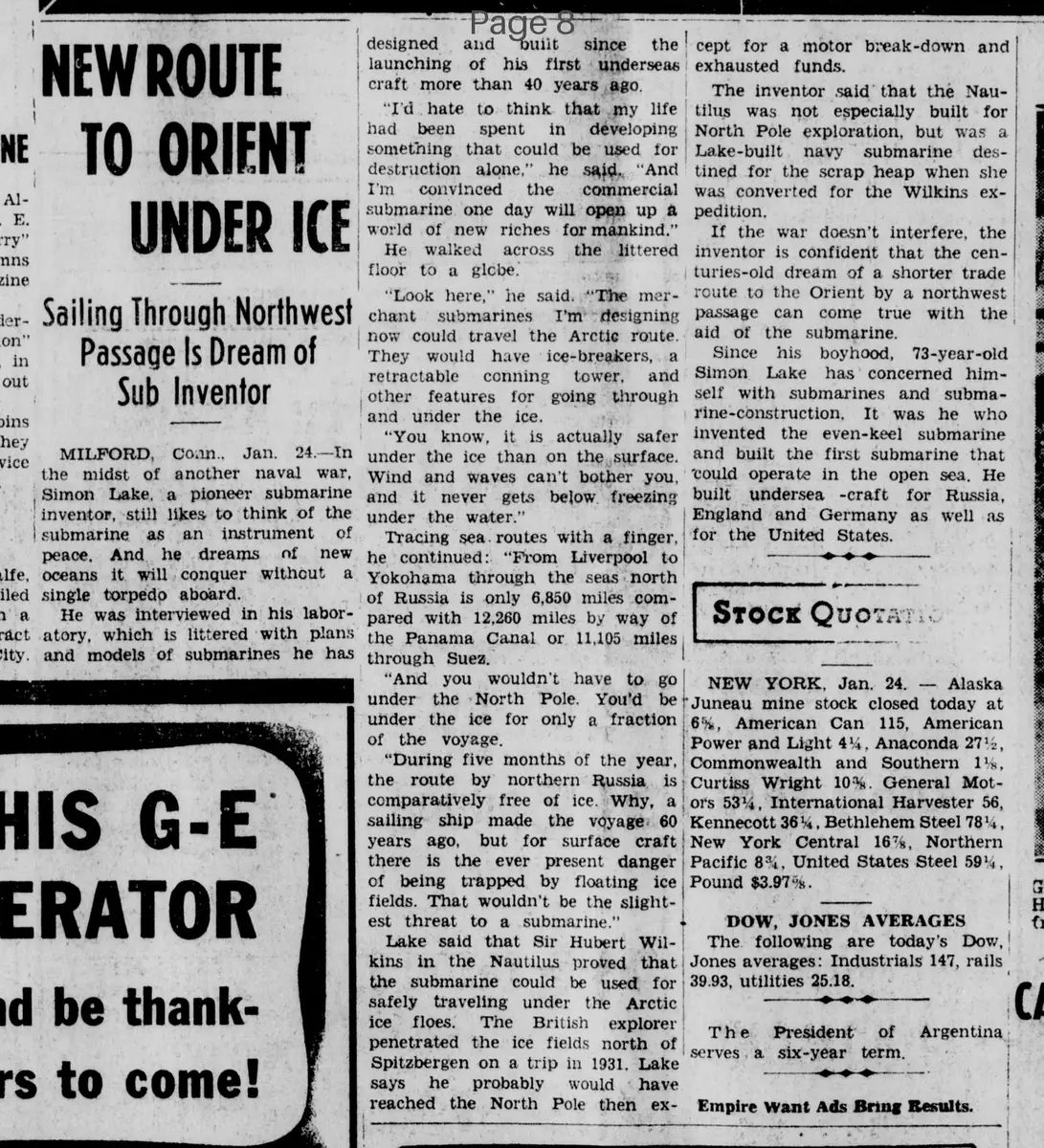
NEW ROUTE TO ORIENT UNDER ICE
Sailing Through Northwest Passage Is Dream of Sub Inventor
MILFORD, Conn., Jan. 24.-In the midst of another naval war, Simon Lake, a pioneer submarine inventor, still likes to think of the submarine as an instrument of peace. And he dreams of new oceans it will conquer without a single torpedo aboard.
He was interviewed in his laboratory, which is littered with plans and models of submarines he has designed and built since the launching of his first underseas craft more than 40 years ago.
"I'd hate to think that my life had been spent in developing something that could be used for destruction alone," he said. "And I'm convinced the commercial submarine one day will open up a world of new riches for mankind."
He walked across the littered floor to a globe.
"Look here." he said. "The merchant submarines I'm designing now could travel the Arctic route. They would have ice-breakers, a retractable conning tower, and other features for going through and under the ice.
"You know, it is actually safer under the ice than on the surface. Wind and waves can't bother you, and it never gets below freezing under the water."
Tracing sea routes with a finger, he continued: "From Liverpool to Yokohama through the seas north of Russia is only 6,850 miles compared with 12,260 miles by way of the Panama Canal or 11,105 miles through Suez.
"And you wouldn't have to go under the North Pole. You'd be under the ice for only a fraction of the voyage.
"During five months of the year, the route by northern Russia is comparatively free of ice. Why, a sailing ship made the voyage 60 years ago, but for surface craft there is the ever present danger of being trapped by floating ice fields. That wouldn't be the slightest threat to a submarine."
Lake said that Sir Hubert Wilkins in the Nautilus proved that the submarine could be used for safely traveling under the Arctic ice floes. The British explorer penetrated the ice fields north of Spitzbergen on a trip in 1931. Lake says he probably would have reached the North Pole then except for a motor break-down and exhausted funds.
The inventor said that the Nautilus was not especially built for North Pole exploration, but was a Lake-built navy submarine destined for the scrap heap when she was converted for the Wilkins expedition.
If the war doesn't interfere, the inventor is confident that the centuries-old dream of a shorter trade route to the Orient by a northwest passage can come true with the aid of the submarine.
Since his boyhood, 73-year-old Simon Lake has concerned himself with submarines and submarine-construction. It was he who invented the even-keel submarine and built the first submarine that could operate in the open sea. He built undersea craft for Russia, England and Germany as well as for the United States.
Sailing Through Northwest Passage Is Dream of Sub Inventor
MILFORD, Conn., Jan. 24.-In the midst of another naval war, Simon Lake, a pioneer submarine inventor, still likes to think of the submarine as an instrument of peace. And he dreams of new oceans it will conquer without a single torpedo aboard.
He was interviewed in his laboratory, which is littered with plans and models of submarines he has designed and built since the launching of his first underseas craft more than 40 years ago.
"I'd hate to think that my life had been spent in developing something that could be used for destruction alone," he said. "And I'm convinced the commercial submarine one day will open up a world of new riches for mankind."
He walked across the littered floor to a globe.
"Look here." he said. "The merchant submarines I'm designing now could travel the Arctic route. They would have ice-breakers, a retractable conning tower, and other features for going through and under the ice.
"You know, it is actually safer under the ice than on the surface. Wind and waves can't bother you, and it never gets below freezing under the water."
Tracing sea routes with a finger, he continued: "From Liverpool to Yokohama through the seas north of Russia is only 6,850 miles compared with 12,260 miles by way of the Panama Canal or 11,105 miles through Suez.
"And you wouldn't have to go under the North Pole. You'd be under the ice for only a fraction of the voyage.
"During five months of the year, the route by northern Russia is comparatively free of ice. Why, a sailing ship made the voyage 60 years ago, but for surface craft there is the ever present danger of being trapped by floating ice fields. That wouldn't be the slightest threat to a submarine."
Lake said that Sir Hubert Wilkins in the Nautilus proved that the submarine could be used for safely traveling under the Arctic ice floes. The British explorer penetrated the ice fields north of Spitzbergen on a trip in 1931. Lake says he probably would have reached the North Pole then except for a motor break-down and exhausted funds.
The inventor said that the Nautilus was not especially built for North Pole exploration, but was a Lake-built navy submarine destined for the scrap heap when she was converted for the Wilkins expedition.
If the war doesn't interfere, the inventor is confident that the centuries-old dream of a shorter trade route to the Orient by a northwest passage can come true with the aid of the submarine.
Since his boyhood, 73-year-old Simon Lake has concerned himself with submarines and submarine-construction. It was he who invented the even-keel submarine and built the first submarine that could operate in the open sea. He built undersea craft for Russia, England and Germany as well as for the United States.
What sub-type of article is it?
Biography
Journey
Curiosity
What themes does it cover?
Exploration
Triumph
What keywords are associated?
Submarine Invention
Northwest Passage
Arctic Route
Simon Lake
Nautilus Expedition
What entities or persons were involved?
Simon Lake
Sir Hubert Wilkins
Where did it happen?
Milford, Conn.; Arctic Route From Liverpool To Yokohama
Story Details
Key Persons
Simon Lake
Sir Hubert Wilkins
Location
Milford, Conn.; Arctic Route From Liverpool To Yokohama
Event Date
Jan. 24; 1931
Story Details
Simon Lake, submarine inventor, envisions commercial submarines traveling a shorter Arctic route to the Orient via the Northwest Passage under ice, safer than surface ships, citing Sir Hubert Wilkins' 1931 Nautilus expedition as proof.