Thank you for visiting SNEWPapers!
Sign up free
Literary
April 25, 1862
Watertown Republican
Watertown, Jefferson County, Dodge County, Wisconsin
What is this article about?
The text explains the Earth's structure as a hollow ball with a cool outer crust supporting life and resources, but containing fluid igneous matter beneath that could lead to its destruction. It discusses evidence from volcanoes and earthquakes, and temperature increases with depth, rendering the interior fluid at 100 miles.
Clipping
OCR Quality
95%
Excellent
Full Text
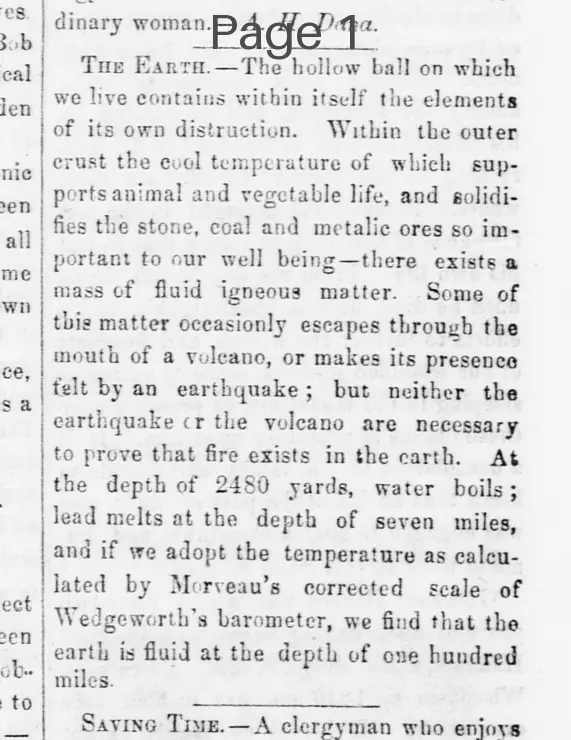
The Earth.—The hollow ball on which we live contains within itself the elements of its own destruction. Within the outer crust the cool temperature of which supports animal and vegetable life, and solidifies the stone, coal and metallic ores so important to our well being—there exists a mass of fluid igneous matter. Some of this matter occasionally escapes through the mouth of a volcano, or makes its presence felt by an earthquake; but neither the earthquake or the volcano are necessary to prove that fire exists in the earth. At the depth of 2480 yards, water boils; lead melts at the depth of seven miles, and if we adopt the temperature as calculated by Morveau's corrected scale of Wedgewood's barometer, we find that the earth is fluid at the depth of one hundred miles.
What sub-type of article is it?
Essay
What themes does it cover?
Nature
What keywords are associated?
Earth Structure
Igneous Matter
Volcano
Earthquake
Geological Temperature
Fluid Interior
Literary Details
Title
The Earth.
Key Lines
Within The Outer Crust The Cool Temperature Of Which Supports Animal And Vegetable Life, And Solidifies The Stone, Coal And Metallic Ores So Important To Our Well Being—There Exists A Mass Of Fluid Igneous Matter.
Some Of This Matter Occasionally Escapes Through The Mouth Of A Volcano, Or Makes Its Presence Felt By An Earthquake;
At The Depth Of 2480 Yards, Water Boils; Lead Melts At The Depth Of Seven Miles,