Thank you for visiting SNEWPapers!
Sign up free
The Enquirer
Richmond, Henrico County, Virginia
What is this article about?
Hon Sir T. Strange's charge to the Calcutta grand jury addresses fears of revolution in India, criticizing East India Company officers for resisting government authority and deserting duties, urging loyalty and suppression of rebellion to restore union and security.
Clipping
OCR Quality
Full Text
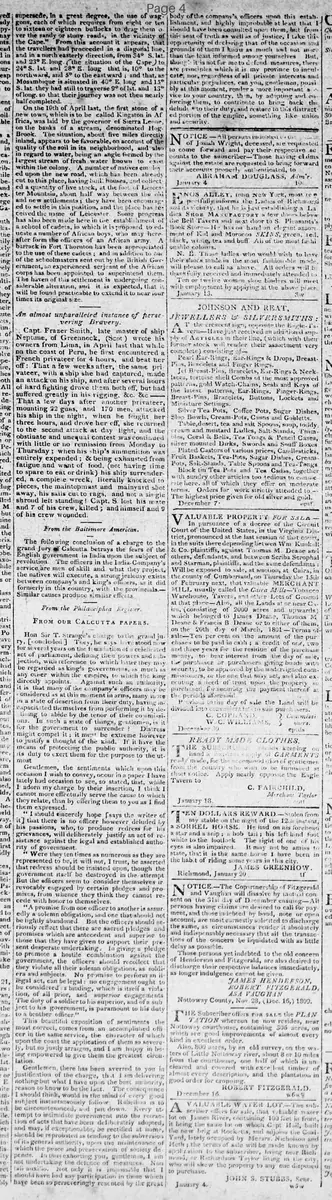
The following conclusion of a charge to the grand Jury of Calcutta betrays the fears of the English government in India upon the subject of revolution. The officers in the India Company's service are men of skill and what they project, the natives will execute, a strong jealousy exists between company's and king's officers, as it did formerly in this country, with the provincials.— Similar causes produce similar effects.
From the Philadelphia Register.
FROM OUR CALCUTTA PAPERS.
Hon Sir T. Strange's charge to the grand jury, [concluded]. They, he says have stood now for several years on the foundation of a celebrated act of parliament, defining their powers and subjection, with reference to which latter they may be regarded as king's governments, as much as any other within the empire, to which the king directly appoints. Against such an authority, it is that many of the company's officers may be considered as at this moment in arms, many more in a state of desertion from their duty, having incapacitated themselves from performing it by declining to abide by the tenor of their commissions. In such a state of things, gentlemen, is it for the government to surrender? Distress might compel it; it must be extreme however to justify a thought of the kind. If it have the means of protecting the public authority, it is its duty to exert them for the purpose to the utmost.
Gentlemen, the sentiments which upon this occasion I wish to convey, occur in a paper I have lately had occasion to see, so stated, that, while I adorn my charge by their insertion, I think I cannot more effectually serve the cause to which they relate, than by offering them to you as I find them expressed.
"I should sincerely hope says the writer of it] that there is no officer however deluded by his passions, who, to produce redress for his grievances, will deliberately justify an act of resistance against the legal and established authority of government.
Were they ten times as numerous as they are represented to be, it will not, I trust, be asserted that redress should be insisted upon, though the government itself be destroyed in the attempt. But the officers seem to consider themselves irrevocably engaged by certain pledges and promises, from whence they think they cannot recede with honor to themselves.
"A promise from one officer to another is assuredly a solemn obligation, and one that should not be lightly abandoned. But the officers should seriously reflect that there are sacred pledges and promises which are antecedent and superior to those that they have given to support their present desperate undertaking. In giving a pledge to promote a hostile combination against the government, the officers should recollect that they violate all their solemn obligations, as soldiers and subjects. No promise to perform an illegal act, can be legal: no engagement ought to be considered as binding, which is itself a violation, of all prior, and superior engagements.
'The duty of a soldier to his superior, and of a subject to his government, is paramount to his duty to a brother officer."
This beautiful exposition of sentiments the most correct, comes from an accomplished officer in the same service, the character of which upon the coast the application of them so severely, but so justly arraigns, and I am happy in being empowered to give them the greatest circulation.
Gentlemen, there has been averred to you in justification of the charge, that I am delivering nothing but what I have upon the best authority, reason to know to be the fact. The consequence I should think, would in the mind of every good subject instantaneously follow. Rebellion is to be discountenanced, and put down. Every attempt to intimidate government into the retraction of acts that have been deliberately adopted, and may, if exceptionable, be rectified at home, should be reprobated as tending to the subversion of its general authority, upon the maintenance of which the peace and preservation of society depends. In thus exhorting you, gentlemen, I am not undertaking the defence of measures. Non tali auxilio. Not only it is impossible that I should have had any participation, in those which have been so perseveringly resented by the great body of the company's officers upon this establishment. and highly improbable at least that I should have been consulted upon them, but from this seat of truth as well as of justice. I take this opportunity of declaring that of the occasion and grounds of them I know as much and not more than the least informed among yourselves. But, though it is not for me to defend measures, there are principles which it is my province to inculcate, nor, regardless of all private interests and particular prejudices, can you, gentlemen, possibly at this moment, render a more important service to your country. than, by adopting and enforcing them, to contribute to bring back the deluded to their duty, and restore to this distracted portion of the empire, something like union and security.
What sub-type of article is it?
What keywords are associated?
What entities or persons were involved?
Where did it happen?
Foreign News Details
Primary Location
Calcutta
Key Persons
Outcome
rebellion to be discountenanced and put down; restore union and security to the empire.
Event Details
Hon Sir T. Strange charges the grand jury on fears of revolution in India, noting East India Company officers in arms or desertion against king's government authority, urges government to protect public authority, quotes an officer on duty over illegal promises, and exhorts to suppress rebellion and enforce principles of loyalty.