Thank you for visiting SNEWPapers!
Sign up free
Portland Gazette, And Maine Advertiser
Portland, Cumberland County, Maine
What is this article about?
A letter criticizes the U.S. government's imprudent negotiation with British Minister Erskine without verifying his authority, leading to diplomatic embarrassments and risks to peace, rather than blaming British perfidy. It defends British actions and faults Madison and Smith for haste in commercial arrangements.
Merged-components note: Continuation across pages of the communication to the editor regarding foreign relations.
Clippings
1 of 2
OCR Quality
Full Text
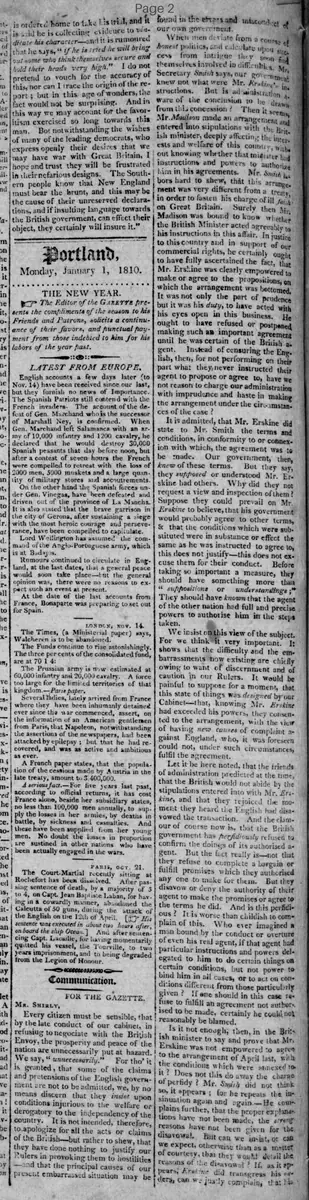
FOR THE GAZETTE.
Mr. Shirley,
Every citizen must be sensible, that by the late conduct of our cabinet, in refusing to negotiate with the British Envoy, the prosperity and peace of the nation are unnecessarily put at hazard.
We say, "unnecessarily." For tho' it is granted, that some of the claims and pretensions of the English government are not to be admitted, we, by no means discern that they insist upon conditions injurious to the welfare or derogatory to the independency of the country. It is not intended, therefore, to apologize for all the acts or claims of the British—but rather to shew, that they have done nothing to justify our Rulers in provoking them to hostilities—and that the principal causes of our present embarrassed situation may be found in the errors and misconduct of our own government.
When men deviate from a course of honest politics, and calculate upon success from intrigue they soon find themselves involved in difficulties. Mr Secretary Smith says, our government knew not what were Mr. Erskine's instructions. But is administration aware of the conclusion to be drawn from this concession? Then it seems; Mr. Madison made an arrangement and entered into stipulations with the British minister, deeply affecting the interests and welfare of this country, without knowing whether that minister had instructions and powers to authorize him in his agreements. Mr. Smith labors hard to shew, that this arrangement was very different from a treaty. in order to fasten his charge of ill faith on Great Britain.
Surely then Mr. Madison was bound to know whether the British Minister acted agreeably to his instructions in this affair. In justice to this country and in support of our commercial rights, he certainly ought to have fully ascertained the fact, that Mr. Erskine was clearly empowered to make or agree to the propositions, on which the arrangement was bottomed.
It was not only the part of prudence but it was his duty, to have acted with his eyes open in this business. He ought to have refused or postponed making such an important agreement until he was certain of the British agent. Instead of censuring the English, then, for not performing on their part what they, never instructed their agent to propose or agree to, have we not reason to charge our administration with imprudence and haste in making the arrangement under the circumstances of the case?
It is admitted, that Mr. Erskine did state to Mr. Smith the terms and conditions, in conformity to or connexion with which, the agreement was to be made. Our government, then, knew of these terms. But they say, they supposed or understood Mr. Erskine had others. Why did they not request a view and inspection of them?
Suppose they could prevail on Mr. Erskine to believe, that his government would probably agree to other terms, & that the conditions which were substituted were in substance or effect the same as he was instructed to agree to, this does not justify—this does not excuse them for their conduct. Before taking so important a measure, they should have something more than "suppositions or understandings;" They should have known that the agent of the other nation had full and precise powers to authorise him in the steps taken.
We insist on this view of the subject. For we think it very important. It shews that the difficulty and the embarrassments now existing are chiefly owing to want of discernment and of caution in our Rulers. It would be painful to suppose for a moment, that this state of things was designed by our Cabinet—that, knowing Mr. Erskine had exceeded his powers, they consented to the arrangement, with the view of having new causes of complaint against England, who, it was foreseen could not, under such circumstances, fulfil the agreement.
Let it be here noted, that the friends of administration predicted at the time, that the British would not abide by the stipulations entered into with Mr. Erskine, and that they rejoiced the moment they heard the English had disavowed the transaction. And the clamour of course now is, that the British government has perfidiously refused to confirm the doings of its authorised agent. But the fact really is—not that they refuse to complete a bargain or fulfill promises which they authorised any one to make for them. But they disavow or deny the authority of their agent to make the promises or agree to the terms he did. And is this perfidious? It is worse than childish to complain of this. Who ever imagined a man bound by the conduct or overture of even his real agent, if that agent had particular instructions and powers delegated to him to do certain things on certain conditions, but not power to bind him in all cases, or to act on conditions different from those particularly given? If one should in this case refuse to fulfill an agreement not authorised to be made, certainly he could no reasonably be blamed.
Is it not enough, then, in the British minister to say and prove that Mr. Erskine was not empowered to agree to the arrangement of April last, with the conditions which were annexed to it? Does not this do away the charge of perfidy? Mr. Smith did not think so, it appears; or he repeats the insinuation again and again.—He complains further, that the proper explanations have not been made, the strong reasons have not been given for the disavowal. But can we insist, or can we expect, otherwise than as a matter of courtesy, that they would detail the reasons of the disavowal? If, as it appears, Erskine did transgress his orders, can we justly complain, that his government has not thought proper to expose the weakness or folly of their confidential servant, by publishing his instructions?
But Mr. Smith is here again plunging himself into difficulty. For if our government are of opinion there could be very little difference in the state of things, whether the arrangement with Mr. Erskine be confirmed, or that given up, and the orders of Council as modified in April last (which Mr. Smith attempts to show) were to be in force and regulate affairs, how can we approve of the conduct of the Cabinet? They are disputing about trifles: They have quarrelled with Jackson without cause: They have put the peace of the country at risque, for a thing of indifference by their own concession. The British Minister is dismissed, the demands of his government said to be insolent, inconsistent with our rights and hostile to our peace—and yet it seems according to Mr. Smith, that there is little or no real practical difference between the views and objects of the British as expressed in the Orders of last April, and the principles of the convention made by Mr. Erskine.
But it is said Mr. Jackson was insolent. It is admitted he was not very conciliating—neither was Mr. Smith. The insinuations of the latter, as to the breach of faith in the British government, are certainly much more palpable and strong, than those of the former, that our Cabinet were aware Mr. Erskine exceeded his authority. Mr. Jackson is severe. But was he not forced to do so, in vindicating his own government from the charges brought against it by Mr. Smith? And for one, I do not perceive, that Mr. Jackson has even implied that our government knew Mr. Erskine had no further powers than first made known. He merely asserts, those were all his powers: and then intimates, indeed, that our Rulers might and ought to have ascertained whether he had more. And had they acted with caution and prudence in this stage of the business, the present difficulties had not existed.
What sub-type of article is it?
What themes does it cover?
What keywords are associated?
What entities or persons were involved?
Letter to Editor Details
Recipient
Mr. Shirley
Main Argument
the u.s. government's failure to verify british minister erskine's authority before entering into a commercial arrangement led to unnecessary diplomatic embarrassments and risks to national peace, rather than british perfidy being at fault.
Notable Details