Thank you for visiting SNEWPapers!
Sign up free
Letter to Editor
June 3, 1820
Daily National Intelligencer
Washington, District Of Columbia
What is this article about?
A letter to the editors recommends muzzling dogs with leather muzzles during hot months to prevent rabies (hydrophobia) by stopping them from eating putrefying carrion, a common European practice. Attributes city cases to dead animal carcasses in fields. Promises to deposit a model at the mayor's office. Signed Pro Bono Publico, June 1.
Clipping
OCR Quality
98%
Excellent
Full Text
TO THE EDITORS.
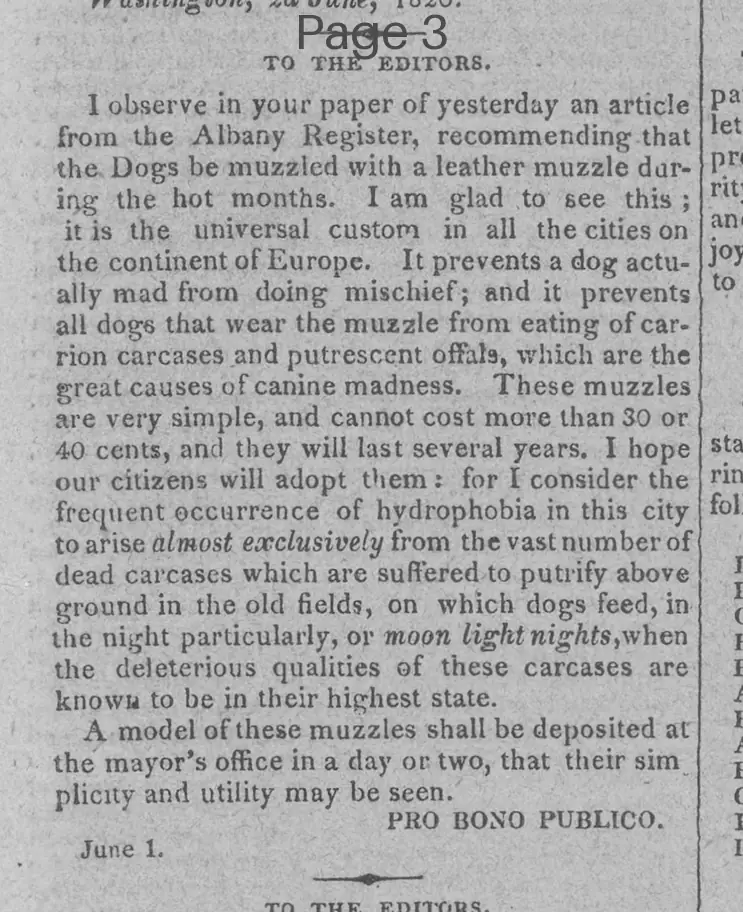
I observe in your paper of yesterday an article from the Albany Register, recommending that the Dogs be muzzled with a leather muzzle during the hot months. I am glad to see this; it is the universal custom in all the cities on the continent of Europe. It prevents a dog actually mad from doing mischief; and it prevents all dogs that wear the muzzle from eating of carrion carcases and putrescent offals, which are the great causes of canine madness. These muzzles are very simple, and cannot cost more than 30 or 40 cents, and they will last several years. I hope our citizens will adopt them: for I consider the frequent occurrence of hydrophobia in this city to arise almost exclusively from the vast number of dead carcases which are suffered to putrify above ground in the old fields, on which dogs feed, in the night particularly, or moonlight nights, when the deleterious qualities of these carcases are known to be in their highest state.
A model of these muzzles shall be deposited at the mayor's office in a day or two, that their simplicity and utility may be seen.
PRO BONO PUBLICO.
June 1.
I observe in your paper of yesterday an article from the Albany Register, recommending that the Dogs be muzzled with a leather muzzle during the hot months. I am glad to see this; it is the universal custom in all the cities on the continent of Europe. It prevents a dog actually mad from doing mischief; and it prevents all dogs that wear the muzzle from eating of carrion carcases and putrescent offals, which are the great causes of canine madness. These muzzles are very simple, and cannot cost more than 30 or 40 cents, and they will last several years. I hope our citizens will adopt them: for I consider the frequent occurrence of hydrophobia in this city to arise almost exclusively from the vast number of dead carcases which are suffered to putrify above ground in the old fields, on which dogs feed, in the night particularly, or moonlight nights, when the deleterious qualities of these carcases are known to be in their highest state.
A model of these muzzles shall be deposited at the mayor's office in a day or two, that their simplicity and utility may be seen.
PRO BONO PUBLICO.
June 1.
What sub-type of article is it?
Informative
Persuasive
What themes does it cover?
Health Medicine
Social Issues
What keywords are associated?
Dog Muzzling
Hydrophobia Prevention
Canine Madness
Carrion Feeding
Public Health
European Custom
What entities or persons were involved?
Pro Bono Publico.
To The Editors.
Letter to Editor Details
Author
Pro Bono Publico.
Recipient
To The Editors.
Main Argument
leather muzzles for dogs during hot months should be adopted to prevent rabies by stopping consumption of putrefying carrion, a practice common in european cities, as the city's hydrophobia cases stem from dogs feeding on dead carcasses in old fields.
Notable Details
Universal Custom In All The Cities On The Continent Of Europe
Muzzles Cost 30 Or 40 Cents And Last Several Years
Model To Be Deposited At The Mayor's Office
Hydrophobia Arises From Dogs Feeding On Putrifying Carcasses In Old Fields At Night