Thank you for visiting SNEWPapers!
Sign up free
Editorial
October 31, 1942
The Daily Alaska Empire
Juneau, Juneau County, Alaska
What is this article about?
Editorial critiques military censorship and lax Pearl Harbor defenses on December 7, 1941, citing a carrier's war orders and near-sighting of Japanese ships near Wake Island, while praising emerging eyewitness accounts of service members' valor.
Clipping
OCR Quality
98%
Excellent
Full Text
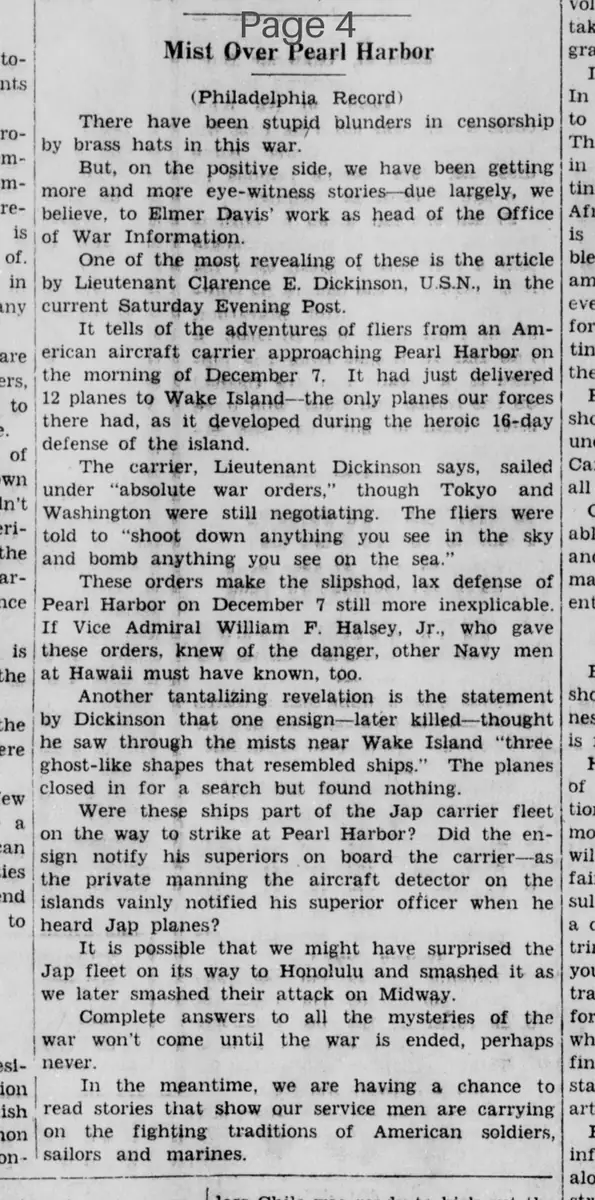
Mist Over Pearl Harbor
(Philadelphia Record)
There have been stupid blunders in censorship
by brass hats in this war.
But, on the positive side, we have been getting
more and more eye-witness stories—due largely, we
believe, to Elmer Davis' work as head of the Office
of War Information.
One of the most revealing of these is the article
by Lieutenant Clarence E. Dickinson, U.S.N., in the
current Saturday Evening Post.
It tells of the adventures of fliers from an Am-
erican aircraft carrier approaching Pearl Harbor on
the morning of December 7. It had just delivered
12 planes to Wake Island—the only planes our forces
there had, as it developed during the heroic 16-day
defense of the island.
The carrier, Lieutenant Dickinson says, sailed
under "absolute war orders," though Tokyo and
Washington were still negotiating. The fliers were
told to "shoot down anything you see in the sky
and bomb anything you see on the sea."
These orders make the slipshod, lax defense of
Pearl Harbor on December 7 still more inexplicable.
If Vice Admiral William F. Halsey, Jr., who gave
these orders, knew of the danger, other Navy men
at Hawaii must have known, too.
Another tantalizing revelation is the statement
by Dickinson that one ensign—later killed—thought
he saw through the mists near Wake Island "three
ghost-like shapes that resembled ships." The planes
closed in for a search but found nothing.
Were these ships part of the Jap carrier fleet
on the way to strike at Pearl Harbor? Did the en-
sign notify his superiors on board the carrier—as
the private manning the aircraft detector on the
islands vainly notified his superior officer when he
heard Jap planes?
It is possible that we might have surprised the
Jap fleet on its way to Honolulu and smashed it as
we later smashed their attack on Midway.
Complete answers to all the mysteries of the
war won't come until the war is ended, perhaps
never.
In the meantime, we are having a chance
to
read stories that show our service men are carrying
on the fighting traditions of American soldiers,
sailors and marines.
(Philadelphia Record)
There have been stupid blunders in censorship
by brass hats in this war.
But, on the positive side, we have been getting
more and more eye-witness stories—due largely, we
believe, to Elmer Davis' work as head of the Office
of War Information.
One of the most revealing of these is the article
by Lieutenant Clarence E. Dickinson, U.S.N., in the
current Saturday Evening Post.
It tells of the adventures of fliers from an Am-
erican aircraft carrier approaching Pearl Harbor on
the morning of December 7. It had just delivered
12 planes to Wake Island—the only planes our forces
there had, as it developed during the heroic 16-day
defense of the island.
The carrier, Lieutenant Dickinson says, sailed
under "absolute war orders," though Tokyo and
Washington were still negotiating. The fliers were
told to "shoot down anything you see in the sky
and bomb anything you see on the sea."
These orders make the slipshod, lax defense of
Pearl Harbor on December 7 still more inexplicable.
If Vice Admiral William F. Halsey, Jr., who gave
these orders, knew of the danger, other Navy men
at Hawaii must have known, too.
Another tantalizing revelation is the statement
by Dickinson that one ensign—later killed—thought
he saw through the mists near Wake Island "three
ghost-like shapes that resembled ships." The planes
closed in for a search but found nothing.
Were these ships part of the Jap carrier fleet
on the way to strike at Pearl Harbor? Did the en-
sign notify his superiors on board the carrier—as
the private manning the aircraft detector on the
islands vainly notified his superior officer when he
heard Jap planes?
It is possible that we might have surprised the
Jap fleet on its way to Honolulu and smashed it as
we later smashed their attack on Midway.
Complete answers to all the mysteries of the
war won't come until the war is ended, perhaps
never.
In the meantime, we are having a chance
to
read stories that show our service men are carrying
on the fighting traditions of American soldiers,
sailors and marines.
What sub-type of article is it?
Military Affairs
War Or Peace
What keywords are associated?
Pearl Harbor
Censorship Blunders
Eyewitness Stories
Wake Island
Japanese Fleet
Navy Orders
Defense Lapses
What entities or persons were involved?
Lieutenant Clarence E. Dickinson
Elmer Davis
Vice Admiral William F. Halsey Jr.
Japanese Carrier Fleet
Pearl Harbor
Wake Island
Editorial Details
Primary Topic
Analysis Of Pearl Harbor Defense Lapses And Potential Early Detection Of Japanese Fleet
Stance / Tone
Critical Of Defensive Shortcomings, Appreciative Of Eyewitness Accounts
Key Figures
Lieutenant Clarence E. Dickinson
Elmer Davis
Vice Admiral William F. Halsey Jr.
Japanese Carrier Fleet
Pearl Harbor
Wake Island
Key Arguments
Stupid Blunders In Censorship By Military Leaders
Increased Eyewitness Stories Due To Office Of War Information
Carrier Under Absolute War Orders Approaching Pearl Harbor On December 7
Lax Defense Of Pearl Harbor Inexplicable Given Prior Warnings
Possible Sighting Of Japanese Ships Near Wake Island
Missed Opportunity To Surprise Japanese Fleet
Full Answers To War Mysteries May Never Come
Service Men Uphold American Fighting Traditions