Thank you for visiting SNEWPapers!
Sign up free
Story
October 21, 1860
Daily National Democrat
Marysville, Yuba County, California
What is this article about?
An article defends Stephen A. Douglas against charges of political duplicity, asserting his consistent support for Supreme Court decisions on slavery across speeches in the North and South during the 1860 campaign, contrasting him with Breckinridge.
Clipping
OCR Quality
98%
Excellent
Full Text
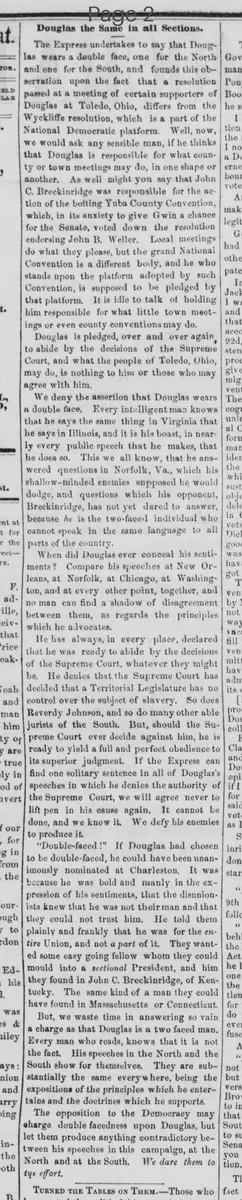
Douglas the Same in all Sections.
The Express undertakes to say that Douglas wears a double face, one for the North and one for the South, and founds this observation upon the fact that a resolution passed at a meeting of certain supporters of Douglas at Toledo, Ohio, differs from the Wycliffe resolution, which is a part of the National Democratic platform. Well, now, we would ask any sensible man, if he thinks that Douglas is responsible for what county or town meetings may do, in one shape or another. As well might you say that John C. Breckinridge was responsible for the action of the bolting Yuba County Convention which, in its anxiety to give Gwin a chance for the Senate, voted down the resolution endorsing John B. Weller. Local meetings do what they please, but the grand National Convention is a different body, and he who stands upon the platform adopted by such Convention, is supposed to be pledged by that platform. It is idle to talk of holding him responsible for what little town meetings or even county conventions may do.
Douglas is pledged, over and over again to abide by the decisions of the Supreme Court, and what the people of Toledo, Ohio, may do, is nothing to him or those who may agree with him.
We deny the assertion that Douglas wears a double face. Every intelligent man knows that he says the same thing in Virginia that he says in Illinois, and it is his boast, in nearly every public speech that he makes, that he does so. This we all know, that he answered questions in Norfolk, Va., which his shallow-minded enemies supposed he would dodge, and questions which his opponent, Breckinridge, has not yet dared to answer, because he is the two-faced individual who cannot speak in the same language to all parts of the country.
When did Douglas ever conceal his sentiments? Compare his speeches at New Orleans, at Norfolk, at Chicago, at Washington, and at every other point, together, and no man can find a shadow of disagreement between them, as regards the principles which he advocates.
He has always, in every place, declared that he was ready to abide by the decisions of the Supreme Court, whatever they might be. He denies that the Supreme Court has decided that a Territorial Legislature has no control over the subject of slavery. So does Reverdy Johnson, and so do many other able jurists of the South. But, should the Supreme Court ever decide against him, he is ready to yield a full and perfect obedience to its superior judgment. If the Express can find one solitary sentence in all of Douglas's speeches in which he denies the authority of the Supreme Court, we will agree never to lift pen in his cause again. It cannot be done, and we know it. We defy his enemies to produce it.
"Double-faced!" If Douglas had chosen to be double-faced, he could have been unanimously nominated at Charleston. It was because he was bold and manly in the expression of his sentiments, that the disunionists knew that he was not their man and that they could not trust him. He told them plainly and frankly that he was for the entire Union, and not a part of it. They wanted some easy going fellow whom they could mould into a sectional President, and him they found in John C. Breckinridge, of Kentucky. The same kind of a man they could have found in Massachusetts or Connecticut.
But, we waste time in answering so vain a charge as that Douglas is a two faced man. Every man who reads, knows that it is not the fact. His speeches in the North and the South show for themselves. They are substantially the same everywhere, being the expositions of the principles which he entertains and the doctrines which he supports.
The opposition to the Democracy may charge double facedness upon Douglas, but let them produce anything contradictory between his speeches in this campaign, at the North and at the South. We dare them to try the effort.
The Express undertakes to say that Douglas wears a double face, one for the North and one for the South, and founds this observation upon the fact that a resolution passed at a meeting of certain supporters of Douglas at Toledo, Ohio, differs from the Wycliffe resolution, which is a part of the National Democratic platform. Well, now, we would ask any sensible man, if he thinks that Douglas is responsible for what county or town meetings may do, in one shape or another. As well might you say that John C. Breckinridge was responsible for the action of the bolting Yuba County Convention which, in its anxiety to give Gwin a chance for the Senate, voted down the resolution endorsing John B. Weller. Local meetings do what they please, but the grand National Convention is a different body, and he who stands upon the platform adopted by such Convention, is supposed to be pledged by that platform. It is idle to talk of holding him responsible for what little town meetings or even county conventions may do.
Douglas is pledged, over and over again to abide by the decisions of the Supreme Court, and what the people of Toledo, Ohio, may do, is nothing to him or those who may agree with him.
We deny the assertion that Douglas wears a double face. Every intelligent man knows that he says the same thing in Virginia that he says in Illinois, and it is his boast, in nearly every public speech that he makes, that he does so. This we all know, that he answered questions in Norfolk, Va., which his shallow-minded enemies supposed he would dodge, and questions which his opponent, Breckinridge, has not yet dared to answer, because he is the two-faced individual who cannot speak in the same language to all parts of the country.
When did Douglas ever conceal his sentiments? Compare his speeches at New Orleans, at Norfolk, at Chicago, at Washington, and at every other point, together, and no man can find a shadow of disagreement between them, as regards the principles which he advocates.
He has always, in every place, declared that he was ready to abide by the decisions of the Supreme Court, whatever they might be. He denies that the Supreme Court has decided that a Territorial Legislature has no control over the subject of slavery. So does Reverdy Johnson, and so do many other able jurists of the South. But, should the Supreme Court ever decide against him, he is ready to yield a full and perfect obedience to its superior judgment. If the Express can find one solitary sentence in all of Douglas's speeches in which he denies the authority of the Supreme Court, we will agree never to lift pen in his cause again. It cannot be done, and we know it. We defy his enemies to produce it.
"Double-faced!" If Douglas had chosen to be double-faced, he could have been unanimously nominated at Charleston. It was because he was bold and manly in the expression of his sentiments, that the disunionists knew that he was not their man and that they could not trust him. He told them plainly and frankly that he was for the entire Union, and not a part of it. They wanted some easy going fellow whom they could mould into a sectional President, and him they found in John C. Breckinridge, of Kentucky. The same kind of a man they could have found in Massachusetts or Connecticut.
But, we waste time in answering so vain a charge as that Douglas is a two faced man. Every man who reads, knows that it is not the fact. His speeches in the North and the South show for themselves. They are substantially the same everywhere, being the expositions of the principles which he entertains and the doctrines which he supports.
The opposition to the Democracy may charge double facedness upon Douglas, but let them produce anything contradictory between his speeches in this campaign, at the North and at the South. We dare them to try the effort.
What sub-type of article is it?
Historical Event
Biography
What themes does it cover?
Deception
Justice
Moral Virtue
What keywords are associated?
Stephen Douglas
Political Consistency
Supreme Court
Slavery
1860 Election
Double Faced
Charleston Convention
What entities or persons were involved?
Douglas
John C. Breckinridge
Reverdy Johnson
Gwin
John B. Weller
Where did it happen?
United States (North And South)
Story Details
Key Persons
Douglas
John C. Breckinridge
Reverdy Johnson
Gwin
John B. Weller
Location
United States (North And South)
Event Date
1860
Story Details
The article refutes claims that Douglas is two-faced by highlighting his consistent speeches on Supreme Court decisions regarding slavery in Territorial Legislatures across regions, pledging obedience to the Court, and contrasting his unionism with Breckinridge's sectionalism at the Charleston convention.