Thank you for visiting SNEWPapers!
Sign up free
Editorial
November 17, 1787
The Daily Advertiser
New York, New York County, New York
What is this article about?
An editorial praises the US Constitution's near-perfection and urges its adoption, criticizing opponents as motivated by sinister reasons. It proposes amendments dividing the executive into three departments: President, Chief Justice, and Superintendent of Finance, with an Auditor General, to enhance checks and balances.
Clipping
OCR Quality
98%
Excellent
Full Text
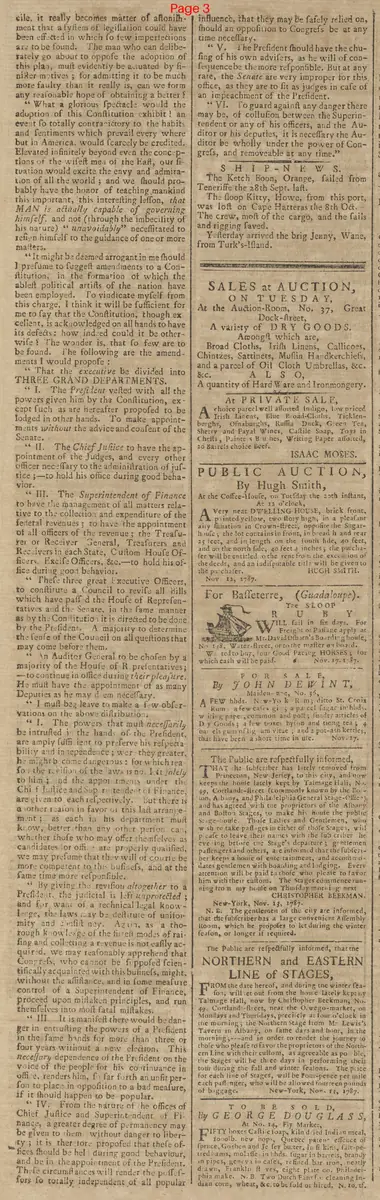
While it really becomes a matter of astonishment that a system of legislation could have been effected in which so few imperfections are to be found. The man who can deliberately go about to oppose the adoption of this plan, must evidently be actuated by sinister motives; for admitting it to be much more faulty than it really is, can we form any reasonable hope of obtaining a better?
What a glorious spectacle would the adoption of this Constitution exhibit! an event so totally contradictory to the habits and sentiments which prevail every where but in America, would scarcely be credited. Elevated infinitely beyond even the conceptions of the wisest men of the East, our situation would excite the envy and admiration of all the world; and we should probably have the honor of teaching mankind this important, this interesting lesson, that MAN is actually capable of governing himself, and not (through the imbecility of his nature) "unavoidably" necessitated to resign himself to the guidance of one or more masters.
It might be deemed arrogant in me should I presume to suggest amendments to a Constitution, in the formation of which the ablest political artists of the nation have been employed. To vindicate myself from this charge, I think it will be sufficient for me to say that the Constitution, though excellent, is acknowledged on all hands to have its defects: how indeed could it be otherwise? The wonder is, that so few are to be found. The following are the amendments I would propose:
That the executive be divided into THREE GRAND DEPARTMENTS.
I. The President vested with all the powers given him by the Constitution, except such as are hereafter proposed to be lodged in other hands. To make appointments without the advice and consent of the Senate.
II. The Chief Justice to have the appointment of the Judges, and every other officer necessary to the administration of justice;—to hold his office during good behavior.
III. The Superintendent of Finance to have the management of all matters relative to the collection and expenditure of the federal revenues; to have the appointment of all officers of the revenue: the Treasurer or Receiver General, Treasurers and Receivers in each State, Custom House Officers. Excise Officers, &c.—to hold his office during good behavior.
These three great Executive Officers, to constitute a Council to revise all Bills which have passed the House of Representatives and the Senate, in the same manner as by the Constitution it is directed to be done by the President. A majority to determine the sense of the Council on all questions that may come before them.
An Auditor General to be chosen by a majority of the House of Representatives; to continue in office during their pleasure. He must have the appointment of as many Deputies as he may deem necessary.
I must beg leave to make a few observations on the above distribution.
I. The powers that must necessarily be intrusted in the hands of the President, are amply sufficient to preserve his respectability and independence; were they greater, he might become dangerous: for which reason the revision of the laws is not solely to him: and the appointments under the Chief Justice and Superintendent of Finance, are given to each respectively. But there is another reason in favor of this last arrangement; as each in his department must know, better than any other person can, whether those who may offer themselves as candidates for offices are properly qualified. we may presume that they will of course be more competent to the business, and at the same time more responsible.
By giving the revision altogether to a President, the judicial is left unprotected; and for want of a technical legal knowledge, the laws may be destitute of uniformity and consistency. Again, as a thorough knowledge of the best modes of raising and collecting a revenue is not easily acquired, we may reasonably apprehend that Congress, who cannot be supposed scientifically acquainted with this business, might, without the assistance, and in some measure control of a Superintendent of Finance, proceed upon mistaken principles, and run themselves into most fatal mistakes.
III. It is manifest there would be danger in entrusting the powers of a President in the same hands for more than three or four years without a new election. This necessary dependence of the President on the voice of the people for his continuance in office, renders him, so far forth an unfit person to place in opposition to a bad measure, if it should happen to be popular.
IV. From the nature of the offices of Chief Justice and Superintendent of Finance, a greater degree of permanency may be given to them without danger to liberty; it is therefore proposed that these offices should be held during good behaviour, and be in the appointment of the President. These circumstances will render the possessors so totally independent of all popular influence, that they may be safely relied on, should an opposition to Congress be at any time necessary.
V. The President should have the choosing of his own advisers, as he will of consequence be the more responsible. But at any rate, the Senate are very improper for this office, as they are to sit as judges in case of an impeachment of the President.
VI. To guard against any danger there may be, of collusion between the Superintendent or any of his officers, and the Auditor or his deputies, it is necessary the Auditor be wholly under the power of Congress, and removeable at any time.
What a glorious spectacle would the adoption of this Constitution exhibit! an event so totally contradictory to the habits and sentiments which prevail every where but in America, would scarcely be credited. Elevated infinitely beyond even the conceptions of the wisest men of the East, our situation would excite the envy and admiration of all the world; and we should probably have the honor of teaching mankind this important, this interesting lesson, that MAN is actually capable of governing himself, and not (through the imbecility of his nature) "unavoidably" necessitated to resign himself to the guidance of one or more masters.
It might be deemed arrogant in me should I presume to suggest amendments to a Constitution, in the formation of which the ablest political artists of the nation have been employed. To vindicate myself from this charge, I think it will be sufficient for me to say that the Constitution, though excellent, is acknowledged on all hands to have its defects: how indeed could it be otherwise? The wonder is, that so few are to be found. The following are the amendments I would propose:
That the executive be divided into THREE GRAND DEPARTMENTS.
I. The President vested with all the powers given him by the Constitution, except such as are hereafter proposed to be lodged in other hands. To make appointments without the advice and consent of the Senate.
II. The Chief Justice to have the appointment of the Judges, and every other officer necessary to the administration of justice;—to hold his office during good behavior.
III. The Superintendent of Finance to have the management of all matters relative to the collection and expenditure of the federal revenues; to have the appointment of all officers of the revenue: the Treasurer or Receiver General, Treasurers and Receivers in each State, Custom House Officers. Excise Officers, &c.—to hold his office during good behavior.
These three great Executive Officers, to constitute a Council to revise all Bills which have passed the House of Representatives and the Senate, in the same manner as by the Constitution it is directed to be done by the President. A majority to determine the sense of the Council on all questions that may come before them.
An Auditor General to be chosen by a majority of the House of Representatives; to continue in office during their pleasure. He must have the appointment of as many Deputies as he may deem necessary.
I must beg leave to make a few observations on the above distribution.
I. The powers that must necessarily be intrusted in the hands of the President, are amply sufficient to preserve his respectability and independence; were they greater, he might become dangerous: for which reason the revision of the laws is not solely to him: and the appointments under the Chief Justice and Superintendent of Finance, are given to each respectively. But there is another reason in favor of this last arrangement; as each in his department must know, better than any other person can, whether those who may offer themselves as candidates for offices are properly qualified. we may presume that they will of course be more competent to the business, and at the same time more responsible.
By giving the revision altogether to a President, the judicial is left unprotected; and for want of a technical legal knowledge, the laws may be destitute of uniformity and consistency. Again, as a thorough knowledge of the best modes of raising and collecting a revenue is not easily acquired, we may reasonably apprehend that Congress, who cannot be supposed scientifically acquainted with this business, might, without the assistance, and in some measure control of a Superintendent of Finance, proceed upon mistaken principles, and run themselves into most fatal mistakes.
III. It is manifest there would be danger in entrusting the powers of a President in the same hands for more than three or four years without a new election. This necessary dependence of the President on the voice of the people for his continuance in office, renders him, so far forth an unfit person to place in opposition to a bad measure, if it should happen to be popular.
IV. From the nature of the offices of Chief Justice and Superintendent of Finance, a greater degree of permanency may be given to them without danger to liberty; it is therefore proposed that these offices should be held during good behaviour, and be in the appointment of the President. These circumstances will render the possessors so totally independent of all popular influence, that they may be safely relied on, should an opposition to Congress be at any time necessary.
V. The President should have the choosing of his own advisers, as he will of consequence be the more responsible. But at any rate, the Senate are very improper for this office, as they are to sit as judges in case of an impeachment of the President.
VI. To guard against any danger there may be, of collusion between the Superintendent or any of his officers, and the Auditor or his deputies, it is necessary the Auditor be wholly under the power of Congress, and removeable at any time.
What sub-type of article is it?
Constitutional
What keywords are associated?
Constitution Adoption
Executive Amendments
Presidential Powers
Financial Superintendent
Judicial Appointments
Government Structure
Self Governance
What entities or persons were involved?
President
Chief Justice
Superintendent Of Finance
Auditor General
Congress
Senate
House Of Representatives
Editorial Details
Primary Topic
Proposed Amendments To The Executive Branch Of The Us Constitution
Stance / Tone
Strongly Supportive Of Constitution Adoption With Suggested Improvements
Key Figures
President
Chief Justice
Superintendent Of Finance
Auditor General
Congress
Senate
House Of Representatives
Key Arguments
Opposition To Constitution Adoption Stems From Sinister Motives
Adoption Would Demonstrate Self Governance Capability
Constitution Has Few Defects Despite Being Formed By Experts
Divide Executive Into Three Departments For Better Checks
President Should Appoint Without Senate Consent
Chief Justice And Superintendent Hold Office During Good Behavior
Council Of Executives To Revise Bills
Auditor General Chosen By House To Prevent Collusion