Thank you for visiting SNEWPapers!
Sign up free
Letter to Editor
November 7, 1836
The Watchman
Hartford, Hartford County, Connecticut
What is this article about?
A letter defending sailors against prejudices portraying them as degraded, emphasizing the honor and utility of their profession in commerce, national defense, and spreading the gospel, and attributing their career choice to noble passions for the sea and adventure rather than vice.
Clipping
OCR Quality
98%
Excellent
Full Text
FOR THE WATCHMAN.
THE MARINER.
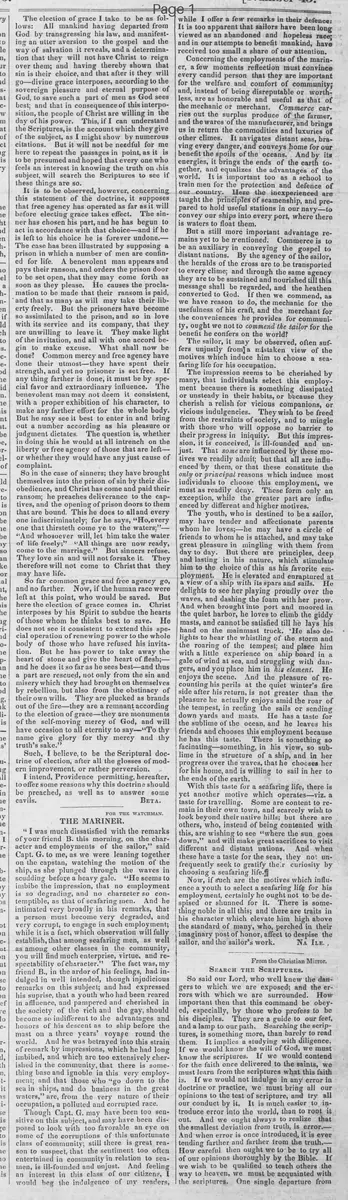
"I was much dissatisfied with the remarks of your friend B. this morning, on the character and employments of the sailor," said Capt. G. to me, as we were leaning together on the capstan, watching the motion of the ship, as she plunged through the waves in scudding before a heavy gale. "He seems to imbibe the impression, that no employment is so degrading, and no character so contemptible, as that of seafaring men. And he intimated very broadly in his remarks, that a person must become very degraded, and very corrupt, to engage in such employment; while it is a fact, which observation will fully establish, that among seafaring men, as well as among other classes in the community, you will find much enterprise, virtue, and respectability of character." The fact was, my friend B., in the ardor of his feelings, had indulged in well intended, though injudicious remarks on this subject; and had expressed his surprise, that a youth who had been reared in affluence, and pampered and cherished in the society of the rich and the gay, should become so indifferent to the advantages and honors of his descent as to ship before the mast on a three years' voyage round the world. And he was betrayed into this strain of remark by impressions, which he had long imbibed, and which are too extensively cherished in the community, that there is something base and ignoble in this very employment; and that those who "go down to the sea in ships, and do business in the great waters," are, from the very nature of their occupation, a polluted and corrupted race.
Though Capt. G. may have been too sensitive on this subject, and may have been disposed to look with too favorable an eye on some of the corruptions of this unfortunate class of community; still there is great reason to suspect, that the sentiment too often entertained in community in relation to seamen, is ill-founded and unjust. And feeling an interest in this class of our citizens, I would beg the indulgence of my readers, while I offer a few remarks in their defence:
It is too apparent that sailors have been long viewed as an abandoned and hopeless race; and in our attempts to benefit mankind, have received too small a share of our attention. Concerning the employments of the mariner, a few moments reflection must convince every candid person that they are important for the welfare and comfort of community; and, instead of being disreputable or worthless, are as honorable and useful as that of the mechanic or merchant. Commerce carries out the surplus produce of the farmer, and the wares of the manufacturer, and brings us in return the commodities and luxuries of other climes. It navigates distant seas, braving every danger, and conveys home for our benefit the spoils of the oceans. And by its energies, it brings the ends of the earth together, and equalizes the advantages of the world. It is important too as a school to train men for the protection and defence of our country. Here the inexperienced are taught the principles of seamanship, and prepared to hold useful stations in our navy—to convey our ships into every port, where there is water to float them.
But a still more important advantage remains yet to be mentioned. Commerce is to be an auxiliary in conveying the gospel to distant nations. By the agency of the sailor, the heralds of the cross are to be transported to every clime; and through the same agency they are to be sustained and nourished till this message shall be regarded, and the heathen converted to God. If then we commend, as we have reason to do, the mechanic for the usefulness of his craft, and the merchant for the conveniences he provides for community, ought we not to commend the sailor for the benefit he confers on the world?
The sailor, it may be observed, often suffers unjustly from a mistaken view of the motives which induce him to choose a seafaring life for his occupation. The impression seems to be cherished by many, that individuals select this employment because there is something dissipated or unsteady in their habits, or because they cherish a relish for vicious companions, or vicious indulgencies. They wish to be freed from the restraints of society, and to mingle with those who will oppose no barrier to their progress in iniquity. But this impression, it is conceived, is ill-founded and unjust. That some are influenced by these motives we readily admit; but that all are influenced by them, or that these constitute the only or principal reasons which induce most individuals to choose this employment, we must as readily deny. These form only an exception, while the greater part are influenced by different and higher motives.
The youth, who is destined to be a sailor may have tender and affectionate parents whom he loves;—he may have a circle of friends to whom he is attached, and may take great pleasure in mingling with them from day to day. But there are principles, deep and lasting in his nature, which stimulate him to the choice of this as his favorite employment. He is elevated and enraptured at a view of a ship with its spars and sails. He delights to see her playing proudly over the waves, and dashing the foam with her prow. And when brought into port and moored in the quiet harbor, he loves to climb the giddy masts, and cannot be satisfied till he lays his hand on the mainmast truck. He also delights to hear the whistling of the storm and the roaring of the tempest; and place him with a little experience on ship board in a gale of wind at sea, and struggling with dangers, and you place him in his element. He enjoys the scene. And the pleasure of recounting his perils at the quiet winter's fireside after his return, is not greater than the pleasure he actually enjoys amid the roar of the tempest, in reefing the sails or sending down yards and masts. He has a taste for the sublime of the ocean, and he leaves his friends and chooses this employment because he has this taste. There is something so fascinating—something, in his view, so sublime in the structure of a ship, and in her progress over the waves, that he chooses her for his home, and is willing to sail in her to the ends of the earth.
With this taste for a seafaring life, there is yet another motive which operates—viz. a taste for travelling. Some are content to remain in their own town, and scarcely wish to look beyond their native hills; but there are others, who, instead of being contented with this, are wishing to see "where the sun goes down," and will make great sacrifices to visit different and distant nations. And when these have a taste for the seas, they not unfrequently seek to gratify their curiosity by choosing a seafaring life.
Now, if such are the motives which influence a youth to select a seafaring life for his employment, certainly he ought not to be despised or shunned for it. There is something noble in all this; and there are traits in his character which elevate him high above the standard of many, who, perched in their imaginary post of honor, affect to despise the sailor, and the sailor's work.
NAILE.
THE MARINER.
"I was much dissatisfied with the remarks of your friend B. this morning, on the character and employments of the sailor," said Capt. G. to me, as we were leaning together on the capstan, watching the motion of the ship, as she plunged through the waves in scudding before a heavy gale. "He seems to imbibe the impression, that no employment is so degrading, and no character so contemptible, as that of seafaring men. And he intimated very broadly in his remarks, that a person must become very degraded, and very corrupt, to engage in such employment; while it is a fact, which observation will fully establish, that among seafaring men, as well as among other classes in the community, you will find much enterprise, virtue, and respectability of character." The fact was, my friend B., in the ardor of his feelings, had indulged in well intended, though injudicious remarks on this subject; and had expressed his surprise, that a youth who had been reared in affluence, and pampered and cherished in the society of the rich and the gay, should become so indifferent to the advantages and honors of his descent as to ship before the mast on a three years' voyage round the world. And he was betrayed into this strain of remark by impressions, which he had long imbibed, and which are too extensively cherished in the community, that there is something base and ignoble in this very employment; and that those who "go down to the sea in ships, and do business in the great waters," are, from the very nature of their occupation, a polluted and corrupted race.
Though Capt. G. may have been too sensitive on this subject, and may have been disposed to look with too favorable an eye on some of the corruptions of this unfortunate class of community; still there is great reason to suspect, that the sentiment too often entertained in community in relation to seamen, is ill-founded and unjust. And feeling an interest in this class of our citizens, I would beg the indulgence of my readers, while I offer a few remarks in their defence:
It is too apparent that sailors have been long viewed as an abandoned and hopeless race; and in our attempts to benefit mankind, have received too small a share of our attention. Concerning the employments of the mariner, a few moments reflection must convince every candid person that they are important for the welfare and comfort of community; and, instead of being disreputable or worthless, are as honorable and useful as that of the mechanic or merchant. Commerce carries out the surplus produce of the farmer, and the wares of the manufacturer, and brings us in return the commodities and luxuries of other climes. It navigates distant seas, braving every danger, and conveys home for our benefit the spoils of the oceans. And by its energies, it brings the ends of the earth together, and equalizes the advantages of the world. It is important too as a school to train men for the protection and defence of our country. Here the inexperienced are taught the principles of seamanship, and prepared to hold useful stations in our navy—to convey our ships into every port, where there is water to float them.
But a still more important advantage remains yet to be mentioned. Commerce is to be an auxiliary in conveying the gospel to distant nations. By the agency of the sailor, the heralds of the cross are to be transported to every clime; and through the same agency they are to be sustained and nourished till this message shall be regarded, and the heathen converted to God. If then we commend, as we have reason to do, the mechanic for the usefulness of his craft, and the merchant for the conveniences he provides for community, ought we not to commend the sailor for the benefit he confers on the world?
The sailor, it may be observed, often suffers unjustly from a mistaken view of the motives which induce him to choose a seafaring life for his occupation. The impression seems to be cherished by many, that individuals select this employment because there is something dissipated or unsteady in their habits, or because they cherish a relish for vicious companions, or vicious indulgencies. They wish to be freed from the restraints of society, and to mingle with those who will oppose no barrier to their progress in iniquity. But this impression, it is conceived, is ill-founded and unjust. That some are influenced by these motives we readily admit; but that all are influenced by them, or that these constitute the only or principal reasons which induce most individuals to choose this employment, we must as readily deny. These form only an exception, while the greater part are influenced by different and higher motives.
The youth, who is destined to be a sailor may have tender and affectionate parents whom he loves;—he may have a circle of friends to whom he is attached, and may take great pleasure in mingling with them from day to day. But there are principles, deep and lasting in his nature, which stimulate him to the choice of this as his favorite employment. He is elevated and enraptured at a view of a ship with its spars and sails. He delights to see her playing proudly over the waves, and dashing the foam with her prow. And when brought into port and moored in the quiet harbor, he loves to climb the giddy masts, and cannot be satisfied till he lays his hand on the mainmast truck. He also delights to hear the whistling of the storm and the roaring of the tempest; and place him with a little experience on ship board in a gale of wind at sea, and struggling with dangers, and you place him in his element. He enjoys the scene. And the pleasure of recounting his perils at the quiet winter's fireside after his return, is not greater than the pleasure he actually enjoys amid the roar of the tempest, in reefing the sails or sending down yards and masts. He has a taste for the sublime of the ocean, and he leaves his friends and chooses this employment because he has this taste. There is something so fascinating—something, in his view, so sublime in the structure of a ship, and in her progress over the waves, that he chooses her for his home, and is willing to sail in her to the ends of the earth.
With this taste for a seafaring life, there is yet another motive which operates—viz. a taste for travelling. Some are content to remain in their own town, and scarcely wish to look beyond their native hills; but there are others, who, instead of being contented with this, are wishing to see "where the sun goes down," and will make great sacrifices to visit different and distant nations. And when these have a taste for the seas, they not unfrequently seek to gratify their curiosity by choosing a seafaring life.
Now, if such are the motives which influence a youth to select a seafaring life for his employment, certainly he ought not to be despised or shunned for it. There is something noble in all this; and there are traits in his character which elevate him high above the standard of many, who, perched in their imaginary post of honor, affect to despise the sailor, and the sailor's work.
NAILE.
What sub-type of article is it?
Persuasive
Informative
Ethical Moral
What themes does it cover?
Commerce Trade
Military War
Religion
What keywords are associated?
Sailors Defense
Seafaring Honor
Commerce Utility
Naval Training
Gospel Transport
Adventure Motives
Prejudices Against Seamen
What entities or persons were involved?
Naile.
For The Watchman.
Letter to Editor Details
Author
Naile.
Recipient
For The Watchman.
Main Argument
sailors possess enterprise, virtue, and respectability, and their profession is honorable and essential for commerce, national defense, and conveying the gospel, chosen primarily by noble motives like love of the sea and adventure rather than vice or degradation.
Notable Details
Conversation With Capt. G.
Biblical Reference 'Go Down To The Sea In Ships'
Role In Transporting Missionaries