Thank you for visiting SNEWPapers!
Sign up free
Story
May 18, 1896
Waterbury Democrat
Waterbury, New Haven County, Connecticut
What is this article about?
1896 fashion article on summer trends: white and yellow organdie gowns with lace trims, cross draperies, debutante mohair outfits, evolving trimmed skirts, and large hats for children. Highlights weather inconsistencies and fashion innovations.
Clipping
OCR Quality
98%
Excellent
Full Text
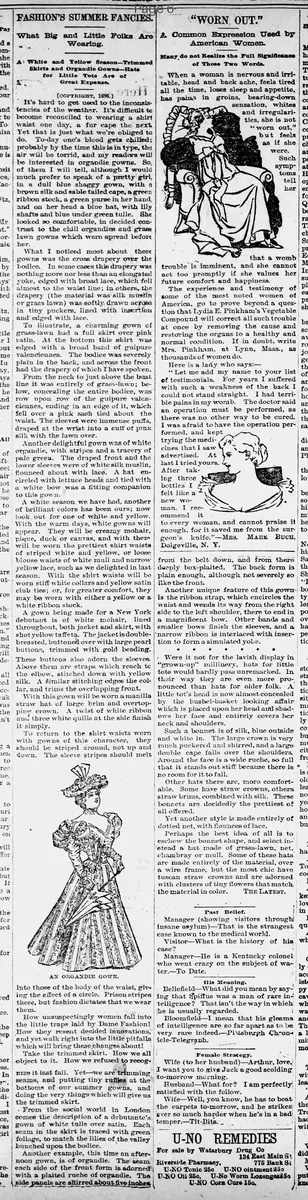
FASHION'S SUMMER FANCIES
What Big and Little Folks Are Wearing.
A White and Yellow Season—Trimmed Skirts and Organdie Gowns—Hats for Little Tots Are of Great Expansion
[COPYRIGHT, 1896.]
It's hard to get used to the inconsistencies of the weather. It's difficult to become reconciled to wearing a shirt waist one day, a fur cape the next Yet that is just what we're obliged to do. To-day one's blood gets chilled; probably by the time this is in type, the air will be torrid, and my readers will be interested in organdie gowns. So, of them I will tell, although I would much prefer to speak of a pretty girl in a dull blue shaggy gown, with a brown silk and sable tailed cape, a green ribbon stock, a green purse in her hand and on her head a blue hat, with lily shafts and blue under green tulle. She looked so comfortable, in decided contrast to the chill organdies and grass lawn gowns which were spread before her.
What I noticed most about these gowns was the cross drapery over the bodice. In some cases this drapery was nothing more nor less than an elongated yoke, edged with broad lace, which fell almost to the waist line; in others, the drapery (the material was silk muslin or grass lawn) was softly drawn across in tiny puckers, lined with insertion and edged with lace.
To illustrate, a charming gown of grass-lawn had a full skirt over pink satin. At the bottom this skirt was edged with a broad band of guipure valenciennes. The bodice was severely plain in the back, and across the front had the drapery of which I have spoken. From the neck to just above the bust line it was entirely of grass-lawn; below, concealing the entire bodice, was row upon row of the guipure valenciennes, ending in an edge of it, which fell over a pink sash tied about the waist. The sleeves were immense puffs, draped at the wrist into a cuff of pink silk with the lawn over.
Another delightful gown was of white organdie, with stripes and a tracery of pale green. The draped front and the lower sleeves were of white silk muslin, flounced about with lace. A hat encircled with lettuce heads and tied with a white bow was a fitting companion to this gown.
A white season we have had, another of brilliant colors has been ours; now look out for one of white and yellow. With the warm days, white gowns will appear. They will be creamy mohair, pique, duck or canvas, and with them will be worn the prettiest shirt waists of striped white and yellow, or loose blouse waists of white mull and narrow yellow lace, such as we delighted in last season. With the shirt waists will be worn stiff white collars and yellow satin club ties; or, for greater comfort, they may be worn with either a yellow or a white ribbon stock.
A gown being made for a New York debutante is of white mohair, lined throughout, both jacket and skirt, with shot yellow taffeta. The jacket is double-breasted, buttoned over with large pearl buttons, trimmed with gold beading. These buttons also adorn the sleeves Above them are straps which reach to the elbow, stitched down with yellow silk. A similar stitching edges the collar, and trims the overlapping front. With this gown will be worn a manilla straw hat of large brim and overtopping crown. A twist of white ribbon and three white quills at the side finish it simply.
To return to the shirt waists worn with gowns of this character, they should be striped around, not up and down. The sleeve stripes should melt into those of the body of the waist, giving the effect of a circle. Prison stripes these, but fashion dictates that we wear them.
How unsuspectingly women fall into the little traps laid by Dame Fashion! How they resent decided innovations, and yet walk right into the little pitfalls which will bring these changes about! Take the trimmed skirt. How we all object to it. How we refused to recognize it last fall. Yet—we are trimming seams, and putting tiny ruffles at the bottoms of our summer gowns, and doing the very things which will give us the trimmed skirt.
From the social world in London comes the description of a debutante's gown of white tulle over satin. Each seam in the skirt is traced with green foliage, to match the lilies of the valley bunched upon the bodice.
Another example, this time an afternoon gown, is of organdie. The seam each side of the front form is adorned with a plaited ruche of organdie. The side panels are shirred about five inches from the belt down, and from there deeply box-plaited. The back form is plain enough, although not severely so like the front.
Another unique feature of this gown is the ribbon strap, which encircles the waist and wends its way from the right side to the left shoulder, there to end in a magnificent bow. Other bands and smaller bows finish the sleeves, and a narrow ribbon is interlaced with insertion to form a simulated yoke.
Were it not for the lavish display in grown-up millinery, hats for little tots would hardly pass unremarked. In their way they are even more pronounced than hats for older folk. A little tot's head is now almost concealed by the bushel-basket looking affair which is placed upon her head and shadows her face and entirely covers her neck and shoulders.
Such a bonnet is of silk, blue outside and white in. The large crown is very much puckered and shirred, and a large double cape falls over the shoulders. Around the face is a wide ruche, so full that it stands out stiff because there is no room for it to fall.
Other hats there are, more comfortable. Some have straw crowns, others straw brims, combined with silk. These bonnets are decidedly the prettiest of all offered.
Yet another style is made entirely of dotted net, with flounces of lace. Perhaps the best idea of all is to eschew the bonnet shape, and select instead a hat made of grass-lawn, net, chambray or mull. Some of these hats are made entirely of the material, over a wire frame, but the most chic have tuscan straw crowns and are adorned with clusters of tiny flowers that match the material in color.
What Big and Little Folks Are Wearing.
A White and Yellow Season—Trimmed Skirts and Organdie Gowns—Hats for Little Tots Are of Great Expansion
[COPYRIGHT, 1896.]
It's hard to get used to the inconsistencies of the weather. It's difficult to become reconciled to wearing a shirt waist one day, a fur cape the next Yet that is just what we're obliged to do. To-day one's blood gets chilled; probably by the time this is in type, the air will be torrid, and my readers will be interested in organdie gowns. So, of them I will tell, although I would much prefer to speak of a pretty girl in a dull blue shaggy gown, with a brown silk and sable tailed cape, a green ribbon stock, a green purse in her hand and on her head a blue hat, with lily shafts and blue under green tulle. She looked so comfortable, in decided contrast to the chill organdies and grass lawn gowns which were spread before her.
What I noticed most about these gowns was the cross drapery over the bodice. In some cases this drapery was nothing more nor less than an elongated yoke, edged with broad lace, which fell almost to the waist line; in others, the drapery (the material was silk muslin or grass lawn) was softly drawn across in tiny puckers, lined with insertion and edged with lace.
To illustrate, a charming gown of grass-lawn had a full skirt over pink satin. At the bottom this skirt was edged with a broad band of guipure valenciennes. The bodice was severely plain in the back, and across the front had the drapery of which I have spoken. From the neck to just above the bust line it was entirely of grass-lawn; below, concealing the entire bodice, was row upon row of the guipure valenciennes, ending in an edge of it, which fell over a pink sash tied about the waist. The sleeves were immense puffs, draped at the wrist into a cuff of pink silk with the lawn over.
Another delightful gown was of white organdie, with stripes and a tracery of pale green. The draped front and the lower sleeves were of white silk muslin, flounced about with lace. A hat encircled with lettuce heads and tied with a white bow was a fitting companion to this gown.
A white season we have had, another of brilliant colors has been ours; now look out for one of white and yellow. With the warm days, white gowns will appear. They will be creamy mohair, pique, duck or canvas, and with them will be worn the prettiest shirt waists of striped white and yellow, or loose blouse waists of white mull and narrow yellow lace, such as we delighted in last season. With the shirt waists will be worn stiff white collars and yellow satin club ties; or, for greater comfort, they may be worn with either a yellow or a white ribbon stock.
A gown being made for a New York debutante is of white mohair, lined throughout, both jacket and skirt, with shot yellow taffeta. The jacket is double-breasted, buttoned over with large pearl buttons, trimmed with gold beading. These buttons also adorn the sleeves Above them are straps which reach to the elbow, stitched down with yellow silk. A similar stitching edges the collar, and trims the overlapping front. With this gown will be worn a manilla straw hat of large brim and overtopping crown. A twist of white ribbon and three white quills at the side finish it simply.
To return to the shirt waists worn with gowns of this character, they should be striped around, not up and down. The sleeve stripes should melt into those of the body of the waist, giving the effect of a circle. Prison stripes these, but fashion dictates that we wear them.
How unsuspectingly women fall into the little traps laid by Dame Fashion! How they resent decided innovations, and yet walk right into the little pitfalls which will bring these changes about! Take the trimmed skirt. How we all object to it. How we refused to recognize it last fall. Yet—we are trimming seams, and putting tiny ruffles at the bottoms of our summer gowns, and doing the very things which will give us the trimmed skirt.
From the social world in London comes the description of a debutante's gown of white tulle over satin. Each seam in the skirt is traced with green foliage, to match the lilies of the valley bunched upon the bodice.
Another example, this time an afternoon gown, is of organdie. The seam each side of the front form is adorned with a plaited ruche of organdie. The side panels are shirred about five inches from the belt down, and from there deeply box-plaited. The back form is plain enough, although not severely so like the front.
Another unique feature of this gown is the ribbon strap, which encircles the waist and wends its way from the right side to the left shoulder, there to end in a magnificent bow. Other bands and smaller bows finish the sleeves, and a narrow ribbon is interlaced with insertion to form a simulated yoke.
Were it not for the lavish display in grown-up millinery, hats for little tots would hardly pass unremarked. In their way they are even more pronounced than hats for older folk. A little tot's head is now almost concealed by the bushel-basket looking affair which is placed upon her head and shadows her face and entirely covers her neck and shoulders.
Such a bonnet is of silk, blue outside and white in. The large crown is very much puckered and shirred, and a large double cape falls over the shoulders. Around the face is a wide ruche, so full that it stands out stiff because there is no room for it to fall.
Other hats there are, more comfortable. Some have straw crowns, others straw brims, combined with silk. These bonnets are decidedly the prettiest of all offered.
Yet another style is made entirely of dotted net, with flounces of lace. Perhaps the best idea of all is to eschew the bonnet shape, and select instead a hat made of grass-lawn, net, chambray or mull. Some of these hats are made entirely of the material, over a wire frame, but the most chic have tuscan straw crowns and are adorned with clusters of tiny flowers that match the material in color.
What sub-type of article is it?
Fashion Trends
Clothing Description
What themes does it cover?
Social Manners
What keywords are associated?
Summer Fashion
Organdie Gowns
White Yellow
Trimmed Skirts
Children Hats
Where did it happen?
New York; London
Story Details
Location
New York; London
Event Date
1896
Story Details
Article describes summer fashion trends including organdie gowns with cross drapery, white and yellow combinations, trimmed skirts, debutante attire, and expansive hats for children.