Thank you for visiting SNEWPapers!
Sign up free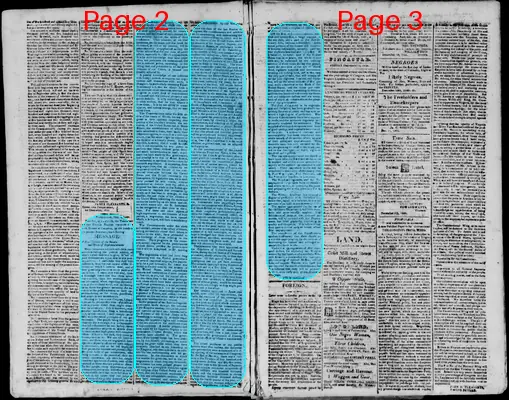
Fincastle Mirror
Fincastle, Botetourt County, Virginia
What is this article about?
On December 5, 1823, the President transmitted a message to Congress addressing foreign relations with Britain, France, Russia, and others; financial surplus; military improvements; and proposals on slave trade and privateering.
Merged-components note: Continuation of the President's message to Congress across pages 2 and 3, ending with '(To be continued.)'; kept as 'domestic_news' as it pertains to national government affairs.
Clippings
1 of 2
OCR Quality
Full Text
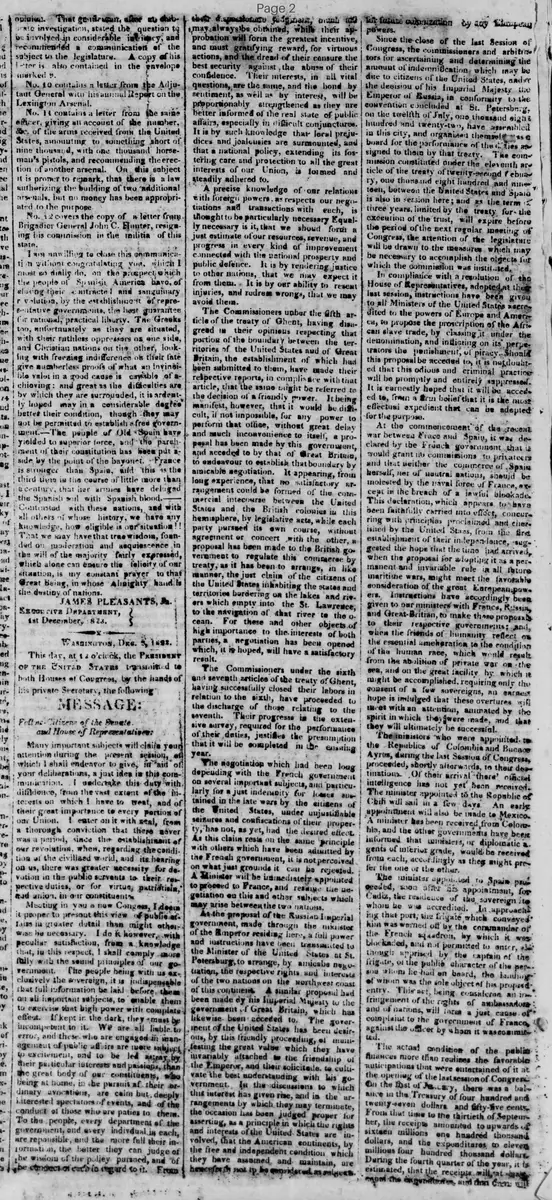
This day, at 2 o'clock, the President of the United States transmitted to both Houses of Congress, by the hand of his private Secretary, the following
MESSAGE:
Fellow-Citizens of the Senate and House of Representatives:
Many important subjects will claim your attention during the present session, of which I shall endeavor to give, in aid of your deliberations, a just idea in this communication. I undertake this duty with diffidence, from the vast extent of the interests on which I have to treat, and of their great importance to every portion of our Union. I enter on it with zeal, from a thorough conviction that there never was a period, since the establishment of our revolution, when, regarding the condition of the civilized world, and its bearing on us, there was greater necessity for devotion in the public servants to their respective duties, or for virtue, patriotism, and union, in our constituents. Meeting in you a new Congress, I deem it proper to present this view of public affairs in greater detail than might otherwise be necessary. I do know however, with peculiar satisfaction, from a knowledge that, in this respect, I shall comply more fully with the sound principles of our government. The people being with us exclusively the sovereign, it is indispensable that full information be laid before them on all important subjects, to enable them to exercise that high power with complete effect. If kept in the dark, they must be incompetent to it. We are all liable to error, and those who are engaged in the management of public affairs are more subject to excitement, and to be led astray by their particular interests and passions, than the great body of our constituents, who being at home, in the pursuit of their ordinary avocations, are calm but deeply interested spectators of events, and of the conduct of those who are parties to them.
To the people, every department of the government, and every individual, in each, are responsible, and the more full their information, the better they can judge of the wisdom of the policy pursued, and of the conduct observed in regard to it. From thence information is to be derived, and from thence their approbation may always be obtained, while their approbation will form the greatest incentive, and most gratifying reward, of virtuous actions, and the dread of their censure the best security against the abuse of their confidence. Their interests, in all vital questions, are the same, and the bond by sentiment, as well as by interest, will be proportionably strengthened as they are better informed of the real state of public affairs, especially in difficult conjunctures. It is by such knowledge that local prejudices and jealousies are surmounted, and that a national policy, extending its fostering care and protection to all the great interests of our Union, is formed and steadily adhered to.
A precise knowledge of our relations with foreign powers, as respects our negotiations and transactions with each, is thought to be particularly necessary Equally necessary is it, that we should form a just estimate of our resources, revenue, and progress in every kind of improvement connected with the national prosperity and public defence. It is by rendering justice to other nations, that we may expect it from them. It is by our ability to resent injuries, and redress wrongs, that we may avoid them.
The Commissioners under the fifth article of the treaty of Ghent, having disagreed in their opinions respecting that portion of the boundary between the territories of the United States and of Great Britain, the establishment of which had been submitted to them, have made their respective reports, in compliance with that article, that the same might be referred to the decision of a friendly power. It being manifest, however, that it would be difficult, if not impossible, for any power to perform that office, without great delay and much inconvenience to itself, a proposal has been made by this government, and acceded to by that of Great Britain, to endeavour to establish that boundary by amicable negotiation. It appearing, from long experience, that no satisfactory arrangement could be formed of the commercial intercourse between the United States and the British colonies in this hemisphere, by legislative acts, while each party pursued its own course, without agreement or concert with the other, a proposal has been made to the British government to regulate this commerce by treaty, as it has been to arrange, in like manner, the just claim of the citizens of the United States inhabiting the states and territories bordering on the lakes and rivers which empty into the St. Lawrence, to the navigation of that river to the ocean. For these and other objects of high importance to the interests of both parties, a negotiation has been opened which, it is hoped, will have a satisfactory result.
The Commissioners under the sixth and seventh articles of the treaty of Ghent, having successfully closed their labors in relation to the sixth, have proceeded to the discharge of those relating to the seventh. Their progress in the extensive survey, required for the performance of their duties, justifies the presumption that it will be completed in the ensuing year.
The negotiation which had been long depending with the French government on several important subjects, and particularly on a just indemnity for losses sustained in the late wars by the citizens of the United States, under unjustifiable seizures and confiscations of their property, has not, as yet, had the desired effect. As this claim rests on the same principle with others which have been admitted by the French government, it is not perceived on what just grounds it can be rejected. A Minister will be immediately appointed to proceed to France, and resume the negotiation on this and other subjects which may arise between the two nations.
At the proposal of the Russian Imperial government, made through the minister of the Emperor residing here, a full power and instructions have been transmitted to the Minister of the United States at St. Petersburg to arrange, by amicable negotiation, the respective rights and interests of the two nations on the northwest coast of this continent. A similar proposal had been made by his Imperial Majesty to the government of Great Britain, which has likewise been acceded to. The government of the United States has been desirous, by this friendly proceeding, of manifesting the great value which they have invariably attached to the friendship of the Emperor, and their solicitude to cultivate the best understanding with his government. In the discussions to which this interest has given rise, and in the arrangements by which they may terminate, the occasion has been judged proper for asserting, as a principle in which the rights and interests of the United States are involved, that the American continents, by the free and independent condition which they have assumed and maintain, are henceforth not to be considered as subjects for future colonization by any European powers.
Since the close of the last Session of Congress, the commissioners and arbitrators for ascertaining and determining the amount of indemnification which may be due to citizens of the United States, under the decision of his Imperial Majesty the Emperor of Russia, in conformity to the convention concluded at St. Petersburg, on the twelfth of July, one thousand eight hundred and twenty-two, have assembled in this city, and organized themselves as a board for the performance of the duties assigned to them by that treaty. The commission constituted under the eleventh article of the treaty of twenty-second February, one thousand eight hundred and nineteen, between the United States and Spain is also in session here; and as the term is three years, limited by the treaty for the execution of the trust, will expire before the period of the next regular meeting of Congress, the attention of the legislature will be drawn to the measures which may be necessary to accomplish the objects for which the Commission was instituted.
In compliance with a resolution of the House of Representatives, adopted at the last session, instructions have been given to all Ministers of the United States accredited to the powers of Europe and America, to propose the proscription of the African slave trade, by classing it under the denomination, and inflicting on its perpetrators the punishment, of piracy Should this proposal be acceded to, it is not doubted that this odious and criminal practice will be promptly and entirely suppressed. It is earnestly hoped that it will be acceded to, from a firm belief that it is the most effectual expedient that can be adopted for the purpose.
At the commencement of the present war between France and Spain, it was declared by the French government that it would grant no commissions to privateers, and that neither the commerce of Spain herself, nor of neutral nations, should be molested by the naval force of France, except in the breach of a lawful blockade. This declaration, which appears to have been faithfully carried into effect, concurring with principles proclaimed and cherished by the United States from the third establishment of their independence, suggested the hope that the time had arrived, when the proposal for adopting it as a permanent and invariable rule in all future maritime wars, might meet the favorable consideration of the great European powers. Instructions have accordingly been given to our ministers with France, Russia, and Great Britain, to make those proposals to their respective governments; and, when the friends of humanity reflect on the essential amelioration to the condition of the human race, which would result from the abolition of private war on the sea, and on the great facility by which it might be accomplished, requiring only the consent of a few sovereigns, an earnest hope is indulged that these overtures will meet with an attention, animated by the spirit in which they were made, and that they will ultimately be successful.
The ministers who were appointed to the Republics of Colombia and Buenos Ayres, during the last Session of Congress, proceeded, shortly afterwards, to their destinations. Of their arrival there official intelligence has not yet been received. The minister appointed to the Republic of Chili will sail in a few days. An early appointment will also be made to Mexico. A minister has been received from Colombia, and the other governments have been informed that ministers, or diplomatic agents of inferior grade, would be received from each, accordingly as they might prefer the one or the other.
The minister appointed to Spain proceeded, soon after his appointment, for Cadiz, the residence of the sovereign to whom he was accredited. In approaching that port; the frigate which conveyed him was warned off by the commander of the French squadron, by which it was blockaded, and not permitted to enter, although apprised by the captain of the frigate, of the public character of the person whom he had on board, the landing whose mission was the sole object of his proposed entry. This act, being considered an infringement of the rights of ambassadors and of nations, will form a just cause of complaint to the government of France, against the officer by whom it was committed.
The actual condition of the public finances more than realizes the favorable anticipations that were entertained of it at the opening of the last session of Congress. On the 1st of January, there was a balance in the Treasury of four hundred and twenty-seven thousand dollars and fifty-five cents. From that time to the thirtieth of September, the receipts amounted to upwards of sixteen millions one hundred thousand dollars, and the expenditures to eleven millions four hundred thousand dollars. During the fourth quarter of the year, it is estimated, that the receipts will exceed the expenditures, and that the loan will be reduced.
It is estimated that there will remain to me Thursday, on the first day of January next, a surplus of nearly nine millions of dollars.
On the 1st of January, eighteen hundred and twenty-five, a large amount of the war debt, and a part of the Revolutionary debt, become redeemable. Additional portions of the former will continue to become redeemable, annually, until the year eighteen hundred and thirty-five. It is believed, however, that if the United States remain at peace, the whole of that debt may be redeemed by the ordinary revenue of those years during that period, under the provision of the act of March third, eighteen hundred and seventeen, creating the sinking fund, and in that case the only part of debt, that will remain after the year eighteen hundred and thirty-five, will be the seven millions of five per cent. stock subscribed to the Bank of the United States, and the three per cent. Revolutionary debt, amounting to thirteen millions two hundred and ninety six thousand and ninety nine dollars and six cents. Most of Which are redeemable at the pleasure of the government.
The state of the army in its organization and discipline, has been gradually improving for several years, and has now attained a high degree of perfection. The military disbursements have been regularly made, and the accounts regularly and promptly rendered for settlement. The supplies of various descriptions have been of good quality, and regularly issued at all the posts. A system of economy and accountability has been introduced into every branch of the service, which admits of little additional improvement. This desirable state has been attained by the act reorganizing the staff of the army, passed on the fourteenth of April, eighteen hundred and eighteen.
The moneys appropriated for fortifications have been regularly and economically applied, and all the works advanced as rapidly as the amount appropriated would admit. Three important works will be completed in the course of this year; that at Fort Washington, Fort Delaware, and the Fort at the Rigolets, in Louisiana.
The Board of Engineers, and the Topographical Corps have been in constant and active service, in surveying the coast, and projecting the works necessary for its defence.
The Military Academy has attained a degree of perfection in its discipline and instruction, equal, as is believed, to any institution of its kind in any country.
The money appropriated for the use of the Ordnance Department, has been regularly and economically applied. The fabrication of arms at the national armories, and by contract with the Department, has been gradually improving in quality and cheapness. It is believed that their quality is now such as to admit of little improvement.
The completion of the Fortifications renders it necessary that there should be a suitable appropriation, for the purpose of fabricating the cannon and carriages necessary for those works.
Under the appropriation of five thousand dollars, for exploring the Western waters for the location of a site for a Western Armory, a commission was constituted, consisting of colonel McRee, colonel Lee, and captain Talcott, who have not yet reported the result of their labors, but it is believed that they will be prepared to do it, at an early part of this session of Congress.
(To be continued.)
What sub-type of article is it?
What keywords are associated?
What entities or persons were involved?
Where did it happen?
Domestic News Details
Primary Location
Washington
Event Date
Dec. 5, 1823
Key Persons
Event Details
The President transmitted a message to both Houses of Congress via his private Secretary, addressing public affairs, foreign relations including negotiations with Britain, France, Russia, and Spain; proposals on slave trade and privateering; diplomatic appointments; public finances showing a surplus; military improvements and fortifications; and the Military Academy.