Thank you for visiting SNEWPapers!
Sign up free
Gazette Of The United States And Daily Evening Advertiser
Philadelphia, Philadelphia County, Pennsylvania
What is this article about?
In December 1794, Mr. Smith of South Carolina delivered a speech in the House of Representatives advocating for a systematic plan to reduce the U.S. public debt. He detailed the debt amount, revenue surpluses, proposed extending internal taxes until 1801, applying surpluses to a sinking fund, and selling western lands, while praising the President and Treasury Secretary for fiscal prosperity.
Merged-components note: This is a continuation of the same congressional speech on the public debt, spanning pages 2 and 3, as indicated by the sequential reading order and the text flow where page 2 ends abruptly and page 3 picks up directly.
Clippings
1 of 2
OCR Quality
Full Text
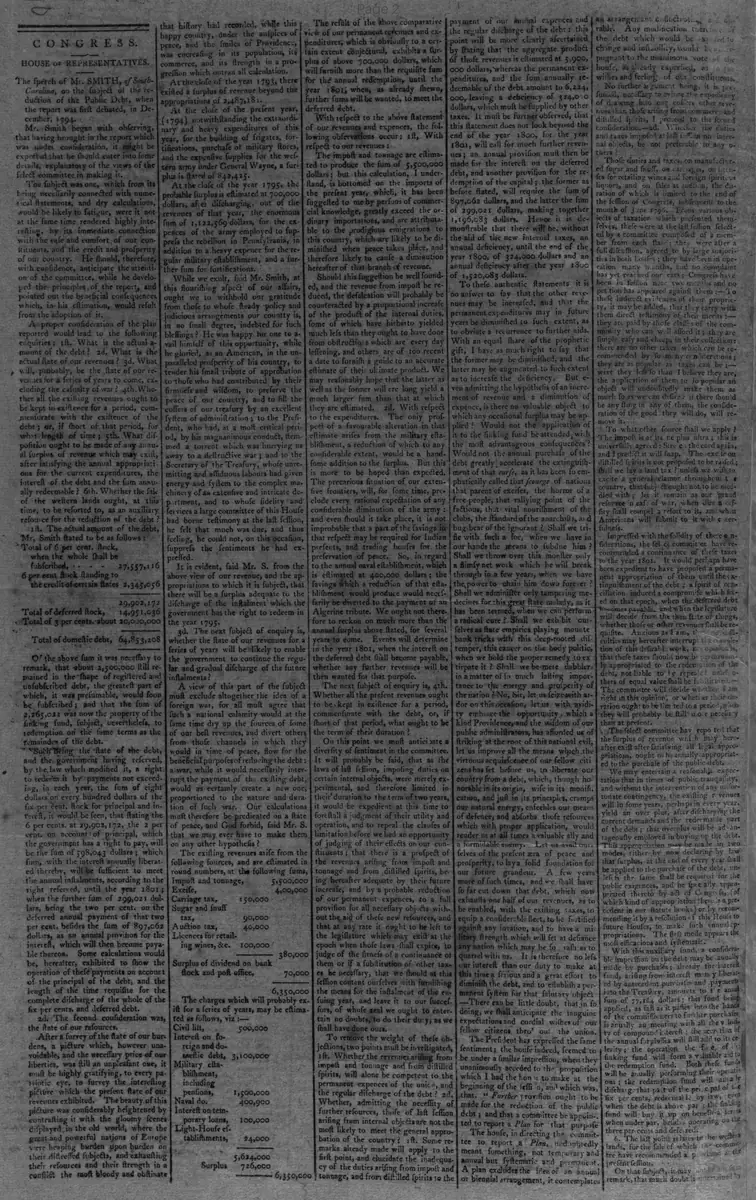
HOUSE OF REPRESENTATIVES.
The speech of Mr. SMITH, of South-Carolina, on the subject of the reduction of the Public Debt, when the report was first debated, in December, 1794.
Mr. Smith began with observing, that having brought in the report which was under consideration, it might be expected that he should enter into some details, explanatory of the views of the select committee in making it.
The subject was one, which from its being necessarily connected with numerical statements, and dry calculations, would be likely to fatigue, were it not at the same time rendered highly interesting, by its immediate connection with the ease and comfort of our constituents, and the credit and prosperity of our country. He should, therefore, with confidence, anticipate the attention of the committee, while he developed the principles, of the report, and pointed out the beneficial consequences which, in his estimation, would result from the adoption of it.
A proper consideration of the plan reported would lead to the following enquiries: 1st. What is the actual amount of the debt? 2d. What is the actual state of our revenues? 3d. What will, probably, be the state of our revenues for a series of years to come, excluding the casualty of war? 4th. Whether all the existing revenues ought to be kept in existence for a period, commensurate with the existence of the debt; or, if short of that period, for what length of time: 5th. What disposition ought to be made of any annual surplus of revenue which may exist, after satisfying the annual appropriations for the current expenditures, the interest of the debt and the sum annually redeemable? 6th. Whether the sale of the western lands ought, at this time, to be resorted to, as an auxiliary resource for the reduction of the debt?
1st. The actual amount of the debt, Mr. Smith stated to be as follows:
Total of 6 per cent. stock, when the whole shall be subscribed,.. 27,557,116
6 per cent stock standing to the credit of certain states 2,345,056
Total of deferred stock, 14,951,036
Total of 3 per cents. about 20,000,000
Total of domestic debt, 64,853,208
Of the above sum it was necessary to remark, that about 2,500,000 still remained in the shape of registered and unsubscribed debt, the greatest part of which, it was presumable, would soon be subscribed; and that the sum of 2,265,021 was now the property of the sinking fund, subject, nevertheless, to redemption on the same terms as the remainder of the debt.
Such being the state of the debt, and the government having reserved, by the law which modified it, a right to redeem it by payments not exceeding, in each year, the sum of eight dollars on every hundred dollars of the six per cent. stock for principal and interest, it would be seen, that stating the 6 per cents. at 29,902,172, the 2 per cent. on account of principal, which the government has a right to pay, will be the sum of 598,043 dollars; which sum, with the interest annually liberated thereby, will be sufficient to meet the annual instalments, according to the right reserved, until the year 1801; when the further sum of 299,021 dollars, being the two per cent. on the deferred annual payment of that two per cent. besides the sum of 897,062 dollars, as an annual provision for the interest, which will then become payable thereon. Some calculations would be, hereafter, exhibited to show the operation of these payments on account of the principal of the debt, and the length of the time requisite for the complete discharge of the whole of the six per cents. and deferred debt.
2d. The second consideration was, the state of our resources.
After a survey of the state of our burdens, a picture which, however unavoidable, and the necessary price of our liberties, was still an unpleasant one, it must be highly gratifying, to every patriotic eye, to survey the interesting picture which the present state of our revenues exhibited. The beauty of this picture was considerably heightened by contrasting it with the gloomy scenes displayed in the old world, where the great and powerful nations of Europe were heaping burden upon burden on their distressed subjects, and exhausting their resources and their strength in a conflict the most bloody and obstinate that history had recorded, while this happy country, under the auspices of peace, and the smiles of Providence, was increasing in its population, its commerce, and its strength in a progression which outran all calculation.
At the close of the year 1793, there existed a surplus of revenue beyond the appropriations of 2,487,181.
At the close of the present year, (1794) notwithstanding the extraordinary and heavy expenditures of this year, or the building of frigates, fortifications, purchase of military stores, and the expensive supplies for the western army under General Wayne, a surplus is stated of 842,425.
At the close of the year 1795, the probable surplus is estimated at 700,000 dollars, after discharging, out of the revenues of that year, the enormous sum of 1,122,569 dollars, for the expenses of the army employed to suppress the rebellion in Pennsylvania, in addition to a heavy expense for the regular military establishment, and a further sum for fortifications.
While we exult, said Mr. Smith, at this flourishing aspect of our affairs, ought we to withhold our gratitude from those to whose steady policy and judicious arrangements our country is, in no small degree, indebted for such blessings? He was happy for one to avail himself of this opportunity, while he gloried, as an American, in the unparalleled prosperity of his country, to tender his small tribute of approbation to those who had contributed by their firmness and wisdom, to preserve the peace of our country, and to fill the coffers of our treasury by an excellent system of administration; to the President, who had, at a most critical period, by his magnanimous conduct, stemmed a torrent which was hurrying us away to a destructive war; and to the Secretary of the Treasury, whose unremitting and assiduous labours had given energy and system to the complex machinery of an extensive and intricate department, and to whose fidelity and services a large committee of this House had borne testimony at the last session, he felt that much was due, and thus feeling, he could not, on this occasion, suppress the sentiments he had expressed.
It is evident, said Mr. S. from the above view of our revenue, and the appropriations to which it is subject, that there will be a surplus adequate to the discharge of the instalment which the government has the right to redeem in the year 1795.
3d. The next subject of enquiry is, whether the state of our revenues for a series of years will be likely to enable the government to continue the regular and gradual discharge of the future instalments?
A view of this part of the subject must exclude altogether the idea of a foreign war, for all must agree that such a national calamity would at the same time dry up the sources of some of our best revenues, and divert others from those channels in which they would in time of peace, flow for the beneficial purposes of reducing the debt: a war, while it would necessarily interrupt the payment of the existing debt, would as certainly create a new one, proportioned to the nature and duration of such war. Our calculations must therefore be predicated on a state of peace, and God forbid, said Mr. S. that we may ever have to make them on any other hypothesis?
The existing revenues arise from the following sources, and are estimated in round numbers, at the following sums,
Impost and tonnage, 5,500,000
Excise, 4,000,000
Carriage tax, 150,000
Sugar and snuff tax, 90,000
Auction tax, 40,000
Licences for retailing wines, &c. 100,000
380,000
Surplus of dividend on bank stock and post office, 70,000
6,350,000
The charges which will probably exist for a series of years, may be estimated as follows, viz:-
Civil list, 500,000
Interest on domestic debt, about 3,724,000
The result of the above comparative view of our permanent revenues and expenditures, which is obviously to a certain extent conjectural, exhibits a surplus of above 700,000 dollars, which will furnish more than the requisite sum for the annual redemption, until the year 1801, when, as already shown, further sums will be wanted, to meet the deferred debt.
With respect to the above statement of our revenues and expenses, the following observations occur: 1st. With respect to our revenues:
The impost and tonnage are estimated to produce the sum of 5,500,000 dollars; but this calculation, I understand, is bottomed on the imports of the present year, which, it has been suggested to me by persons of commercial knowledge, greatly exceed the ordinary importations, and are attributable to the prodigious emigrations to this country, which are likely to be diminished when peace takes place, and therefore likely to cause a diminution hereafter of that branch of revenue. Should this suggestion be well founded, and the revenue from impost be reduced, the defalcation will probably be counteracted by a proportional increase of the product of the internal duties, some of which have hitherto yielded much less than they ought to have done from obstructions which are every day lessening, and others are of too recent a date to furnish a guide to an accurate estimate of their ultimate product. We may reasonably hope that the latter as well as the former will ere long yield a much larger sum than that at which they are estimated. 2d. With respect to the expenditures. The only prospect of a favourable alteration in that estimate arises from the military establishment, a reduction of which to any considerable extent, would be a handsome addition to the surplus. But this is more to be hoped than expected. The precarious situation of our extensive frontiers, will, for some time, preclude every rational expectation of any considerable diminution of the army: and even should it take place, it is not improbable that a part of the savings in that respect may be required for Indian presents, and trading houses for the preservation of peace. So, in regard to the annual naval establishment, which is estimated at 400,000 dollars; the savings which a reduction of that establishment would produce would necessarily be diverted to the payment of an Algerine tribute. We ought not therefore to reckon on much more than the annual surplus above stated, for several years to come. Events will determine in the year 1801, when the interest on the deferred debt shall become payable, whether any further revenues will be then wanted for that purpose.
The next subject of enquiry is, 4th. Whether all the present revenues ought to be kept in existence for a period, commensurate with the debt, or, if short of that period, what ought to be the term of their duration?
On this point we must anticipate a diversity of sentiment in the committee. It will probably be said, that as the laws of last session, imposing duties on certain internal objects, were merely experimental, and therefore limited in their duration to the term of two years, it would be expedient at this time to forstall a judgment of their utility and operation, and to repeal the clauses of limitation before we had an opportunity of judging of their effects on our constituents; that there is a prospect of the revenues arising from impost and tonnage and from distilled spirits, being hereafter adequate by their future increase, and by a probable reduction of our permanent expenses, to a full provision for all necessary objects without the aid of these new resources, and that at any rate it ought to be left to the legislature which may exist at the epoch when those laws shall expire, to judge of the fitness of a continuance of them or if a substitution of other taxes be necessary, that we should at this session content ourselves with furnishing the means for the instalment of the ensuing year, and leave it to our successors, of whose zeal we ought to entertain no doubts, to do their duty, as we shall have done ours.
To remove the weight of these objections, two points must be investigated, 1st. Whether the revenues arising from impost and tonnage and from distilled spirits, will alone be competent to the permanent expenses of the union, and the regular discharge of the debt? 2d. Whether, admitting the necessity of further resources, those of last session arising from internal objects are not the most likely to meet the general approbation of the country? 1. Some remarks already made will apply to the first point, and elucidate the inadequacy of the duties arising from impost and tonnage, and from distilled spirits to the payment of our annual expenses and the regular discharge of the debt: this point will be more clearly ascertained by stating that the aggregate product of those revenues is estimated at 5,900,000 dollars, whereas the permanent expenditures, and the sum annually redeemable of the debt amount to 6,224,000, leaving a deficiency of 324,000 dollars, which must be supplied by other taxes. It must be further observed, that this statement does not look beyond the end of the year 1800, for the year 1801, will call for much further revenues; an annual provision must then be made for the interest on the deferred debt, and another provision for the redemption of the capital; the former as before stated, will require the sum of 897,062 dollars, and the latter the sum of 299,021 dollars, making together 1,196,083 dollars. Hence it is demonstrable that there will be, without the aid of the new internal taxes, an annual deficiency, until the end of the year 1800, of 324,000 dollars and an annual deficiency after the year 1800 of 1,520,083 dollars.
To these authentic statements it is no answer to say that the other revenues may be increased, and that the permanent expenditures may in future years be diminished to such extent, as to obviate a recurrence to further aids. With an equal share of the prophetic gift, I have as much right to say that the former may be diminished, and the latter may be augmented to such extent as to increase the deficiency. But even admitting the hypothesis of an increase of revenue and a diminution of expense, is there no valuable object to which any occasional surplus may be applied? Would not the application of it to the sinking fund be attended, with the most advantageous consequences? Would not the annual purchase of the debt greatly accelerate the extinguishment of that curse, as it has been so emphatically called that scourge of nations that parent of exactions, the horror of a free people, that rallying point of the factious, that vital nourishment of the clubs, the standard of the anarchists, and bug-bear of the ignorant? Shall we trifle with such a foe, when we have in our hands the means to subdue him Shall we throw over this monster only a flimsy net work which he will break through in a few years, when we have the power to chain him down forever? Shall we administer only tampering medicines for this great state malady, as it has been termed, when we can perform a radical cure? Shall we exhibit ourselves as state empirics playing mountebank tricks with this deep-rooted distemper, this cancer on the body politic. when we hold the proper remedy to extirpate it? Shall we be mere dabblers in a matter of so much lasting importance to the energy and prosperity of the nation? No, Sir, let us seize with ardor on this occasion, let us with avidity embrace the opportunity, which a kind Providence, and the wisdom of our public administrators, has afforded us of striking at the root of this national evil, let us improve all the means which the virtuous acquiescence of our fellow citizens has set before us, to liberate our country from a debt, which, though honorable in its origin, wise in its modification, and just in its principles, cramps our natural energy, enfeebles our means of defence, and absorbs those resources which with proper application, would render us at all times a valuable ally and a formidable enemy. Let us avail ourselves of the present aura of peace and prosperity, to lay a solid foundation for our future grandeur. A few years more of such times, and we shall have so far cut down that debt, which now exhausts one half of our revenues, as to be enabled, with the existing taxes, to equip a considerable fleet, to be fortified against any invasion, and to have a military strength which will set at defiance any nation which may be so rash as to quarrel with us. It is therefore no less our interest than our duty to make at this time a vigorous and a great effort to diminish the debt, and to establish a permanent system for that salutary object There can be little doubt, that in so doing, we shall anticipate the sanguine expectations and cordial wishes of our constituents.
The President has expressed the same sentiment; the house indeed, seemed to be under a similar impression, when they unanimously acceded to the proposition which I had the honor to make at the beginning of the session, and which was, that "Further provision ought to be made for the reduction of the public debt; and that a committee be appointed to report a Plan for that purpose"
The house, in directing the committee to report a Plan, undoubtedly meant something, not temporary and annual but systematic and permanent. A plan excludes the idea of an annual or biennial arrangement, it contemplates an arrangement affecting a durable. Any modification therefore in the debt which would be exercised to change and instability, would be a repugnant to the unanimous vote of the house, as already expressed, as gauge wishes and feeling of our constituents.
No further argument being, it is presumed, necessary to evince the expediency of drawing into our coffers other revenues than those arising from commerce and distilled spirits, I proceed to the second consideration.-2d. Whether the duties and taxes imposed at last session on internal objects, be not preferable to any others?
Those duties and taxes. on manufactured sugar and snuff, on carriages, on licenses for retailing wines and foreign spirituous liquors, and on sales at auction, the duration of which is limited to the end of the session of Congress, subsequent to the month of June 1795. From various objects of taxation which presented themselves, these were at the last session elected by a committee composed of a member from each state: they were after a full discussion, agreed to by large majorities in both houses; they have been in operation many months, and no complaint has yet reached our ears; Congress have been in session near two months and no petition has appeared against them :-To these indirect evidences of their propriety, it may be added, that they carry with them direct testimony of their merits :— they are paid by those classes of the community who can well afford it; they are simple easy and cheap, in their collection: there are no other taxes which can be recommended by so many conveniences; they are as popular as taxes can be ;- were they less so than I believe they are, the application of them to so popular an object will undoubtedly make them as much so as we can desire: if there should be any thing in any of them, the consideration of the good they will do, will remove it.
To what other source shall we apply? The impost is at its ne plus ultra; this is universally agreed : Stretch the cord again, and I predict it will snap. The exc. se on distilled spirits is not proposed to be raised; shall we lay a land tax? unless we wish to excite a general clamor throughout this country, that subject ought not to be meddled with; let it remain as our grand resource in case of war, when dire necessity shall compel a resort to it, and when Americans will submit to it with cheerfulness.
Impressed with the solidity of these considerations, the select committee have recommended a continuance of these taxes to the year 1801. It would perhaps have been expedient to have proposed a permanent appropriation of them until the extinguishment of the debt; a spirit of conciliation induced a compromise which fixed on that epoch, when the deferred debt becomes payable and when the legislature will decide from the then state of things, whether those or other revenues shall be requisite. Anxious as I am, to difficulties may hereafter interrupt the completion of this desirable work, my opinion is, that these taxes should now be permanently appropriated to the redemption of the debt, not liable to be repealed unless others of equal value shall be substituted.- The committee will decide whether I am right in this opinion, or whether their duration ought to be limited to a period, when they will probably be still more necessary than at present.
The select committee have reported that the surplus of revenue which may hereafter exist after satisfying all legal appropriations, ought to be annually appropriated to the purchase of the public debt,
We may entertain a reasonable expectation that in times of public tranquility, and without the intervention of any unfortunate contingency, the existing revenues will in some years, perhaps in every year, yield an over plus, after discharging the current demands and the redeemable part of the debt; that overplus will be advantageously employed in buying up the debt. This appropriation may be made in two modes, either by now declaring by law that surplus, at the end of every year shall be applied to the purchase of the debt, unless the same shall be required for the public exigencies, and be specially appropriated thereto by act of Congress, (of which kind of appropriation there is a precedent in our statute books) or by recommending it by a resolution of this House to future Houses, to make such annual appropriations. The first mode appears the most efficacious and systematic.
With this auxiliary fund, a considerable impression on the debt may be annually made by purchases; already the interest fund, arising from interest money liberated by antecedent purchases and payments into the Treasury, amounts to an annual sum of 77,164 dollars; this fund being applied, as fast as it passes into the hands of the commissioners to further purchases by of compound interest ; the accretion of is annually augmenting with all the velocity of the commissioners to further purchases the annual surplus will still add to its celerity; the operation therefore, of sinking fund will form a valuable aid to the redemption fund. Both these funds will be annually performing their operations ; the redemption fund will annually discharge that part of the principal of the six per cents, redeemable by law, even when the debt is above par ; the sinking fund will buy it up on beneficial terms when the debt is above par ; the sinking fund will buy it up on beneficial terms when under par, besides operating on the three per cents and deferred.
6. The last point relates to the western lands, for the sale of which the committee have recommended provision at the present session.
On that subject, it may not be amiss to remark, that much doubt is entertained by Whether this is the proper course of proceeding to the sale of those lands; on the one hand it is opposed that the sale would ever impede the sale or render the event of the war in that country more precarious to take no steps in regard to it unprofitable; that Congress ought to pause at propriety, until a solid and lasting peace has been established. On the other hand, the prospect of an approaching peace and the present rage for land speculations seem to invite to purchase, notwithstanding the late experiment. If adventurers are disappointed in the United States, there appears no good reason why they should wage war on terms advantageous to the U. States when the government could not as early as possible avail itself of this auxiliary resource to reduce its debt. The purchasers in this case run all risks, and take upon themselves all hazards; the latter to sell for ready money or to have warrants has no other care than to have the contracts well secured. Should it be thought however that any sales prior to a peace, will be disadvantageous to the United States, it will in that case be proper to introduce in the bill, a clause declaring that the sales shall not commence, until the President shall, by proclamation, have announced a peace with the Indian tribes. Mr. Smith then said, having thus, Mr. Chairman, touched upon the report and on the subjects incident to it, and on the different points resulting from a due consideration of it, I shall conclude with a few miscellaneous observations not immediately falling under any of the above heads. Though they will be more obvious and applicable when the details of the bill shall come under consideration, yet it may not be altogether useless to draw the attention of the committee to them at this time. 1st. The first consideration which occurs as a matter of detail is the doubt whether the payment of two per cent on the principal of the debt is to extend to that proportion of six per cent stock which has been purchased by the Commissioners of the sinking fund? It appears to me expedient that it should: in that case, the amount so paid must be appropriated to the sinking fund; and the interest liberated by each annual payment must go to swell the payment of the ensuing year, for it will be observed that, according to the right reserved, each annual payment on account of principal will be larger than the payment of the preceding year, by the addition of the interest liberated in that year: by existing laws, the interest on the debt purchased is appropriated to the sinking fund; a repeal of that appropriation will therefore be necessary. 2d. The next consideration which arises is, by whom shall these payments of redemption be made? The Commissioners of the sinking fund present themselves as the most proper persons. The monies requisite for the purpose will be placed at their disposal, by the proper officers of the Treasury. They will keep two separate accounts, one relating to the redemption of the debt by annual payments, the other relating to the purchase of the debt. 3d. Some difficulties may be suggested on the score of the certificates. Are new certificates to be issued at every annual payment? or are the payments to be endorsed or noted on the certificates or only entered on the books of the Treasury in each creditor's account? How is a purchaser to know the value of a certificate, and what steps ought to be taken in relation to certificates in Europe? It may be expedient to vest a discretionary power in the Treasury Department, subject to the control of the President, to regulate these details in the manner most convenient to the creditors, consistent however with a due regard to the Treasury arrangements. 4th. Another point of not less doubt and of equal importance with the foregoing arises, i. e. whether the two per cent on account of principal, shall be made, quarterly, or annually; this doubt will require legislative decision. The advantage of paying it quarterly will be that it will prevent the collection of large sums at the end of the year in the Treasury; but as no interest in that case will be stopped till the end of the year, expediency dictates that the payment of the two per cent should be made at the end of each year. Mr. Smith concluded with observing that from the calculations which he held in his hand, it appeared that from the mere operation of the redemption fund the present six per cent debt would be paid off in less than 23 years, and the deferred in less than 29; there would then remain only the three per cent, and foreign debt: but the combined operation of the sinking fund would very accelerate the discharge of the whole, and should the Legislature think proper to increase our revenues by new taxes, we might soon expect to see a complete discharge of the debt. At all events, as Mr. S. it will be a consolation to us all as we grow old, that the older we grow the nearer we approach that happy period, when our country liberated from its burdens, shall rise in a vigour and elasticity, which will protect our liberties from every external aggression and preserve to us, and perpetuate to our posterity, every internal blessing.
What sub-type of article is it?
What themes does it cover?
What keywords are associated?
What entities or persons were involved?
Where did it happen?
Story Details
Key Persons
Location
House Of Representatives
Event Date
December 1794
Story Details
Mr. Smith presents a report and speech advocating for reducing the public debt through detailed analysis of debt amounts, revenue surpluses from 1793-1795, continuation of internal taxes until 1801, application of surpluses to sinking and redemption funds, and sale of western lands, while emphasizing peace, prosperity, and praise for administration.