Thank you for visiting SNEWPapers!
Sign up free
Story
January 17, 1857
New Hampshire Statesman
Concord, Merrimack County, New Hampshire
What is this article about?
Article from Milwaukee Daily News on quail and ruffed grouse hunting in the Western States, detailing their habits, seasons, and sporting challenges during autumn and winter.
Clipping
OCR Quality
95%
Excellent
Full Text
From the Milwaukee Daily News.
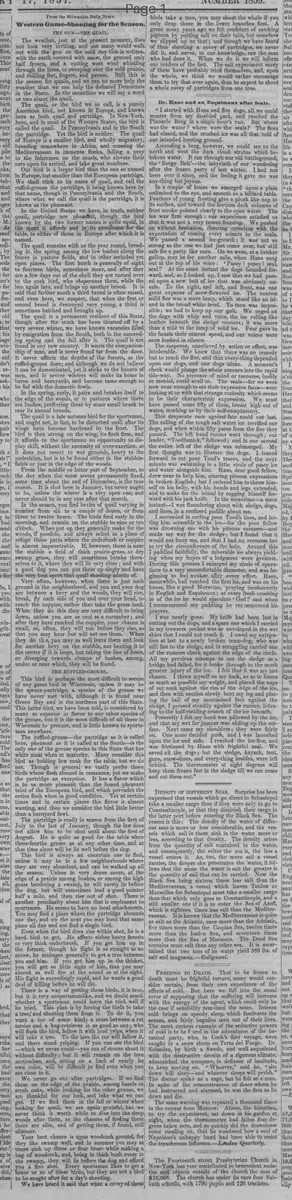
Western Game-Shooting for the Season THE GUN—THE QUAIL.
The weather, just at the present moment, does not look very inviting, and not many would walk out with the gun on the cold day this is written, with the earth covered with snow, the ground only half frozen, and a cutting west wind whistling through the trees, or sweeping over the cold prairie, and chilling feet, fingers, and person. Still this is the season for quails, and we can no more help the weather than we can help the defeated Democrats in the State. In the meantime we will say a word or two about the quail.
The quail, or the bird we so call, is a purely American bird, not known in Europe, and known here as both quail and partridge. In New-York here, and in most of the Western States, the bird is called the quail. In Pennsylvania and in the South the partridge. Yet the bird is neither. The quail of Europe is a smaller bird, and wholly migratory, breeding somewhere in Africa, and crossing the Mediterranean in immense flocks, falling a prey to the fishermen on the coasts, who elevate their nets upon its arrival, and take great numbers.
Our bird is a larger bird than the one so named in Europe, but smaller than the European partridge. We shall stick to its name of quail, and call the ruffed-grouse the partridge, it being known here by that name, though in Pennsylvania and the South, where what we call the quail is the partridge, it is known as the pheasant.
In the United States we have, in truth, neither quail, partridge nor pheasant, though the bird known by the two former names is quite equal, in the sport it affords and in its excellence for the table, to either of those in Europe after which it is named.
The quail remains with us the year round, breeding in- the spring among the low bushes along the fences in pasture fields, and in other secluded yet open places. The first hatch is generally of eight to fourteen birds, sometimes more, and after they are a few days out of the shell they are turned over to the cock bird, who chaperones them, while the hen again lays, and brings up another brood. It is said that farther south a third brood is often raised, and even here, we suspect, that when the first or second brood is destroyed very young, a third is sometimes hatched and brought up.
The quail is a permanent resident of this State though after the stock has been thinned off by a very severe winter, we have known vacancies filled by emigration from the South, both in the succeeding spring and the fall after it. The quail is not found in any new country. It wants the companionship of man, and is never found far from the door. It never affects the depths of the forests, as the ruffed-grouse does; and although we do not believe it can be domesticated, yet it sticks to the haunts of men, and in severe winters will make its home in barns and barnyards, and become tame enough to be fed with the domestic fowls.
In the spring, early, it pairs and betakes itself to the edge of the woods, or to pastures where there are bushes, preferring those by some small brook to rear its annual broods.
The quail is a late autumn bird for the sportsman, and ought not, in fact, to be disturbed until after its wings have become hardened by the frost. The bird is then strong on the wing, its flesh firm, and it affords to the sportsman an opportunity to display skill, without the necessity of over-exertion, as it does not resort to wet grounds, heavy to the pedestrian, but is to be found either in the stubble-fields or just in the edge of the woods.
From the middle or latter part of September. to the day when the snow seems permanently fixed, some time about the end of December, is the true season. It is shot here in January, but never ought to be, unless the winter is a very open one, and never should be in any case after that month.
In the season, you find bevies of quail varying in number from six to a couple of dozen. or from three to twelve brace. The birds feed early in the morning, and remain on the stubble to nine or ten o'clock. When put up they generally make for the woods, if possible, and always select as a place of refuge those parts where the underbush or coppice is almost impenetrable. If, however, there is near the stubble a field of thick prairie-grass, or dry swamp grass, they will sometimes betake themselves to it, where they will lie very close; and with a good dog you can put them up singly and have the very best sport that quail shooting admits of.
Very often, however, when there is just such ground in the neighborhood, and you and your dog are between a bevy and the woods, they will rise. break, fly each side of you and over your head, to reach the coppice. rather than take the grass land. When they do this they are very difficult to bring down, unless you are as cool as a cucumber; and after they have reached the coppice, your chance is small, as, often, they will run before they rise, so that you may hear but will not see them. When they do this, you may as well leave them and look for another bevy on the stubble, not beating it to the center if it is large, but taking the line of fence, or diverging towards clumps of bushes, among, under or near which, they will be found.
THE RUFFLED-GROUSE
This bird is perhaps the most difficult to secure of any game bird in Wisconsin, unless it may be the spruce-partridge, a species of the grouse we have never met with, although it is found near Green Bay and in the northern part of this State. This latter bird, we have been told, is considered by many as superior in flavor to any other species of the grouse, but it is the most difficult of all those in Wisconsin to procure, and is little known to sportsmen anywhere.
The ruffled-grouse—the partridge as it is called here, pheasant as it is called at the South—is the only one of the grouse species in this State that has white meat when at maturity. Many consider this bird as holding low rank for the table, but we do not. Though in general we vastly prefer those birds whose flesh abound in osmazone, yet we make the partridge an exception. It has a flavor which is to us more pleasant than the famed pheasant taint of the European bird, and which pervades the entire flesh when in good condition. Yet at certain times and in certain places this flavor is almost wanting, and then we consider the bird little better than a barnyard fowl.
The partridge is really in season from the first of July to the last of January, though the law does not allow him to be shot until about the first of August. He is quite as good for the table when three-fourths grown as at any other time, and at that time alone will he lie well before the dog.
This bird is always an uncertain one to find. unless it may be in a few neighborhoods where they are very abundant, and can be walked up all the season. Unless in very dense cover, at the edge of a prairie among bushes, or among the high grass bordering a swamp, he will rarely lie before the dog, but will sometimes lead a good pointer half a mile, and then rise out of shot. There is another peculiarity about him that is unpleasant to sportsmen. He seems to have no local attachments. You may find a place where the partridge abounds one day, and on the next you may hunt that same place all day and not find a single bird.
Even when the bird does rise within shot, he is a hard bird to get. He affects either heavy forests or very thick underbrush. If you get him up in the former, though his flight is as straight as an arrow, he manages generally to get a tree between you and him. If you get him up in the thicket, you will get so little sight of him, that you may almost as well fire at the sound as at the sight. His flight is exceedingly rapid, and he wants a good deal of killing before he will die.
There is a way of getting these birds, it is true. but it is very unsportsmanlike, and we doubt much whether a sportsman could learn the trick well if he tried. This plan is by forcing the birds to take a tree, and shooting them from it. To do it, you want a cur of some kind; a cross between a rat terrier and a hog-retriever is as good as any; who will flush the bird, follow it with loud yelps, when it will take a tree. To the tree the cur will follow it. and there stand yelping. If you can see the bird—which we never could—you can of course shoot it without difficulty; but it will remain on the tree motionless, and, sitting on a limb of nearly its own color, will be difficult to find even when you are close to it.
We never go out after partridges. If we find them on the edge of the prairie, among hazels or scrub oaks, while looking for the other grouse, we are thankful for our luck, and take what we can get. If we find them in the fall or winter when looking for quail, we are again grateful, but we never think it worth while to dive into the deep woods after them, as the chances of finding them there are slim, and of getting them, if found, still slimmer.
Your best chance is upon woodcock ground, for they like swamp well, and in summer you may at times pick up three or four brace while making a bag of woodcock, and, being in thick bush cover in the swamp, they will lie before the dog and afford you a fine shot. Every sportsman likes to get a brace or so of these birds, but they are not a bird to be sought after for a day's shooting.
We have heard it said that when a covey of these birds take a tree, you may shoot the whole if you only drop those in the lower branches first. A great many years ago we felt confident of catching pigeons by putting salt on their tails, but somehow we slipped up on that; and though we have heard of thus shooting a covey of partridges, we never did it, and never, to our knowledge, saw the man who had done it. When we do it we will inform our readers of the fact. The salt experiment many of them have probably tried themselves, and, upon the whole, we think we would rather encourage them to try that over again, than to expect to shoot a whole covey of partridges from one tree.
Western Game-Shooting for the Season THE GUN—THE QUAIL.
The weather, just at the present moment, does not look very inviting, and not many would walk out with the gun on the cold day this is written, with the earth covered with snow, the ground only half frozen, and a cutting west wind whistling through the trees, or sweeping over the cold prairie, and chilling feet, fingers, and person. Still this is the season for quails, and we can no more help the weather than we can help the defeated Democrats in the State. In the meantime we will say a word or two about the quail.
The quail, or the bird we so call, is a purely American bird, not known in Europe, and known here as both quail and partridge. In New-York here, and in most of the Western States, the bird is called the quail. In Pennsylvania and in the South the partridge. Yet the bird is neither. The quail of Europe is a smaller bird, and wholly migratory, breeding somewhere in Africa, and crossing the Mediterranean in immense flocks, falling a prey to the fishermen on the coasts, who elevate their nets upon its arrival, and take great numbers.
Our bird is a larger bird than the one so named in Europe, but smaller than the European partridge. We shall stick to its name of quail, and call the ruffed-grouse the partridge, it being known here by that name, though in Pennsylvania and the South, where what we call the quail is the partridge, it is known as the pheasant.
In the United States we have, in truth, neither quail, partridge nor pheasant, though the bird known by the two former names is quite equal, in the sport it affords and in its excellence for the table, to either of those in Europe after which it is named.
The quail remains with us the year round, breeding in- the spring among the low bushes along the fences in pasture fields, and in other secluded yet open places. The first hatch is generally of eight to fourteen birds, sometimes more, and after they are a few days out of the shell they are turned over to the cock bird, who chaperones them, while the hen again lays, and brings up another brood. It is said that farther south a third brood is often raised, and even here, we suspect, that when the first or second brood is destroyed very young, a third is sometimes hatched and brought up.
The quail is a permanent resident of this State though after the stock has been thinned off by a very severe winter, we have known vacancies filled by emigration from the South, both in the succeeding spring and the fall after it. The quail is not found in any new country. It wants the companionship of man, and is never found far from the door. It never affects the depths of the forests, as the ruffed-grouse does; and although we do not believe it can be domesticated, yet it sticks to the haunts of men, and in severe winters will make its home in barns and barnyards, and become tame enough to be fed with the domestic fowls.
In the spring, early, it pairs and betakes itself to the edge of the woods, or to pastures where there are bushes, preferring those by some small brook to rear its annual broods.
The quail is a late autumn bird for the sportsman, and ought not, in fact, to be disturbed until after its wings have become hardened by the frost. The bird is then strong on the wing, its flesh firm, and it affords to the sportsman an opportunity to display skill, without the necessity of over-exertion, as it does not resort to wet grounds, heavy to the pedestrian, but is to be found either in the stubble-fields or just in the edge of the woods.
From the middle or latter part of September. to the day when the snow seems permanently fixed, some time about the end of December, is the true season. It is shot here in January, but never ought to be, unless the winter is a very open one, and never should be in any case after that month.
In the season, you find bevies of quail varying in number from six to a couple of dozen. or from three to twelve brace. The birds feed early in the morning, and remain on the stubble to nine or ten o'clock. When put up they generally make for the woods, if possible, and always select as a place of refuge those parts where the underbush or coppice is almost impenetrable. If, however, there is near the stubble a field of thick prairie-grass, or dry swamp grass, they will sometimes betake themselves to it, where they will lie very close; and with a good dog you can put them up singly and have the very best sport that quail shooting admits of.
Very often, however, when there is just such ground in the neighborhood, and you and your dog are between a bevy and the woods, they will rise. break, fly each side of you and over your head, to reach the coppice. rather than take the grass land. When they do this they are very difficult to bring down, unless you are as cool as a cucumber; and after they have reached the coppice, your chance is small, as, often, they will run before they rise, so that you may hear but will not see them. When they do this, you may as well leave them and look for another bevy on the stubble, not beating it to the center if it is large, but taking the line of fence, or diverging towards clumps of bushes, among, under or near which, they will be found.
THE RUFFLED-GROUSE
This bird is perhaps the most difficult to secure of any game bird in Wisconsin, unless it may be the spruce-partridge, a species of the grouse we have never met with, although it is found near Green Bay and in the northern part of this State. This latter bird, we have been told, is considered by many as superior in flavor to any other species of the grouse, but it is the most difficult of all those in Wisconsin to procure, and is little known to sportsmen anywhere.
The ruffled-grouse—the partridge as it is called here, pheasant as it is called at the South—is the only one of the grouse species in this State that has white meat when at maturity. Many consider this bird as holding low rank for the table, but we do not. Though in general we vastly prefer those birds whose flesh abound in osmazone, yet we make the partridge an exception. It has a flavor which is to us more pleasant than the famed pheasant taint of the European bird, and which pervades the entire flesh when in good condition. Yet at certain times and in certain places this flavor is almost wanting, and then we consider the bird little better than a barnyard fowl.
The partridge is really in season from the first of July to the last of January, though the law does not allow him to be shot until about the first of August. He is quite as good for the table when three-fourths grown as at any other time, and at that time alone will he lie well before the dog.
This bird is always an uncertain one to find. unless it may be in a few neighborhoods where they are very abundant, and can be walked up all the season. Unless in very dense cover, at the edge of a prairie among bushes, or among the high grass bordering a swamp, he will rarely lie before the dog, but will sometimes lead a good pointer half a mile, and then rise out of shot. There is another peculiarity about him that is unpleasant to sportsmen. He seems to have no local attachments. You may find a place where the partridge abounds one day, and on the next you may hunt that same place all day and not find a single bird.
Even when the bird does rise within shot, he is a hard bird to get. He affects either heavy forests or very thick underbrush. If you get him up in the former, though his flight is as straight as an arrow, he manages generally to get a tree between you and him. If you get him up in the thicket, you will get so little sight of him, that you may almost as well fire at the sound as at the sight. His flight is exceedingly rapid, and he wants a good deal of killing before he will die.
There is a way of getting these birds, it is true. but it is very unsportsmanlike, and we doubt much whether a sportsman could learn the trick well if he tried. This plan is by forcing the birds to take a tree, and shooting them from it. To do it, you want a cur of some kind; a cross between a rat terrier and a hog-retriever is as good as any; who will flush the bird, follow it with loud yelps, when it will take a tree. To the tree the cur will follow it. and there stand yelping. If you can see the bird—which we never could—you can of course shoot it without difficulty; but it will remain on the tree motionless, and, sitting on a limb of nearly its own color, will be difficult to find even when you are close to it.
We never go out after partridges. If we find them on the edge of the prairie, among hazels or scrub oaks, while looking for the other grouse, we are thankful for our luck, and take what we can get. If we find them in the fall or winter when looking for quail, we are again grateful, but we never think it worth while to dive into the deep woods after them, as the chances of finding them there are slim, and of getting them, if found, still slimmer.
Your best chance is upon woodcock ground, for they like swamp well, and in summer you may at times pick up three or four brace while making a bag of woodcock, and, being in thick bush cover in the swamp, they will lie before the dog and afford you a fine shot. Every sportsman likes to get a brace or so of these birds, but they are not a bird to be sought after for a day's shooting.
We have heard it said that when a covey of these birds take a tree, you may shoot the whole if you only drop those in the lower branches first. A great many years ago we felt confident of catching pigeons by putting salt on their tails, but somehow we slipped up on that; and though we have heard of thus shooting a covey of partridges, we never did it, and never, to our knowledge, saw the man who had done it. When we do it we will inform our readers of the fact. The salt experiment many of them have probably tried themselves, and, upon the whole, we think we would rather encourage them to try that over again, than to expect to shoot a whole covey of partridges from one tree.
What sub-type of article is it?
Curiosity
What themes does it cover?
Nature
What keywords are associated?
Quail Hunting
Ruffed Grouse
Game Birds
Wisconsin Wildlife
Bird Habits
Sportsman Tips
Where did it happen?
Western States, Wisconsin
Story Details
Location
Western States, Wisconsin
Event Date
Autumn To Winter Season
Story Details
Description of American quail and ruffed grouse, their habits, breeding, migration, and hunting techniques in Wisconsin, emphasizing sporting challenges and table qualities.