Thank you for visiting SNEWPapers!
Sign up free
Story
December 18, 1897
The Age Herald
Birmingham, Jefferson County, Alabama
What is this article about?
The Georgia legislature passes a compromise convict bill establishing a commission to oversee reforms, including a convict farm for vulnerable prisoners, separation by gender, race, and age, and limited use for road labor, while maintaining the leasing system with reduced barbarities.
Clipping
OCR Quality
98%
Excellent
Full Text
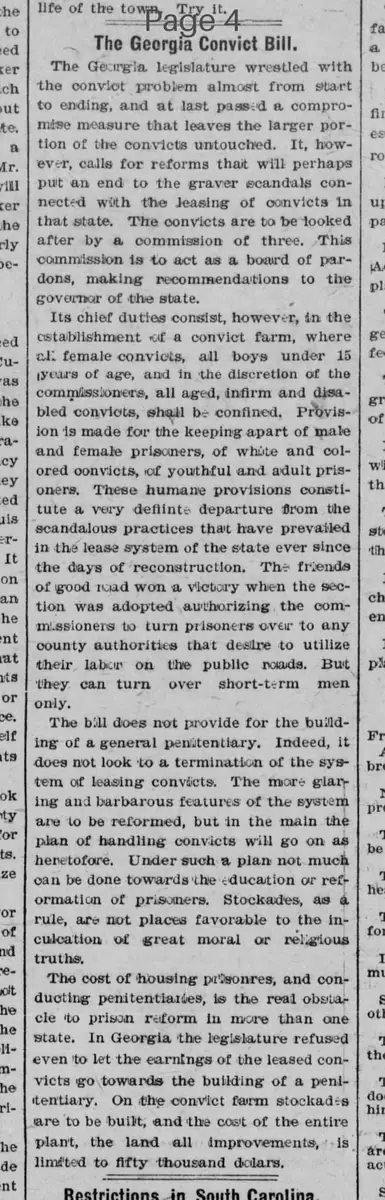
The Georgia Convict Bill.
The Georgia legislature wrestled with the convict problem almost from start to ending, and at last passed a compromise measure that leaves the larger portion of the convicts untouched. It, however, calls for reforms that will perhaps put an end to the graver scandals connected with the leasing of convicts in that state. The convicts are to be looked after by a commission of three. This commission is to act as a board of pardons, making recommendations to the governor of the state.
Its chief duties consist, however, in the establishment of a convict farm, where all female convicts, all boys under 15 years of age, and in the discretion of the commissioners, all aged, infirm and disabled convicts, shall be confined. Provision is made for the keeping apart of male and female prisoners, of white and colored convicts, of youthful and adult prisoners. These humane provisions constitute a very definite departure from the scandalous practices that have prevailed in the lease system of the state ever since the days of reconstruction. The friends of good roads won a victory when the section was adopted authorizing the commissioners to turn prisoners over to any county authorities that desire to utilize their labor on the public roads. But they can turn over short-term men only.
The bill does not provide for the building of a general penitentiary. Indeed, it does not look to a termination of the system of leasing convicts. The more glaring and barbarous features of the system are to be reformed, but in the main the plan of handling convicts will go on as heretofore. Under such a plan not much can be done towards the education or reformation of prisoners. Stockades, as a rule, are not places favorable to the inculcation of great moral or religious truths.
The cost of housing prisoners, and conducting penitentiaries, is the real obstacle to prison reform in more than one state. In Georgia the legislature refused even to let the earnings of the leased convicts go towards the building of a penitentiary. On the convict farm stockades are to be built, and the cost of the entire plant, the land all improvements, is limited to fifty thousand dollars.
The Georgia legislature wrestled with the convict problem almost from start to ending, and at last passed a compromise measure that leaves the larger portion of the convicts untouched. It, however, calls for reforms that will perhaps put an end to the graver scandals connected with the leasing of convicts in that state. The convicts are to be looked after by a commission of three. This commission is to act as a board of pardons, making recommendations to the governor of the state.
Its chief duties consist, however, in the establishment of a convict farm, where all female convicts, all boys under 15 years of age, and in the discretion of the commissioners, all aged, infirm and disabled convicts, shall be confined. Provision is made for the keeping apart of male and female prisoners, of white and colored convicts, of youthful and adult prisoners. These humane provisions constitute a very definite departure from the scandalous practices that have prevailed in the lease system of the state ever since the days of reconstruction. The friends of good roads won a victory when the section was adopted authorizing the commissioners to turn prisoners over to any county authorities that desire to utilize their labor on the public roads. But they can turn over short-term men only.
The bill does not provide for the building of a general penitentiary. Indeed, it does not look to a termination of the system of leasing convicts. The more glaring and barbarous features of the system are to be reformed, but in the main the plan of handling convicts will go on as heretofore. Under such a plan not much can be done towards the education or reformation of prisoners. Stockades, as a rule, are not places favorable to the inculcation of great moral or religious truths.
The cost of housing prisoners, and conducting penitentiaries, is the real obstacle to prison reform in more than one state. In Georgia the legislature refused even to let the earnings of the leased convicts go towards the building of a penitentiary. On the convict farm stockades are to be built, and the cost of the entire plant, the land all improvements, is limited to fifty thousand dollars.
What sub-type of article is it?
Historical Event
What themes does it cover?
Justice
Crime Punishment
What keywords are associated?
Convict Bill
Georgia Legislature
Prison Reform
Convict Leasing
Convict Farm
What entities or persons were involved?
Georgia Legislature
Commission Of Three
Governor
Where did it happen?
Georgia
Story Details
Key Persons
Georgia Legislature
Commission Of Three
Governor
Location
Georgia
Story Details
Georgia legislature passes compromise convict bill creating a three-member commission to oversee pardons and establish a convict farm for female, young, and infirm prisoners with separations by gender, race, and age; allows short-term convicts for road work; maintains leasing system with reforms but no general penitentiary.