Thank you for visiting SNEWPapers!
Sign up free
Editorial
August 22, 1921
The Brattleboro Daily Reformer
Brattleboro, Windham County, Vermont
What is this article about?
Editorial critiques state ownership of industries as economic folly, citing Italian senator Tomasso Tittoni's speech at Williams College, referencing Italian and Russian experiences, noting public expectations lead to inefficiency, and highlighting voter incompetence in management.
Clipping
OCR Quality
95%
Excellent
Full Text
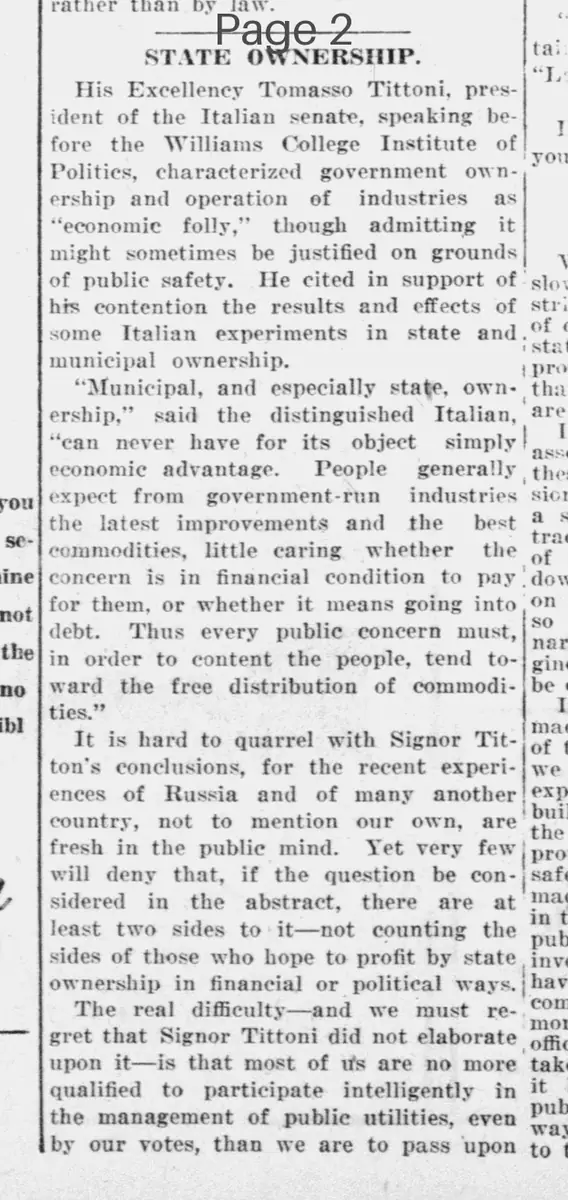
STATE OWNERSHIP.
His Excellency Tomasso Tittoni, president of the Italian senate, speaking before the Williams College Institute of Politics, characterized government ownership and operation of industries as "economic folly," though admitting it might sometimes be justified on grounds of public safety. He cited in support of his contention the results and effects of some Italian experiments in state and municipal ownership.
"Municipal, and especially state, ownership," said the distinguished Italian, "can never have for its object simply economic advantage. People generally expect from government-run industries the latest improvements and the best commodities, little caring whether the concern is in financial condition to pay for them, or whether it means going into debt. Thus every public concern must, in order to content the people, tend toward the free distribution of commodities."
It is hard to quarrel with Signor Tittoni's conclusions, for the recent experiences of Russia and of many another country, not to mention our own, are fresh in the public mind. Yet very few will deny that, if the question be considered in the abstract, there are at least two sides to it—not counting the sides of those who hope to profit by state ownership in financial or political ways.
The real difficulty—and we must regret that Signor Tittoni did not elaborate upon it—is that most of us are no more qualified to participate intelligently in the management of public utilities, even by our votes, than we are to pass upon
His Excellency Tomasso Tittoni, president of the Italian senate, speaking before the Williams College Institute of Politics, characterized government ownership and operation of industries as "economic folly," though admitting it might sometimes be justified on grounds of public safety. He cited in support of his contention the results and effects of some Italian experiments in state and municipal ownership.
"Municipal, and especially state, ownership," said the distinguished Italian, "can never have for its object simply economic advantage. People generally expect from government-run industries the latest improvements and the best commodities, little caring whether the concern is in financial condition to pay for them, or whether it means going into debt. Thus every public concern must, in order to content the people, tend toward the free distribution of commodities."
It is hard to quarrel with Signor Tittoni's conclusions, for the recent experiences of Russia and of many another country, not to mention our own, are fresh in the public mind. Yet very few will deny that, if the question be considered in the abstract, there are at least two sides to it—not counting the sides of those who hope to profit by state ownership in financial or political ways.
The real difficulty—and we must regret that Signor Tittoni did not elaborate upon it—is that most of us are no more qualified to participate intelligently in the management of public utilities, even by our votes, than we are to pass upon
What sub-type of article is it?
Economic Policy
What keywords are associated?
State Ownership
Government Industries
Economic Folly
Public Utilities
Municipal Ownership
What entities or persons were involved?
Tomasso Tittoni
Italian Senate
Williams College Institute Of Politics
Russia
Editorial Details
Primary Topic
Critique Of State Ownership Of Industries
Stance / Tone
Critical Of Government Run Industries
Key Figures
Tomasso Tittoni
Italian Senate
Williams College Institute Of Politics
Russia
Key Arguments
Government Ownership Is Economic Folly, Though Sometimes Justified For Public Safety
Italian Experiments Show Negative Results
Public Expects Best Commodities Without Regard To Financial Condition, Leading To Debt And Free Distribution
Recent Experiences In Russia And Other Countries Support This View
Abstractly, There Are Two Sides To The Issue, Excluding Profiteers
Public Unqualified To Manage Utilities Via Votes