Thank you for visiting SNEWPapers!
Sign up free
Virginia Argus
Richmond, Virginia
What is this article about?
An opinion piece from the Aurora reflecting on the War of 1812's outcomes, arguing it restored U.S. honor, proved the strength of republican government against British subversion and internal disloyalty in states like Massachusetts, and highlighted military victories on land and sea despite initial unpreparedness.
Clipping
OCR Quality
Full Text
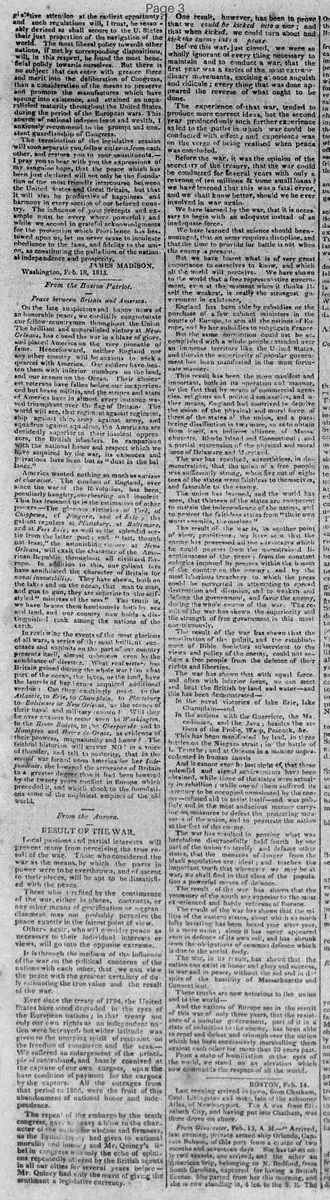
RESULT OF THE WAR.
Local passions and partial interests will prevent many from perceiving the true result of the war. Those who considered the war as the means, by which the party in power were to be overthrown, and of ascent to their places, will be apt to be dissatisfied with the peace. Those who profited by the continuance of the war, either in places, contracts, or any other means of gratification or aggrandizement may not probably perceive the peace exactly in the fairest point of view. Others again, who will consider peace as necessary to their individual interests or views, will go into the opposite extreme. It is through the medium of the influence of the war on the political concerns of the nations with each other, that we can view the peace with the greatest certainty of duly estimating the true value and the result of the war.
Ever since the treaty of 1794, the United States have stood degraded in the eyes of the European nations; in that treaty not only our own rights as an independent nation were betrayed, but wider latitude was given to the usurping spirit of restraint on the freedom of commerce and the seas. We suffered an enlargement of the principle of contraband, and basely connived at the capture of our own cargoes, upon the base condition of payment for the cargoes by the captors. All the outrages from that period to 1806, were the fruit of this abandonment of national honor and independence.
The repeal of the embargo by the tenth congress, gave as heavy a blow to the character of the nation, for wisdom and firmness, as the British treaty had given to national morality and honor: and Mr. Quincy's libel in congress was only the echo of opinions repeatedly uttered by the British agents in all our cities for several years before. Mr. Quincy had only the merit of giving the sentiment a legislative currency.
One result, however, has been to prove that we could be kicked into a war; and that when kicked, we could turn about and kick the enemy into a peace. Before this war, just closed, we were so wholly ignorant of every thing necessary to maintain and to conduct a war, that the first year was a series of the most extraordinary movements, exciting at once anguish and ridicule; every thing that was done appeared the reverse of what ought to be done.
The experience of that war, tended to produce more correct ideas, but the second year produced only such further experience as led to the paths in which war could be conducted with effect: and experience was on the verge of being realised when peace was concluded.
Before the war, it was the opinion of the secretary of the treasury, that the war could be conducted for several years with only a revenue of ten millions & some small loans? we have learned that this was a fatal error, and we shall know better, should we be ever involved in war again.
We have learned by the war, that it is necessary to begin with an adequate instead of an inadequate force. We have learned that science should be encouraged, that an army requires discipline, and that the time to provide for battle is not when the enemy is present.
But we have learnt what is of very great importance to ourselves to know, and which all the world will perceive. We have shown to the world that a free representative government, even at the moment when it thinks itself the weakest, is really the strongest government in existence.
England has been able by subsidies or the purchase of a few cabinet ministers in the courts of Europe, to arm all the nations of Europe, and by her subsidies to subjugate France. But the same corruption could not be accomplished with a whole people extended over an immense territory like the United States, and therein the superiority of popular government has been manifested in the most fortunate manner.
This result has been the more manifest and important, both in its operation and manner, by the fact that by means of commercial agencies, religious and political emissaries, and other means, England had contrived to deprive the union of the physical and moral force of three of the states of the union, and a paralyzing disaffection in two more, so as to obtain from itself, an indirect alliance of Massachusetts, Rhode Island and Connecticut: and a partial suspension of the physical and moral force of Delaware and Maryland.
The war has resulted, nevertheless, in demonstrating, that the union of a free people was sufficiently strong, when five out of eighteen of the states were faithless to themselves, and favorable to the enemy. The union has learned, and the world has seen, that thirteen of the states are competent to sustain the independence of the nation, and to protect the faithless states from "their own worst enemies, themselves".
The result of the war is, in another point of view, prominent: we have seen that the enemy has possessed all the advantages which he could possess from the unrestrained licentiousness of the press; from the constant eulogies imposed by presses within the bosom of the country on the enemy; and by the most laborious treachery to which the press could be perverted in attempting to spread destruction and division, and to weaken and defame the government, and favor the enemy, during the whole course of the war. The result of the war has shewn the superiority and the strength of free government in this most conspicuously.
The result of the war has shewn that the prostitution of the pulpit, and the establishment of Bible Societies subservient to the views and policy of the enemy, could not seduce a free people from the defence of their rights and liberties.
The war has shewn that with equal force, and often with inferior force, we can meet and beat the British by land and water-and this has been demonstrated.
In the naval victories of lake Erie, lake Champlain-and in the actions with the Guerriere, the Macedonian, and the Java: besides the actions of the Frolic, Wasp, Peacock, &c. This has been manifested by land, in three battles on the Niagara strait; in the battle of L. Tranche; and at Orleans in a manner unprecedented in human annals.
And it cannot ever be lost sight of, that these splendid and signal achievements have been obtained, while three of the states were actually in rebellion; while one of them suffered its territory to be occupied unmolested by the enemy-refused aid to assist itself-and was publicly and in the most audacious manner carrying on measures to defeat the protecting measures of the union, and to prostrate the nation at the feet of the enemy.
The war has resulted in proving what was heretofore disgracefully held forth by one part of the union to terrify and defame other states, that the menaces of danger from the black population are ideal; and teaches the important truth that whenever we may be at war, we shall find in that class of the population a powerful means of defence.
The result of the war has shown that the yeomanry of the south are superior to the most experienced and hardy veterans of Europe. The result of the war has shown that the militia of the eastern states, about which so much lofty boasting has been heard year after year, is a mere name: since it has never appeared even in defence of its own soil, and has shrunk from the obligations of common defence which is due to the social body.
The war, in its result, has shewn that the nation can exist in honor and glory and success, in war and in peace, without the aid and in despite of the hostility of Massachusetts and Connecticut.
These truths are now notorious to the union and to the world. And the nations of Europe see in the result of this war of only three years, that the resistance of a popular government, part of it in a state of seduction to the enemy, has been able to repel and defeat and triumph over the nation which has been successively marshalling them against each other for more than 20 years past.
From a state of humiliation in the eyes of the world, we stand on an elevation which now commands the respect of all the world.
What sub-type of article is it?
What themes does it cover?
What keywords are associated?
What entities or persons were involved?
Where did it happen?
Story Details
Key Persons
Location
United States
Event Date
War Of 1812
Story Details
The War of 1812 demonstrated the resilience of American republican government, achieving military victories and national elevation despite internal disloyalty in northeastern states, British subversion, and initial unpreparedness, restoring U.S. honor after prior humiliations like the 1794 treaty and embargo repeal.