Thank you for visiting SNEWPapers!
Sign up free
Washington Telegraph
Washington, Hempstead County, Arkansas
What is this article about?
From Little Rock, Dec. 17, 1850, a letter supports Union amid debates on slavery and legislation, criticizes local papers, and argues against disunion's catastrophic war consequences for the South, emphasizing preservation of slavery within the Union. (214 characters)
Clipping
OCR Quality
Full Text
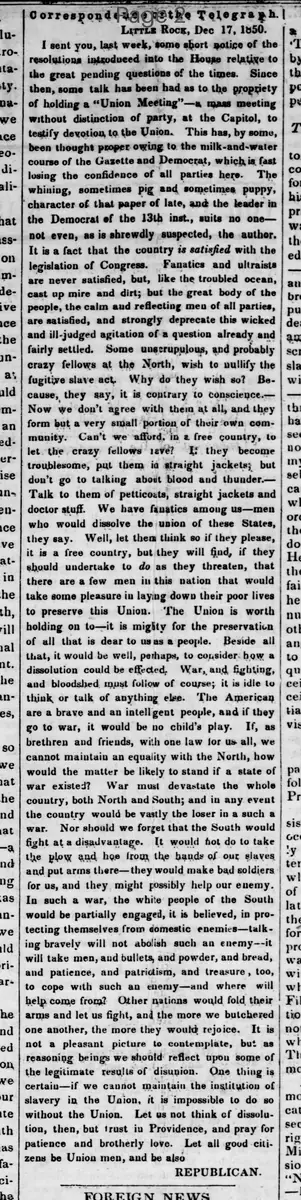
I sent you, last week, some short notice of the resolutions introduced into the House relative to the great pending questions of the times. Since then, some talk has been had as to the propriety of holding a "Union Meeting"—a mass meeting without distinction of party, at the Capitol, to testify devotion, to the Union. This has, by some, been thought proper owing to the milk-and-water course of the Gazette and Democrat, which is fast losing the confidence of all parties here. The whining, sometimes pig and sometimes puppy, character of that paper of late, and the leader in the Democrat of the 13th inst., suits no one—not even, as is shrewdly suspected, the author.
It is a fact that the country is satisfied with the legislation of Congress. Fanatics and ultraists are never satisfied, but, like the troubled ocean, cast up mire and dirt; but the great body of the people, the calm and reflecting men of all parties, are satisfied, and strongly deprecate this wicked and ill-judged agitation of a question already and fairly settled. Some unscrupulous, and probably crazy fellows at the North, wish to nullify the fugitive slave act. Why do they wish so? Because, they say, it is contrary to conscience.— Now we don't agree with them at all, and they form but a very small portion of their own community. Can't we afford, in a free country, to let the crazy fellows rave? If they become troublesome, put them in straight jackets; but don't go to talking about blood and thunder.— Talk to them of petticoats, straight jackets and doctor stuff. We have fanatics among us—men who would dissolve the union of these States, they say. Well, let them think so if they please, it is a free country, but they will find, if they should undertake to do as they threaten, that there are a few men in this nation that would take some pleasure in laying down their poor lives to preserve this Union. The Union is worth holding on to—it is mighty for the preservation of all that is dear to us as a people. Beside all that, it would be well, perhaps, to consider, how a dissolution could be effected. War, and fighting, and bloodshed, must follow of course; it is idle to think or talk of anything else. The American are a brave and an intelligent people, and if they go to war, it would be no child's play. If, as brethren and friends, with one law for us all, we cannot maintain an equality with the North, how would the matter be likely to stand if a state of war existed?
War must devastate the whole country, both North and South; and in any event the country would be vastly the loser in such a war. Nor should we forget that the South would fight at a disadvantage. It would not do to take the plow and hoe from the hands of our slaves and put arms there—they would make bad soldiers for us, and they might possibly help our enemy.
In such a war, the white people of the South would be partially engaged, it is believed, in protecting themselves from domestic enemies—talking bravely will not abolish such an enemy—it will take men, and bullets, and powder, and bread, and patience, and patriotism, and treasure, too, to cope with such an enemy—and where will help come from? Other nations would fold their arms and let us fight, and the more we butchered one another, the more they would rejoice. It is not a pleasant picture to contemplate, but as reasoning beings we should reflect upon some of the legitimate results of disunion. One thing is certain—if we cannot maintain the institution of slavery in the Union, it is impossible to do so without the Union. Let us not think of dissolution, then, but trust in Providence, and pray for patience and brotherly love. Let all good citizens be Union men, and be also
REPUBLICAN.
What sub-type of article is it?
What themes does it cover?
What keywords are associated?
What entities or persons were involved?
Letter to Editor Details
Author
Republican
Recipient
The Editor
Main Argument
the author expresses satisfaction with congress's legislation on key issues like the fugitive slave act and urges devotion to the union, criticizing local newspapers for weak stances. he warns that disunion would lead to devastating war, disadvantage for the south due to slavery, and impossibility of maintaining the institution outside the union, advocating patience and brotherly love instead.
Notable Details