Thank you for visiting SNEWPapers!
Sign up free
Letter to Editor
September 30, 1817
Daily National Intelligencer
Washington, District Of Columbia
What is this article about?
A letter rebutting 'Americanus''s nativist arguments against foreigners in public offices, asserting they can take the required oath under the 1789 act and do not harm native interests. Defends liberal hospitality and critiques narrow-mindedness.
Clipping
OCR Quality
98%
Excellent
Full Text
Messrs. Gales & Seaton
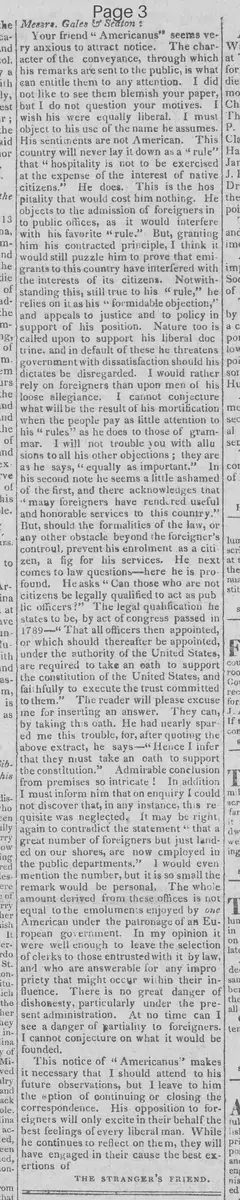
Your friend "Americanus" seems very anxious to attract notice. The character of the conveyance, through which his remarks are sent to the public, is what can entitle them to any attention. I did not like to see them blemish your paper, but I do not question your motives. I wish his were equally liberal. I must object to his use of the name he assumes. His sentiments are not American. This country will never lay it down as a "rule" that "hospitality is not to be exercised at the expense of the interest of native citizens." He does. This is the hospitality that would cost him nothing. He objects to the admission of foreigners into public offices, as it would interfere with his favorite "rule." But, granting him his contracted principle, I think it would still puzzle him to prove that emigrants to this country have interfered with the interests of its citizens. Notwithstanding this, still true to his "rule," he relies on it as his "formidable objection," and appeals to justice and to policy in support of his position. Nature too is called upon to support his liberal doctrine, and in default of these he threatens government with dissatisfaction should his dictates be disregarded. I would rather rely on foreigners than upon men of his loose allegiance. I cannot conjecture what will be the result of his mortification when the people pay as little attention to his "rules" as he does to those of grammar. I will not trouble you with allusions to all his other objections; they are, as he says, "equally as important." In his second note he seems a little ashamed of the first, and there acknowledges that "many foreigners have rendered useful and honorable services to this country." But, should the formalities of the law, or any other obstacle beyond the foreigner's controul, prevent his enrolment as a citizen, a fig for his services. He next comes to law questions—here he is profound. He asks "Can those who are not citizens be legally qualified to act as public officers?" The legal qualification he states to be, by act of congress passed in 1789—"That all officers then appointed, or which should thereafter be appointed, under the authority of the United States, are required to take an oath to support the constitution of the United States, and faithfully to execute the trust committed to them." The reader will please excuse me for inserting an answer. They can, by taking this oath. He had nearly spared me this trouble, for, after quoting the above extract, he says—"Hence I infer that they must take an oath to support the constitution." Admirable conclusion from premises so intricate! In addition I must inform him that on enquiry I could not discover that, in any instance, this requisite was neglected. It may be right again to contradict the statement "that a great number of foreigners but just landed on our shores, are now employed in the public departments." I would even mention the number, but it is so small the remark would be personal. The whole amount derived from these offices is not equal to the emoluments enjoyed by one American under the patronage of an European government. In my opinion it were well enough to leave the selection of clerks to those entrusted with it by law, and who are answerable for any impropriety that might occur within their influence. There is no great danger of dishonesty, particularly under the present administration. At no time can I see a danger of partiality to foreigners. I cannot conjecture on what it would be founded.
This notice of "Americanus" makes it necessary that I should attend to his future observations, but I leave to him the option of continuing or closing the correspondence. His opposition to foreigners will only excite in their behalf the best feelings of every liberal man. While he continues to reflect on them, they will have engaged in their cause the best exertions of
THE STRANGER'S FRIEND.
Your friend "Americanus" seems very anxious to attract notice. The character of the conveyance, through which his remarks are sent to the public, is what can entitle them to any attention. I did not like to see them blemish your paper, but I do not question your motives. I wish his were equally liberal. I must object to his use of the name he assumes. His sentiments are not American. This country will never lay it down as a "rule" that "hospitality is not to be exercised at the expense of the interest of native citizens." He does. This is the hospitality that would cost him nothing. He objects to the admission of foreigners into public offices, as it would interfere with his favorite "rule." But, granting him his contracted principle, I think it would still puzzle him to prove that emigrants to this country have interfered with the interests of its citizens. Notwithstanding this, still true to his "rule," he relies on it as his "formidable objection," and appeals to justice and to policy in support of his position. Nature too is called upon to support his liberal doctrine, and in default of these he threatens government with dissatisfaction should his dictates be disregarded. I would rather rely on foreigners than upon men of his loose allegiance. I cannot conjecture what will be the result of his mortification when the people pay as little attention to his "rules" as he does to those of grammar. I will not trouble you with allusions to all his other objections; they are, as he says, "equally as important." In his second note he seems a little ashamed of the first, and there acknowledges that "many foreigners have rendered useful and honorable services to this country." But, should the formalities of the law, or any other obstacle beyond the foreigner's controul, prevent his enrolment as a citizen, a fig for his services. He next comes to law questions—here he is profound. He asks "Can those who are not citizens be legally qualified to act as public officers?" The legal qualification he states to be, by act of congress passed in 1789—"That all officers then appointed, or which should thereafter be appointed, under the authority of the United States, are required to take an oath to support the constitution of the United States, and faithfully to execute the trust committed to them." The reader will please excuse me for inserting an answer. They can, by taking this oath. He had nearly spared me this trouble, for, after quoting the above extract, he says—"Hence I infer that they must take an oath to support the constitution." Admirable conclusion from premises so intricate! In addition I must inform him that on enquiry I could not discover that, in any instance, this requisite was neglected. It may be right again to contradict the statement "that a great number of foreigners but just landed on our shores, are now employed in the public departments." I would even mention the number, but it is so small the remark would be personal. The whole amount derived from these offices is not equal to the emoluments enjoyed by one American under the patronage of an European government. In my opinion it were well enough to leave the selection of clerks to those entrusted with it by law, and who are answerable for any impropriety that might occur within their influence. There is no great danger of dishonesty, particularly under the present administration. At no time can I see a danger of partiality to foreigners. I cannot conjecture on what it would be founded.
This notice of "Americanus" makes it necessary that I should attend to his future observations, but I leave to him the option of continuing or closing the correspondence. His opposition to foreigners will only excite in their behalf the best feelings of every liberal man. While he continues to reflect on them, they will have engaged in their cause the best exertions of
THE STRANGER'S FRIEND.
What sub-type of article is it?
Persuasive
Political
Social Critique
What themes does it cover?
Politics
Constitutional Rights
Social Issues
What keywords are associated?
Americanus
Foreigners
Public Offices
Oath Of Office
Nativism
Immigration
Hospitality
1789 Act
What entities or persons were involved?
The Stranger's Friend
Messrs. Gales & Seaton
Letter to Editor Details
Author
The Stranger's Friend
Recipient
Messrs. Gales & Seaton
Main Argument
opposes 'americanus''s nativist 'rule' restricting hospitality and public offices to natives, arguing foreigners can qualify by oath under the 1789 act, have not harmed citizens' interests, and deserve liberal treatment.
Notable Details
References Act Of Congress 1789 Requiring Oath To Constitution
Critiques 'Americanus''S Grammar And Logic
Mentions Useful Services By Foreigners
Defends Current Administration's Impartiality