Thank you for visiting SNEWPapers!
Sign up free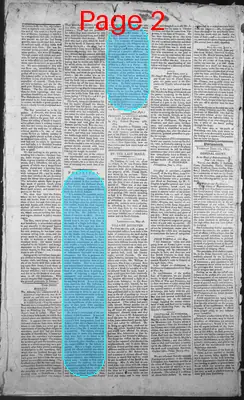
Editorial
June 18, 1805
The New Hampshire Gazette
Portsmouth, Rockingham County, New Hampshire
What is this article about?
This editorial reprints and endorses a report from the Richmond Enquirer speculating that President Jefferson will not seek re-election after his current term, citing his support for rotation in office to prevent power monopolies. It defends Jefferson against Federalist attacks and affirms his honorable retirement.
Clipping
OCR Quality
92%
Excellent
Full Text
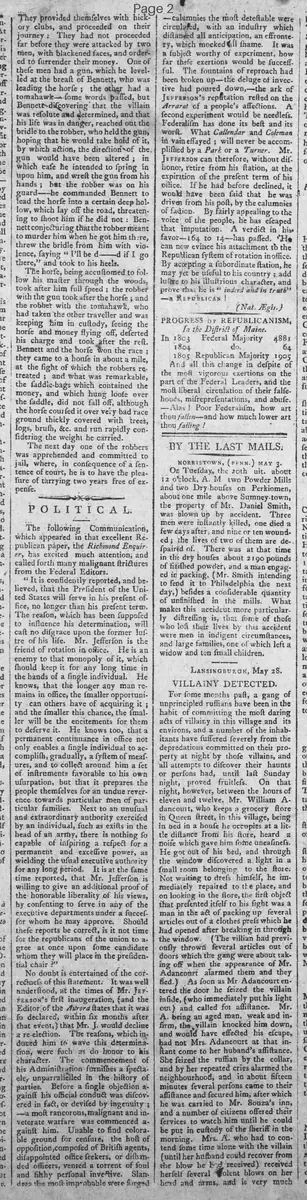
POLITICAL:
The following Communication, which appeared in that excellent Republican paper, the Richmond Enquirer, has excited much attention; and called forth many malignant strictures from the Federal Editors.
"It is confidently reported, and believed, that the President of the United States will serve in his present office, no longer than his present term. The reason, which has been supposed to influence his determination, will cast no disgrace upon the former lustre of his life. Mr. Jefferson is the friend of rotation in office. He is an enemy to that monopoly of it, which should keep it for any long time in the hands of a single individual. He knows, that the longer any man remains in office, the smaller opportunity can others have of acquiring it; and the smaller this chance, the smaller will be the incitements for them to deserve it. He knows too, that a permanent continuance in office not only enables a single individual to accomplish, gradually, a system of measures, and to collect around him a set of instruments favorable to his own usurpation, but that it prepares the people themselves for an undue reverence towards particular men of particular families. Next to an unusual and extraordinary authority exercised by an individual, such as exists in the head of an army, there is nothing so capable of inspiring a respect for a permanent and excessive power, as wielding the usual executive authority for any long period. It is at the same time reported, that Mr. Jefferson is willing to give an additional proof of the honorable liberality of his views, by consenting to serve in any of the executive departments under a successor whom he may approve. Should these reports be correct, is it not time for the republicans of the union to agree at once upon some candidate whom they will place in the presidential chair?"
No doubt is entertained of the correctness of this statement. It was well understood, at the time of Mr. Ferson's first inauguration, (and the Editor of the Aurora states that it was so declared, within six months after that event,) that Mr. J. would decline a re-election. The reasons, which induced him to waive this determination, were such as do honor to his character. The commencement of his Administration furnishes a spectacle, unparallelled in the history of parties. Before a single objection against his official conduct was discovered in fact, or devised by ingenuity; --a most rancorous, malignant and inveterate warfare was commenced against him. Unable to find colorable ground for censure, the host of opposition, composed of British agents, disappointed office seekers, or disbanded officers, vented a torrent of foul and filthy personal invective. Slanders the most improbable were forged calumnies the most detestable were circulated, with an industry which disdained all anticipation, an effrontery, which mocked all shame. It was a subject worthy of experiment, how far these exertions would be successful. The fountains of reproach had been broken up--the deluge of invective had poured down,--the ark of Jefferson's reputation rested on the Ararat of a people's affections. A second experiment would be needless. Federalism has done its best and its worst. What Callendar and Coleman in vain sought: will never be accomplished by a Park or a Turner. Mr. Jefferson can therefore, without dishonor, retire from his station, at the expiration of the present term of his office. If he had before declined, it would have been said that he was driven from his post, by the calumnies of faction. By fairly appealing to the voice of the people, he has escaped that imputation. A verdict in his favor--164 to 14--has passed. He can now evince his attachment to the Republican system of rotation in office: By accepting a subordinate station, he may yet be useful to his country: add lustre to his illustrious character, and prove that he is "indeed and in truth" --a REPUBLICAN!
(Nat. Egis.)
The following Communication, which appeared in that excellent Republican paper, the Richmond Enquirer, has excited much attention; and called forth many malignant strictures from the Federal Editors.
"It is confidently reported, and believed, that the President of the United States will serve in his present office, no longer than his present term. The reason, which has been supposed to influence his determination, will cast no disgrace upon the former lustre of his life. Mr. Jefferson is the friend of rotation in office. He is an enemy to that monopoly of it, which should keep it for any long time in the hands of a single individual. He knows, that the longer any man remains in office, the smaller opportunity can others have of acquiring it; and the smaller this chance, the smaller will be the incitements for them to deserve it. He knows too, that a permanent continuance in office not only enables a single individual to accomplish, gradually, a system of measures, and to collect around him a set of instruments favorable to his own usurpation, but that it prepares the people themselves for an undue reverence towards particular men of particular families. Next to an unusual and extraordinary authority exercised by an individual, such as exists in the head of an army, there is nothing so capable of inspiring a respect for a permanent and excessive power, as wielding the usual executive authority for any long period. It is at the same time reported, that Mr. Jefferson is willing to give an additional proof of the honorable liberality of his views, by consenting to serve in any of the executive departments under a successor whom he may approve. Should these reports be correct, is it not time for the republicans of the union to agree at once upon some candidate whom they will place in the presidential chair?"
No doubt is entertained of the correctness of this statement. It was well understood, at the time of Mr. Ferson's first inauguration, (and the Editor of the Aurora states that it was so declared, within six months after that event,) that Mr. J. would decline a re-election. The reasons, which induced him to waive this determination, were such as do honor to his character. The commencement of his Administration furnishes a spectacle, unparallelled in the history of parties. Before a single objection against his official conduct was discovered in fact, or devised by ingenuity; --a most rancorous, malignant and inveterate warfare was commenced against him. Unable to find colorable ground for censure, the host of opposition, composed of British agents, disappointed office seekers, or disbanded officers, vented a torrent of foul and filthy personal invective. Slanders the most improbable were forged calumnies the most detestable were circulated, with an industry which disdained all anticipation, an effrontery, which mocked all shame. It was a subject worthy of experiment, how far these exertions would be successful. The fountains of reproach had been broken up--the deluge of invective had poured down,--the ark of Jefferson's reputation rested on the Ararat of a people's affections. A second experiment would be needless. Federalism has done its best and its worst. What Callendar and Coleman in vain sought: will never be accomplished by a Park or a Turner. Mr. Jefferson can therefore, without dishonor, retire from his station, at the expiration of the present term of his office. If he had before declined, it would have been said that he was driven from his post, by the calumnies of faction. By fairly appealing to the voice of the people, he has escaped that imputation. A verdict in his favor--164 to 14--has passed. He can now evince his attachment to the Republican system of rotation in office: By accepting a subordinate station, he may yet be useful to his country: add lustre to his illustrious character, and prove that he is "indeed and in truth" --a REPUBLICAN!
(Nat. Egis.)
What sub-type of article is it?
Partisan Politics
What keywords are associated?
Jefferson Retirement
Rotation In Office
Republican Principles
Federalist Attacks
Presidential Succession
Political Opposition
What entities or persons were involved?
Mr. Jefferson
Richmond Enquirer
Federal Editors
Mr. Ferson
Aurora
Callendar
Coleman
Park
Turner
Republicans
Federalism
British Agents
Editorial Details
Primary Topic
Jefferson's Rumored Decision Not To Seek Re Election
Stance / Tone
Strongly Supportive Of Jefferson And Rotation In Office
Key Figures
Mr. Jefferson
Richmond Enquirer
Federal Editors
Mr. Ferson
Aurora
Callendar
Coleman
Park
Turner
Republicans
Federalism
British Agents
Key Arguments
Jefferson Supports Rotation In Office To Avoid Monopoly And Usurpation By Individuals
Long Tenure In Office Fosters Undue Reverence For Particular Men And Families
Jefferson Initially Planned To Serve Only One Term But Continued Due To Honorable Reasons Amid Opposition
Federalist Attacks With Slanders And Calumnies Failed Against Jefferson's Popularity
Jefferson's Re Election By 164 To 14 Votes Vindicates Him, Allowing Honorable Retirement
Jefferson May Serve In A Subordinate Executive Role Under An Approved Successor