Thank you for visiting SNEWPapers!
Sign up free
Jenks' Portland Gazette
Portland, Cumberland County, Maine
What is this article about?
This editorial critiques Thomas Jefferson's administration, highlighting the Republican majority in Congress's tactics of silence during debates and denial of information on key issues like the judiciary system repeal, internal revenue collection expenses, and the Louisiana cession from Spain to France.
Merged-components note: These three components form a single continuous editorial piece titled 'POLITICS. HUME.-No. X Review of Mr. Jefferson's Administration,' with sequential reading order and unbroken narrative.
Clipping
OCR Quality
Full Text
HUME.-No. X
Review of Mr. Jefferson's Administration.
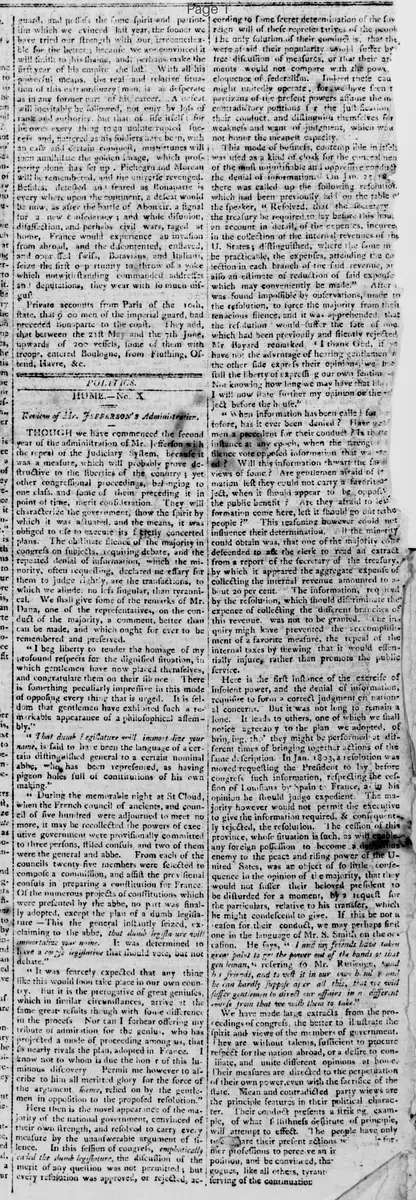
THOUGH we have commenced the second year of the administration of Mr. Jefferson with the repeal of the judiciary System, because it was a measure, which will probably prove destructive to the liberties of the country; yet other congressional proceedings, belonging to one class, and some of them preceding it in point of time, merit consideration. They will characterize the government, show the spirit by which it was actuated, and the means, it was obliged to resort to execute its utterly concerted plans. The obstinate silence of the majority in congress on subjects, requiring debate, and the repeated denial of information, which the minority, often requesting, declared necessary for them to judge rightly, are the transactions, to which we allude: no less singular, than tyrannical. We shall give some of the remarks of Mr. Dana, one of the representatives, on the conduct of the majority, a comment, better than can be made, and which ought for ever to be remembered and preserved.
" I beg liberty to tender the homage of my profound respects for the dignified situation, in which gentlemen have now placed themselves, and congratulate them on their silence There is something peculiarly impressive in this mode of opposing every thing that is urged. It is seldom that gentlemen have exhibited such a remarkable appearance of a philosophical assembly."
"That dumb legislature will immortalize your name, is said to have been the language of a certain distinguished general to a certain nominal abbe, who has been represented, as having pigeon holes full of constitutions of his own making."
" During the memorable night at St Cloud, when the French council of ancients. and council of five hundred were adjourned to meet no more, it may be recollected the powers of executive government were provisionally committed to three persons, titled consuls. and two of them were the general and abbe. From each of the councils twenty-five members were elected to compose a commission, and assist the provisional consuls in preparing a constitution for. France. Of the numerous projects of constitutions which were presented by the abbe, no part was finally adopted, except the plan of a dumb legislature --This the general instantly seized, exclaiming to the abbe, that dumb legislature will immortalize your name. It was determined to have a corps legislative that should vote, but not debate."
" It was scarcely expected that any thing like this would soon take place in our own country. But it is the prerogative of great geniuses, which in similar circumstances, arrive at the same great results though with more difference in the process Nor can I forbear offering my tribute of admiration for the genius, who has projected a mode of proceeding among us, that so nearly rivals the plan, adopted in France. I know not to whom is due the honor of this luminous discovery Permit me however to ascribe to him all merited glory for the force of the argument. whence, relied on by the gentlemen in opposition to the proposed resolution."
Here then is the novel appearance of the majority of the national government, convinced of their own strength, and resolved to carry every measure by the unanswerable argument of silence. In this session of congress, emphatically called the dumb legislature, the discussion of the merit of any question was not permitted; but every resolution was approved, or rejected, according to some secret determination of the sovereign will of these representatives of the people i the only solution.of their conduct? is. that they were afraid their popularity would suffer by free: discussion of measures, or that their arguments ..would not-compare with the powr. eloquence of. federalism. Indeed these causes might unitedly operate. for we have seen the partizans of-the present powers assume the most contradictorv positions for the justification of their conduct, and distinguish themselves Fr weaknets and want of judgment, which would not honor the meanest capacity.
This mode of business, contemptible in itself was used as a kind of cloak for the concealment of the most unjustifiable an oppressive conduct the denial of information.d On Jan. 25th there was called up the following resolution. which had been previously laid / on the table o the speaker, " Resolved, that the secretary the treasury be required, to lay before this hou. an account in detail, of the expences, incurred in the-colection of the internal revenues of the U. States: distinguished. where the same m ay be practicable, the expences, attending the co llection in each branch of the said revenue, and also an estimate of reduction of said expence which may conveniently be made." After : was found impossible by observations, made to the resolution, to force the majority from their tenacious silence, and it was apprehended. that the resolution would-suffer-the fate of one. which had been previously and silently rejected Mr. Bayard remarked, s I thank God, if have not the advantage of hearing gentlemen the other side express their opinions:we shall take the liberty of expressing our own sentiments Not knowing how long we may have that lib.. I will now state further my opinion on'the subject before the house."
" w hen information has been called : for tofore, has it ever been denied ? Have gen- tlemen a precedent for their conduct ?Is this instance at any epoch, when the strength t silence vote opposed information that was required ? Will this information thwart the fa- views of some ? Are gentlemen afraid of information lest they could not carry a favorite object, when it should appear to be opposed to the public benefit ? Are they afraid to let: formation come here, lest it should go forth to the people ?" This reasoning however could not influence their determination. it-the minority could obtain was, that one of the majority con- descended to ask the clerk to read an extract from a report of the secretary of the treasury, by which it appeared the aggregate expence of collecting the internal revenue amounted to a- bout 2O per cent. o The information, required by the resolution, which should discriminate the expence of collecting the different branches o. this revenue. was not to be granted. 7'i he in- quiry might have prevented the accomplishment of a favorite measure, the repeal of the internal taxes by shewing that it would essen- tially injure, rather than promote the public service.
Here is the first instance of the exercise of insolent power, and the denial of information, requisite to form a correct judgment on national concerns." But it was not long to remain a lone. It leads to others, one of which we shall notice agreeably to the plan we adopted, of bringing, tho' they might be performed at dif- ferent times of bringing together actions of the same description. · In Jan. 1803, a resolution was moved requesting the- President to lay. before congress such information, respecting the ce- ssion of Louisiana by Spain to France, as in his opinion he should judge expedient. The ma- jority however would not permit the executive to give the information required, & consequently rejected, the resolution. T he cession of this province, whose situation is such, as will enable. any foreign power to become a dangerous enemy to the peace and rising power of the U. nited States, was an object of so little conse- quence in the opinion of the majority, that they would not suffer their beloved president to be disturbed for a moment, by a request for the particulars, relative to his transfer, which he might condescend to give. If this be not a reason for their conduct, we may perhaps find one in the language of Mr. S. Smithi on the oc- casion. He says, " Iand my friends have taken great pains to get the power out of the hands of that gen tleman, " referring to Mr." Rutledge, 'and b s friends, and to vest it in our own band s ; and he can hardly suppose after all this. that we will suffer gentlemen to divert our affairs in a different course from that rwe wish them to take." ut
We have made large extracts from the pro- ceedings of congress, the better to illustrate the spirit and views of the members of government. They are without talents, sufficient to procure respect for the nation abroad, or a desire to con- ciliate, and unite different opinions at home. Their measures are directed to the perpetuation of their own power,even with the sacrifice of the state. Mean and contradicted party views are the principle features in their political charac- ter. Their conduct presents a striking. exam- ple, of what lithness destitute of principle, will attempt to effect. The people have only to compare their present aCtions w* :- for. mer professions to perceive an ir- reconcilable op- position, and be convinced, that dem- agogues, like all others, tyrants in disguise, are not de- serving of the continuation
What sub-type of article is it?
What keywords are associated?
What entities or persons were involved?
Editorial Details
Primary Topic
Critique Of Congressional Silence And Denial Of Information Under Jefferson's Administration
Stance / Tone
Strongly Critical Of Republican Majority's Tyrannical Tactics
Key Figures
Key Arguments