Thank you for visiting SNEWPapers!
Sign up free
Literary
May 29, 1790
Gazette Of The United States
New York, New York County, New York
What is this article about?
This concluding essay from Discourses on Davila explores the passion of emulation and ambition as essential to human nature, arguing they must be regulated rather than eradicated for virtue, education, military success, and governance. It illustrates effects of disappointment in schools, armies, and civil offices, emphasizing their role in driving genius and public service.
Clipping
OCR Quality
98%
Excellent
Full Text
DISCOURSES ON DAVILA.
No. VII.
CONCLUDED.
The Senate's thanks, the Gazette's pompous tale,
With force restless, o'er the brave prevail;
This power has praise, that virtue scarce can warm
Till fame supplies the universal charm.
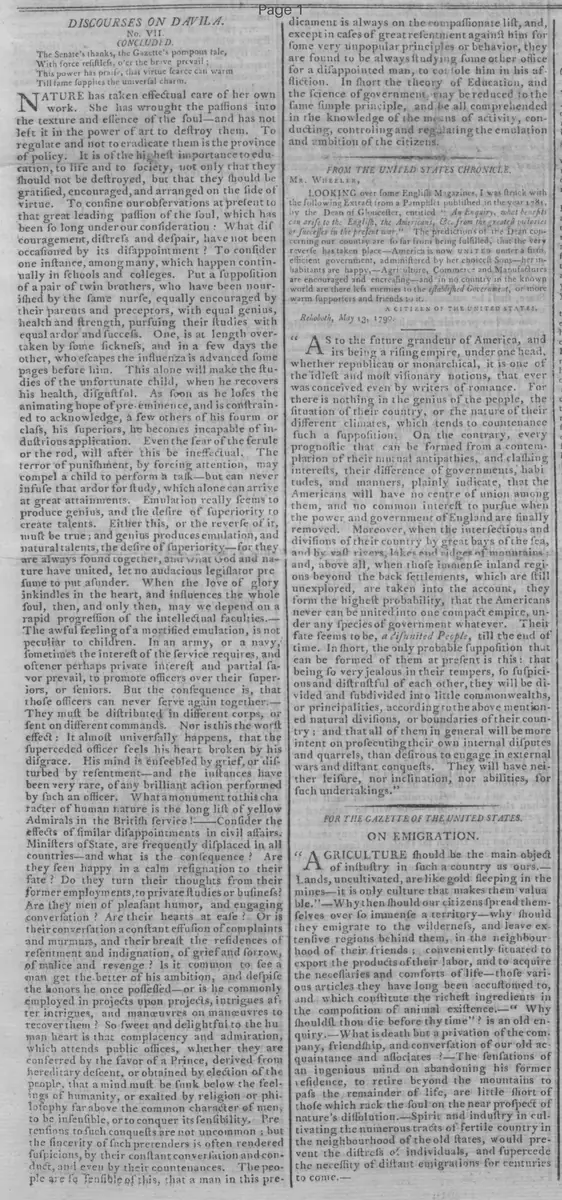
NATURE has taken effectual care of her own work. She has wrought the passions into the texture and essence of the soul—and has not left it in the power of art to destroy them. To regulate and not to eradicate them is the province of policy. It is of the highest importance to education, to life and to society, not only that they should not be destroyed, but that they should be gratified, encouraged, and arranged on the side of virtue. To confine our observations at present to that great leading passion of the soul, which has been so long under our consideration: What discouragement, distress and despair, have not been occasioned by its disappointment? To consider one instance, among many, which happen continually in schools and colleges. Suppose a supposition of a pair of twin brothers, who have been nourished by the same nurse, equally encouraged by their parents and preceptors, with equal genius, health and strength, pursuing their studies with equal ardor and success. One, is at length overtaken by some sickness, and in a few days the other, who escapes the influenza is advanced some pages before him. This alone will make the studies of the unfortunate child, when he recovers his health, disgustful. As soon as he loses the animating hope of pre-eminence, and is constrained to acknowledge, a few others of his form or class, his superiors, he becomes incapable of industrious application. Even the fear of the ferule or the rod, will after this be ineffectual. The terror of punishment, by forcing attention, may compel a child to perform a task—but can never infuse that ardor for study, which alone can arrive at great attainments. Emulation really seems to produce genius, and the desire of superiority to create talents. Either this, or the reverse of it, must be true; and genius produces emulation, and natural talents, the desire of superiority—for they are always found together, and what God and nature have united, let no audacious legislator presume to put asunder. When the love of glory kindles in the heart, and influences the whole soul, then, and only then, may we depend on a rapid progression of the intellectual faculties.—The awful feeling of a mortified emulation, is not peculiar to children. In an army, or a navy, sometimes the interest of the service requires, and oftener perhaps private interest and partial favor prevail, to promote officers over their superiors, or seniors. But the consequence is, that those officers can never serve again together.—They must be distributed in different corps, or sent on different commands. Nor is this the worst effect: It almost universally happens, that the superseded officer feels his heart broken by his disgrace. His mind is enfeebled by grief, or disturbed by resentment—and the instances have been very rare, of any brilliant action performed by such an officer. What a monument to this character of human nature is the long list of yellow Admirals in the British service! Consider the effects of similar disappointments in civil affairs. Ministers of State, are frequently displaced in all countries—and what is the consequence? Are they seen happy in a calm resignation to their fate? Do they turn their thoughts from their former employments, to private studies or business? Are they men of pleasant humor, and engaging conversation? Are their hearts at ease? Or is their conversation a constant effusion of complaints and murmurs, and their breast the residences of resentment and indignation, of grief and sorrow, of malice and revenge? Is it common to see a man get the better of his ambition, and despise the honors he once possessed—or is he commonly employed in projects upon projects, intrigues after intrigues, and manoeuvres on manoeuvres to recover them? So sweet and delightful to the human heart is that complacency and admiration, which attends public offices, whether they are conferred by the favor of a Prince, derived from hereditary descent, or obtained by election of the people. that a mind must be sunk below the feelings of humanity, or exalted by religion or philosophy far above the common character of men, to be insensible, or to conquer its sensibility. Pretensions to such conquests are not uncommon; but the sincerity of such pretenders is often rendered suspicious, by their constant conversation and conduct, and even by their countenances. The people are sensible of this, that a man in this predicament is always on the compassionate list, and,
except in cases of great resentment against him for some very unpopular principles or behavior, they are found to be always studying some other office for a disappointed man, to console him in his affliction. In short the theory of Education, and the science of government, may be reduced to the same simple principle, and be all comprehended in the knowledge of the means of activity, conducting, controlling and regulating the emulation and ambition of the citizens.
No. VII.
CONCLUDED.
The Senate's thanks, the Gazette's pompous tale,
With force restless, o'er the brave prevail;
This power has praise, that virtue scarce can warm
Till fame supplies the universal charm.
NATURE has taken effectual care of her own work. She has wrought the passions into the texture and essence of the soul—and has not left it in the power of art to destroy them. To regulate and not to eradicate them is the province of policy. It is of the highest importance to education, to life and to society, not only that they should not be destroyed, but that they should be gratified, encouraged, and arranged on the side of virtue. To confine our observations at present to that great leading passion of the soul, which has been so long under our consideration: What discouragement, distress and despair, have not been occasioned by its disappointment? To consider one instance, among many, which happen continually in schools and colleges. Suppose a supposition of a pair of twin brothers, who have been nourished by the same nurse, equally encouraged by their parents and preceptors, with equal genius, health and strength, pursuing their studies with equal ardor and success. One, is at length overtaken by some sickness, and in a few days the other, who escapes the influenza is advanced some pages before him. This alone will make the studies of the unfortunate child, when he recovers his health, disgustful. As soon as he loses the animating hope of pre-eminence, and is constrained to acknowledge, a few others of his form or class, his superiors, he becomes incapable of industrious application. Even the fear of the ferule or the rod, will after this be ineffectual. The terror of punishment, by forcing attention, may compel a child to perform a task—but can never infuse that ardor for study, which alone can arrive at great attainments. Emulation really seems to produce genius, and the desire of superiority to create talents. Either this, or the reverse of it, must be true; and genius produces emulation, and natural talents, the desire of superiority—for they are always found together, and what God and nature have united, let no audacious legislator presume to put asunder. When the love of glory kindles in the heart, and influences the whole soul, then, and only then, may we depend on a rapid progression of the intellectual faculties.—The awful feeling of a mortified emulation, is not peculiar to children. In an army, or a navy, sometimes the interest of the service requires, and oftener perhaps private interest and partial favor prevail, to promote officers over their superiors, or seniors. But the consequence is, that those officers can never serve again together.—They must be distributed in different corps, or sent on different commands. Nor is this the worst effect: It almost universally happens, that the superseded officer feels his heart broken by his disgrace. His mind is enfeebled by grief, or disturbed by resentment—and the instances have been very rare, of any brilliant action performed by such an officer. What a monument to this character of human nature is the long list of yellow Admirals in the British service! Consider the effects of similar disappointments in civil affairs. Ministers of State, are frequently displaced in all countries—and what is the consequence? Are they seen happy in a calm resignation to their fate? Do they turn their thoughts from their former employments, to private studies or business? Are they men of pleasant humor, and engaging conversation? Are their hearts at ease? Or is their conversation a constant effusion of complaints and murmurs, and their breast the residences of resentment and indignation, of grief and sorrow, of malice and revenge? Is it common to see a man get the better of his ambition, and despise the honors he once possessed—or is he commonly employed in projects upon projects, intrigues after intrigues, and manoeuvres on manoeuvres to recover them? So sweet and delightful to the human heart is that complacency and admiration, which attends public offices, whether they are conferred by the favor of a Prince, derived from hereditary descent, or obtained by election of the people. that a mind must be sunk below the feelings of humanity, or exalted by religion or philosophy far above the common character of men, to be insensible, or to conquer its sensibility. Pretensions to such conquests are not uncommon; but the sincerity of such pretenders is often rendered suspicious, by their constant conversation and conduct, and even by their countenances. The people are sensible of this, that a man in this predicament is always on the compassionate list, and,
except in cases of great resentment against him for some very unpopular principles or behavior, they are found to be always studying some other office for a disappointed man, to console him in his affliction. In short the theory of Education, and the science of government, may be reduced to the same simple principle, and be all comprehended in the knowledge of the means of activity, conducting, controlling and regulating the emulation and ambition of the citizens.
What sub-type of article is it?
Essay
What themes does it cover?
Political
Moral Virtue
What keywords are associated?
Emulation
Ambition
Human Nature
Education
Government
Military
Public Office
Passions
Literary Details
Title
Discourses On Davila. No. Vii. Concluded.
Subject
On Emulation And Ambition In Education, Military, And Civil Life
Key Lines
Emulation Really Seems To Produce Genius, And The Desire Of Superiority To Create Talents.
What God And Nature Have United, Let No Audacious Legislator Presume To Put Asunder.
What A Monument To This Character Of Human Nature Is The Long List Of Yellow Admirals In The British Service!
So Sweet And Delightful To The Human Heart Is That Complacency And Admiration, Which Attends Public Offices...
The Theory Of Education, And The Science Of Government, May Be Reduced To The Same Simple Principle... Regulating The Emulation And Ambition Of The Citizens.