Thank you for visiting SNEWPapers!
Sign up free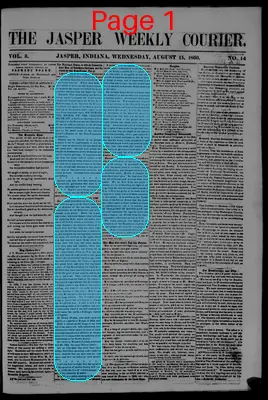
Editorial
August 15, 1860
The Jasper Weekly Courier
Jasper, Dubois County, Indiana
What is this article about?
An editorial warns conservative Union men in Southern Indiana against voting Republican, citing quotes from Republican leaders and conventions advocating repeal of the Fugitive Slave Act, immediate abolition, and even support for slave insurrections, portraying the party as radically anti-slavery.
Clipping
OCR Quality
95%
Excellent
Full Text
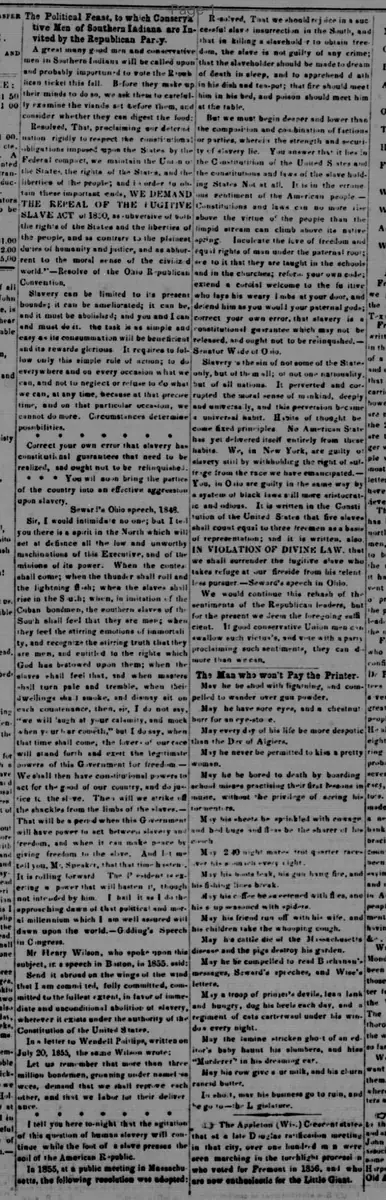
A great many good men and conservative men in Southern Indiana will be called upon and probably importuned to vote the Republican ticket this fall. Before they make up their minds to do so, we ask them to carefully examine the winds set before them, and consider whether they can digest the food:
Resolved, That, proclaiming our determination rigidly to respect the constitutional obligations imposed upon the States by the Federal compact, we maintain the Union of the States, the rights of the States, and the liberties of the people; and in order to attain these important ends, WE DEMAND THE REPEAL OF THE FUGITIVE SLAVE ACT of 1850, as subversive of the rights of the States and the liberties of the people, and as contrary to the plainest duties of humanity and justice, and as abhorrent to the moral sense of the civilized world.—Resolves of the Ohio Republican Convention.
Slavery can be limited to its present bounds; it can be ameliorated; it can be, and it must be abolished; and you and I can and must do it. The task is as simple and easy as its consummation will be beneficent and its rewards glorious. It requires to follow only this simple rule of action; to do everywhere and on every occasion what we can, and not to neglect or refuse to do what we can, at any time, because at that precise time, and on that particular occasion, we cannot do more.
Circumstances determine possibilities.
Correct your own error that slavery has constitutional guarantees that need to be realized, and ought not to be relinquished. You will soon bring the parties of the country into an effective agreement upon slavery.
Seward's Ohio speech, 1854.
Sir, I would intimidate no one; but I tell you there is a spirit in the North which will set at defiance all the low and unworthy machinations of this Executive, and of the minions of its power. When the contest shall come; when the thunder shall roll and the lightning flash; when the slaves shall rise in the South; when, in imitation of the Cuban bondmen, the southern slaves of the South shall feel that they are men; when they feel the stirring emotions of immortality, and recognize the stirring truth that they are men, and entitled to the rights which God has bestowed upon them; when the slaves shall feel that, and when masters shall turn pale and tremble, when their dwellings shall quake, and dismay sit on each countenance, then, sir, I do not say, "we will laugh at your calamity, and mock when your fear cometh," but I do say, when that time shall come; the lover of our race will stand forth and exert the legitimate powers of this Government for freedom— We shall then have constitutional powers to act for the good of our country, and do justice to the slave. Then, will we strike off the shackles from the limbs of the slaves.— That will be a period when this Government will have power to act between slavery and freedom, and when it can make peace by giving freedom to the slave. And let me tell you, Mr. Speaker, that that time hastens. It is rolling forward. The President exercising power that will hasten it, though not intended by him. I hail it as I do the approaching dawn of that political and moral millennium which I am well assured will dawn upon the world.—Giddings's Speech in Congress.
Mr. Henry Wilson, who spoke upon this subject, in a speech in Boston, in 1855, said: Send it abroad on the wings of the wind that I am committed, fully committed, to the fullest extent, in favor of immediate and unconditional abolition of slavery wherever it exists under the authority of the Constitution of the United States.
In a letter to Wendell Phillips, written on July 20, 1855, the same Wilson wrote:
Let us remember that more than three million bondmen, groaning under the merciless driver's lash, we demand that we shall receive each other, and that we labor for their deliverance.
I tell you here to-night that the agitation of this question of human slavery will continue while the foot of slave presses the soil of the American Republic.
In 1855, at a public meeting in Massachusetts, the following resolution was adopted:
Resolved, That we should rejoice in a successful slave insurrection in the South, and that in killing a slaveholder to obtain freedom, the slave is not guilty of any crime; that the slaveholder should be made to dream of death in sleep, and to apprehend death in his dish and tea-pot; that fire should meet him in his bed, and poison should meet him at the table.
But we must begin deeper and lower than the composition and combination of factions or parties, wherein the strength and security of slavery lie. You answer that's it lies in the Constitution of the United States and the constitutions and laws of the slave holding States. Not at all. It is in the erroneous sentiment of the American people— Constitutions and laws can no more rise above the virtue of the people than the limpid stream can climb above its native spring.
Inculcate the love of freedom and equal rights of man under the paternal roof; see to it that they are taught in the schools and in the churches; reform your own code; extend a cordial welcome to the fugitive who lags his weary limbs at your door, and defend him as you would your paternal gods; Correct your own error, that slavery is constitutional guarantee which may not be released, and ought not to be relinquished.— Senator Wade of Ohio.
Slavery is the sin of not some of the States only, but of them all; of not one nationality, but of all nations. It perverted and corrupted the moral sense of mankind, deeply and universally, and this perversion became a universal habit. Hosts of thought become fixed principles. No American State has yet delivered itself entirely from these habits.
We, in New York, are guilty of slavery still by withholding the right of suffrage from the race we have emancipated.— You, in Ohio are guilty in the same way by a system of black laws still more aristocratic and odious. It is written in the Constitution of the United States that five slaves shall count equal to three freemen as a basis of representation; and it is written, also, IN VIOLATION OF DIVINE LAW, that we shall surrender the fugitive slave who takes refuge at our fireside from his relentless pursuer.—Seward's speech in Ohio.
We would continue this rehash of the sentiments of the Republican leaders, but for the present we deem the foregoing sufficient.
If good conservative Union men can swallow such victuals, and vote with a party proclaiming such sentiments, they can do more than we can.
Resolved, That, proclaiming our determination rigidly to respect the constitutional obligations imposed upon the States by the Federal compact, we maintain the Union of the States, the rights of the States, and the liberties of the people; and in order to attain these important ends, WE DEMAND THE REPEAL OF THE FUGITIVE SLAVE ACT of 1850, as subversive of the rights of the States and the liberties of the people, and as contrary to the plainest duties of humanity and justice, and as abhorrent to the moral sense of the civilized world.—Resolves of the Ohio Republican Convention.
Slavery can be limited to its present bounds; it can be ameliorated; it can be, and it must be abolished; and you and I can and must do it. The task is as simple and easy as its consummation will be beneficent and its rewards glorious. It requires to follow only this simple rule of action; to do everywhere and on every occasion what we can, and not to neglect or refuse to do what we can, at any time, because at that precise time, and on that particular occasion, we cannot do more.
Circumstances determine possibilities.
Correct your own error that slavery has constitutional guarantees that need to be realized, and ought not to be relinquished. You will soon bring the parties of the country into an effective agreement upon slavery.
Seward's Ohio speech, 1854.
Sir, I would intimidate no one; but I tell you there is a spirit in the North which will set at defiance all the low and unworthy machinations of this Executive, and of the minions of its power. When the contest shall come; when the thunder shall roll and the lightning flash; when the slaves shall rise in the South; when, in imitation of the Cuban bondmen, the southern slaves of the South shall feel that they are men; when they feel the stirring emotions of immortality, and recognize the stirring truth that they are men, and entitled to the rights which God has bestowed upon them; when the slaves shall feel that, and when masters shall turn pale and tremble, when their dwellings shall quake, and dismay sit on each countenance, then, sir, I do not say, "we will laugh at your calamity, and mock when your fear cometh," but I do say, when that time shall come; the lover of our race will stand forth and exert the legitimate powers of this Government for freedom— We shall then have constitutional powers to act for the good of our country, and do justice to the slave. Then, will we strike off the shackles from the limbs of the slaves.— That will be a period when this Government will have power to act between slavery and freedom, and when it can make peace by giving freedom to the slave. And let me tell you, Mr. Speaker, that that time hastens. It is rolling forward. The President exercising power that will hasten it, though not intended by him. I hail it as I do the approaching dawn of that political and moral millennium which I am well assured will dawn upon the world.—Giddings's Speech in Congress.
Mr. Henry Wilson, who spoke upon this subject, in a speech in Boston, in 1855, said: Send it abroad on the wings of the wind that I am committed, fully committed, to the fullest extent, in favor of immediate and unconditional abolition of slavery wherever it exists under the authority of the Constitution of the United States.
In a letter to Wendell Phillips, written on July 20, 1855, the same Wilson wrote:
Let us remember that more than three million bondmen, groaning under the merciless driver's lash, we demand that we shall receive each other, and that we labor for their deliverance.
I tell you here to-night that the agitation of this question of human slavery will continue while the foot of slave presses the soil of the American Republic.
In 1855, at a public meeting in Massachusetts, the following resolution was adopted:
Resolved, That we should rejoice in a successful slave insurrection in the South, and that in killing a slaveholder to obtain freedom, the slave is not guilty of any crime; that the slaveholder should be made to dream of death in sleep, and to apprehend death in his dish and tea-pot; that fire should meet him in his bed, and poison should meet him at the table.
But we must begin deeper and lower than the composition and combination of factions or parties, wherein the strength and security of slavery lie. You answer that's it lies in the Constitution of the United States and the constitutions and laws of the slave holding States. Not at all. It is in the erroneous sentiment of the American people— Constitutions and laws can no more rise above the virtue of the people than the limpid stream can climb above its native spring.
Inculcate the love of freedom and equal rights of man under the paternal roof; see to it that they are taught in the schools and in the churches; reform your own code; extend a cordial welcome to the fugitive who lags his weary limbs at your door, and defend him as you would your paternal gods; Correct your own error, that slavery is constitutional guarantee which may not be released, and ought not to be relinquished.— Senator Wade of Ohio.
Slavery is the sin of not some of the States only, but of them all; of not one nationality, but of all nations. It perverted and corrupted the moral sense of mankind, deeply and universally, and this perversion became a universal habit. Hosts of thought become fixed principles. No American State has yet delivered itself entirely from these habits.
We, in New York, are guilty of slavery still by withholding the right of suffrage from the race we have emancipated.— You, in Ohio are guilty in the same way by a system of black laws still more aristocratic and odious. It is written in the Constitution of the United States that five slaves shall count equal to three freemen as a basis of representation; and it is written, also, IN VIOLATION OF DIVINE LAW, that we shall surrender the fugitive slave who takes refuge at our fireside from his relentless pursuer.—Seward's speech in Ohio.
We would continue this rehash of the sentiments of the Republican leaders, but for the present we deem the foregoing sufficient.
If good conservative Union men can swallow such victuals, and vote with a party proclaiming such sentiments, they can do more than we can.
What sub-type of article is it?
Slavery Abolition
Partisan Politics
Constitutional
What keywords are associated?
Republican Party
Fugitive Slave Act
Slavery Abolition
Slave Insurrection
Constitutional Guarantees
Public Sentiment
Henry Wilson
William Seward
What entities or persons were involved?
Ohio Republican Convention
William Seward
Joshua Giddings
Henry Wilson
Wendell Phillips
Senator Wade
Republican Leaders
Editorial Details
Primary Topic
Warning Conservatives Against Republican Anti Slavery Radicalism
Stance / Tone
Strongly Critical Of Republican Party's Abolitionist Positions
Key Figures
Ohio Republican Convention
William Seward
Joshua Giddings
Henry Wilson
Wendell Phillips
Senator Wade
Republican Leaders
Key Arguments
Demand Repeal Of Fugitive Slave Act Of 1850 As Subversive To States' Rights And Humanity
Slavery Must Be Abolished By Doing What Can Be Done In Every Circumstance
Slavery Lacks True Constitutional Guarantees And Public Sentiment Must Change
Northern Spirit Will Defy Executive On Slavery And Support Slave Uprisings
Committed To Immediate And Unconditional Abolition Under The Constitution
Agitation Against Slavery Will Continue Until Its End
Rejoice In Successful Slave Insurrections And Justify Violence Against Slaveholders
Strength Of Slavery Lies In Erroneous Public Sentiment, Not Just Laws
All States Guilty Of Slavery's Sins, Including Fugitive Slave Surrender Violating Divine Law
Conservatives Should Not Vote Republican If They Cannot Accept These Sentiments