Thank you for visiting SNEWPapers!
Sign up free
Literary
May 4, 1805
Virginia Argus
Richmond, Virginia
What is this article about?
An essay observing a friend's loneliness and advocating reading as a source of innocent delight, moral improvement, and escape. Includes excerpts from Brydone's travel narrative on Mount Etna and Pope's translation of Homer's Iliad to illustrate literature's transportive power. Urges youth to embrace study over idleness. Signed GRONOVIUS, Richmond, December 16, 1804.
Clipping
OCR Quality
95%
Excellent
Full Text
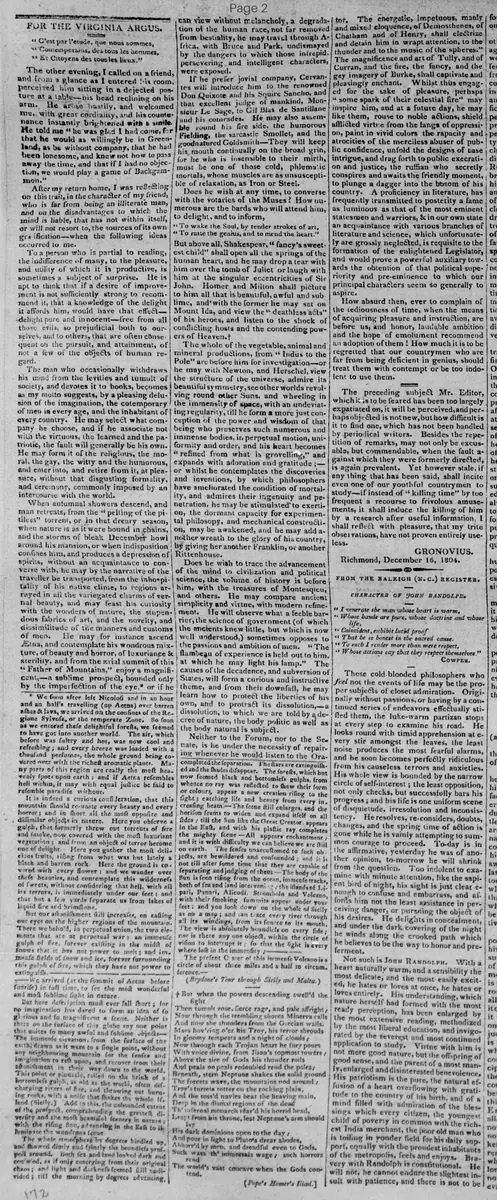
The other evening, I called on a friend, and from a glance as I entered his room, perceived him sitting in a dejected posture at a table—his head reclining on his arm. He arose hastily, and welcomed me with great cordiality, and his countenance instantly brightened with a smile. He told me he was glad I had come, for that he would as willingly be in Greenland, as be without company, that he had been lonesome, and knew not how to pass away the time, and that if I had no objection, we would play a game of Backgammon.
After my return home, I was reflecting on this trait, in the character of my friend, who is far from being an illiterate man, and on the disadvantages to which the mind is liable, that has not within itself, or will not resort to, the sources of its own gratification—when the following ideas occurred to me.
To a person who is partial to reading, the indifference of many, to the pleasure, and utility of which it is productive, is sometimes a subject of surprise. He is apt to think that if a desire of improvement is not sufficiently strong to recommend it, that a knowledge of the delight it affords him, would have that effect—delight pure and innocent—free from all those evils, so prejudicial both to ourselves, and to others, that are often consequent on the pursuit, and attainment, of not a few of the objects of human regard.
The man who occasionally withdraws his mind from the levities and tumult of society, and devotes it to books, becomes as my motto suggests, by a pleasing delusion of the imagination, the cotemporary of men in every age, and the inhabitant of every country. He may select what company he choose, and if he associate not with the virtuous, the learned and the patriotic, the fault will generally be his own. He may form it of the religious, the moral, the gay, the witty and the humorous, and enter into, and retire from it, at pleasure, without that disgusting formality, and ceremony, commonly imposed by an intercourse with the world.
When autumnal showers descend, and man retreats from the "pelting of the pitiless" torrent, or in that dreary season, when nature is as it were bound in chains, and the storms of bleak December howl around his mansion, or when indisposition confines him, and produces a depression of spirits, without an acquaintance to converse with, he may by the narrative of the traveller be transported, from the inhospitality of his native clime, to regions arrayed in all the variegated charms of vernal beauty, and may feast his curiosity with the wonders of nature, the stupendous fabrics of art, and the novelty, and dissimilitude of the manners and customs of men. He may for instance ascend Etna, and contemplate his wondrous mixture, of beauty and horror, of luxuriance & sterility, and from the aerial summit of this "Father of Mountains," enjoy a magnificent,—a sublime prospect, bounded only by the imperfection of the eye, or if he
* We soon after left Nicolosi and in an hour and an half's travelling (up Aetna) over barren ashes & lava, we arrived on the confines of the Regione Sylva, or the temperate Zone. So soon as we entered these delightful forests, we seemed to have got into another world. The air, which before was sultry and hot, was now cool and refreshing; and every breeze was loaded with a thousand perfumes, the whole ground being covered over with the richest aromatic plants. Many parts of this region are really the most heavenly spots upon earth : and if Aetna resembles hell within, it may with equal justice be said to resemble paradise without.
It is indeed a curious consideration, that this mountain should re-unite every beauty and every horror; and in short all the most opposite and dissimilar objects in nature. Here you observe a gulph, that formerly threw out torrents of fire and smoke, now covered with the most luxuriant vegetation ; and from an object of terror become one of delight. - Here you gather the most delicious fruits, spring from what was but lately a black and barren rock. Here the ground is covered with every flower : and we wander over these beauties, and contemplate this wilderness of sweets, without considering that hell, with all its terrors, is immediately under our feet; and that but a few yards separate us from lakes of liquid fire and brimstone.
But our astonishment still increases, on casting our eyes on the higher regions of the mountain. There we behold, in perpetual union, the two elements that are at perpetual war: an immense gulph of fire, forever existing in the midst of snows that it has not power to melt; and immense fields of snow and ice, forever surrounding this gulph of fire, which they have not power to extinguish.
-We arrived (at the summit of Aetna before sunrise) in full time, to see the most wonderful and most sublime Sight in nature.
But here description must ever fall short; for no imagination has dared to form an idea of so glorious and so magnificent a scene. Neither is there on the surface of this globe any one point that unites so many awful and sublime objects— The immense elevation, from the surface of the earth, drawn as it were to a single point, without any neighbouring mountain for the senses and imagination to rest upon, and recover from their astonishment in their way down to the world.
This point or pinnacle, raised on the brink of a bottomless gulph, as old as the world, often discharging rivers of fire, and throwing out burning rocks, with a noise that shakes the whole Island (Sicily.) Add to this, the unbounded extent of the prospect, comprehending the greatest diversity and the most beautiful scenery in nature; with the rising Sun, advancing in the East to illuminate the wondrous scene
The whole atmosphere by degrees kindled up, and showed dimly and faintly the boundless prospect around. Both sea and land looked dark and confused, as if only emerging from their original chaos; and light and darkness seemed still undivided; till the morning by degrees advancing,
completed the separation. The stars are extinguished and the shades disappear. The forests, which but now seemed black and bottomless gulphs, from whence no ray was reflected to shew their form or colours, appear a new creation rising to the light; catching life and beauty from every increasing beam.—The scene still enlarges, and the horizon seems to widen and expand itself on all sides ; till the Sun like the Great Creator appears in the East, and with his plastic ray completes the mighty scene—All appears enchantment ; and it is with difficulty we can believe we are still on earth. The senses unaccustomed to such objects, are bewildered and confounded; and it is not till after some time that they are capable of separating and judging of them—The body of the Sun is seen rising from the ocean, immense tracks, both of sea and land intervene— ; the islands of Lipari, Panari, Alicudi, Stromboli and Volcano, with their smoking summits appear under your feet; and you look down on the whole of Sicily as on a map; and can trace every river through all its windings, from its source to its mouth.
The view is absolutely boundless on every side; nor is there any one object, within the circle of vision to interrupt it ; so that the sight is every where lost in the immensity ;
The present Crater of this immense Volcano is a circle of about three miles and a half in circumference.—
(Brydone's Tour through Sicily and Malta.)
But when the powers descending swell'd the fight
Then tumult rose. fierce rage, and pale afright
Now through the trembling shores Minerva calls
And now she thunders from the Grecian walls.
Mars hov'ring o'er his Troy, his terror shrouds
In gloomy tempests and a night of clouds;
Now through each Trojan heart he fury pours
With voice divine, from Ilion's topmost towers;
Above the sire of Gods his thunder rolls
And peals on peals redoubled rend the poles;
Beneath, stern Neptune shakes the solid ground
The forests wave, the mountains nod around ;
Troy's turrets totter on the rocking plain,
And the toss'd navies beat the heaving main.
Deep in the dismal regions of the dead
Th'infernal monarch rear'd his horrid head,
Leapt from his throne, lest Neptune's arm should lay
His dark dominions open to the day;
And pour in light to Pluto's drear abodes,
Abhorr'd by men, and dreadful even to Gods.
Such wars th' immortals wage; such horrors rend
The world's vast concave when the Gods contend.
[Pope's Homer's Iliad.]
...tor. The energetic, impetuous, manly and mixed eloquence, of Demosthenes, of Chatham and of Henry, shall electrify and detain him in wrapt attention, to the thunder and to the music of the spheres."
The magnificence and art of Tully, and of Curran, and the fire, the fancy, and the gay imagery of Burke, shall captivate and pleasingly enchant. Whilst thus engaged for the sake of pleasure, perhaps
" some spark of their celestial fire" may inspire him, and at a future day, he may like them, rouse to noble actions, shield afflicted virtue from the fangs of oppression, paint in vivid colors the rapacity and atrocities of the merciless abuser of public confidence, unfold the designs of base intrigue, and drag forth to public execration and justice, the ruffian who secretly conspires and awaits the friendly moment, to plunge a dagger into the bosom of his country. A proficiency in literature, has frequently transmitted to posterity a fame as luminous as that of the most eminent statesmen and warriors, & in our own state an acquaintance with various branches of literature and science, which unfortunately are grossly neglected, is requisite to the formation of the enlightened Legislator, and would prove a powerful auxiliary towards the obtention of that political superiority and pre-eminence to which our principal characters seem so generally to aspire.
How absurd then, ever to complain of the tediousness of time, when the means of acquiring pleasure and instruction, are before us, and honor, laudable ambition and the hope of emolument recommend an adoption of them ! How much it is to be regretted that our countrymen who are far from being deficient in genius, should treat them with contempt or be too indolent to use them.
The preceding subject Mr. Editor, which it is to be feared has been too largely expatiated on, it will be perceived, and perhaps objected is not new, but how difficult is it to find one, which has not been handled by periodical writers. Besides the repetition of remarks, may not only be excusable, but commendable, when the fault against which they were formerly directed, is again prevalent. Yet however stale, if any thing that has been said, shall incite even one of our youthful countrymen to study—if instead of "killing time" by too frequent a recourse to frivolous amusements, it shall induce the killing of time by a research after useful information, I shall reflect with pleasure, that my trite observations, have not proven entirely useless.
GRONOVIUS.
Richmond, December 16, 1804.
After my return home, I was reflecting on this trait, in the character of my friend, who is far from being an illiterate man, and on the disadvantages to which the mind is liable, that has not within itself, or will not resort to, the sources of its own gratification—when the following ideas occurred to me.
To a person who is partial to reading, the indifference of many, to the pleasure, and utility of which it is productive, is sometimes a subject of surprise. He is apt to think that if a desire of improvement is not sufficiently strong to recommend it, that a knowledge of the delight it affords him, would have that effect—delight pure and innocent—free from all those evils, so prejudicial both to ourselves, and to others, that are often consequent on the pursuit, and attainment, of not a few of the objects of human regard.
The man who occasionally withdraws his mind from the levities and tumult of society, and devotes it to books, becomes as my motto suggests, by a pleasing delusion of the imagination, the cotemporary of men in every age, and the inhabitant of every country. He may select what company he choose, and if he associate not with the virtuous, the learned and the patriotic, the fault will generally be his own. He may form it of the religious, the moral, the gay, the witty and the humorous, and enter into, and retire from it, at pleasure, without that disgusting formality, and ceremony, commonly imposed by an intercourse with the world.
When autumnal showers descend, and man retreats from the "pelting of the pitiless" torrent, or in that dreary season, when nature is as it were bound in chains, and the storms of bleak December howl around his mansion, or when indisposition confines him, and produces a depression of spirits, without an acquaintance to converse with, he may by the narrative of the traveller be transported, from the inhospitality of his native clime, to regions arrayed in all the variegated charms of vernal beauty, and may feast his curiosity with the wonders of nature, the stupendous fabrics of art, and the novelty, and dissimilitude of the manners and customs of men. He may for instance ascend Etna, and contemplate his wondrous mixture, of beauty and horror, of luxuriance & sterility, and from the aerial summit of this "Father of Mountains," enjoy a magnificent,—a sublime prospect, bounded only by the imperfection of the eye, or if he
* We soon after left Nicolosi and in an hour and an half's travelling (up Aetna) over barren ashes & lava, we arrived on the confines of the Regione Sylva, or the temperate Zone. So soon as we entered these delightful forests, we seemed to have got into another world. The air, which before was sultry and hot, was now cool and refreshing; and every breeze was loaded with a thousand perfumes, the whole ground being covered over with the richest aromatic plants. Many parts of this region are really the most heavenly spots upon earth : and if Aetna resembles hell within, it may with equal justice be said to resemble paradise without.
It is indeed a curious consideration, that this mountain should re-unite every beauty and every horror; and in short all the most opposite and dissimilar objects in nature. Here you observe a gulph, that formerly threw out torrents of fire and smoke, now covered with the most luxuriant vegetation ; and from an object of terror become one of delight. - Here you gather the most delicious fruits, spring from what was but lately a black and barren rock. Here the ground is covered with every flower : and we wander over these beauties, and contemplate this wilderness of sweets, without considering that hell, with all its terrors, is immediately under our feet; and that but a few yards separate us from lakes of liquid fire and brimstone.
But our astonishment still increases, on casting our eyes on the higher regions of the mountain. There we behold, in perpetual union, the two elements that are at perpetual war: an immense gulph of fire, forever existing in the midst of snows that it has not power to melt; and immense fields of snow and ice, forever surrounding this gulph of fire, which they have not power to extinguish.
-We arrived (at the summit of Aetna before sunrise) in full time, to see the most wonderful and most sublime Sight in nature.
But here description must ever fall short; for no imagination has dared to form an idea of so glorious and so magnificent a scene. Neither is there on the surface of this globe any one point that unites so many awful and sublime objects— The immense elevation, from the surface of the earth, drawn as it were to a single point, without any neighbouring mountain for the senses and imagination to rest upon, and recover from their astonishment in their way down to the world.
This point or pinnacle, raised on the brink of a bottomless gulph, as old as the world, often discharging rivers of fire, and throwing out burning rocks, with a noise that shakes the whole Island (Sicily.) Add to this, the unbounded extent of the prospect, comprehending the greatest diversity and the most beautiful scenery in nature; with the rising Sun, advancing in the East to illuminate the wondrous scene
The whole atmosphere by degrees kindled up, and showed dimly and faintly the boundless prospect around. Both sea and land looked dark and confused, as if only emerging from their original chaos; and light and darkness seemed still undivided; till the morning by degrees advancing,
completed the separation. The stars are extinguished and the shades disappear. The forests, which but now seemed black and bottomless gulphs, from whence no ray was reflected to shew their form or colours, appear a new creation rising to the light; catching life and beauty from every increasing beam.—The scene still enlarges, and the horizon seems to widen and expand itself on all sides ; till the Sun like the Great Creator appears in the East, and with his plastic ray completes the mighty scene—All appears enchantment ; and it is with difficulty we can believe we are still on earth. The senses unaccustomed to such objects, are bewildered and confounded; and it is not till after some time that they are capable of separating and judging of them—The body of the Sun is seen rising from the ocean, immense tracks, both of sea and land intervene— ; the islands of Lipari, Panari, Alicudi, Stromboli and Volcano, with their smoking summits appear under your feet; and you look down on the whole of Sicily as on a map; and can trace every river through all its windings, from its source to its mouth.
The view is absolutely boundless on every side; nor is there any one object, within the circle of vision to interrupt it ; so that the sight is every where lost in the immensity ;
The present Crater of this immense Volcano is a circle of about three miles and a half in circumference.—
(Brydone's Tour through Sicily and Malta.)
But when the powers descending swell'd the fight
Then tumult rose. fierce rage, and pale afright
Now through the trembling shores Minerva calls
And now she thunders from the Grecian walls.
Mars hov'ring o'er his Troy, his terror shrouds
In gloomy tempests and a night of clouds;
Now through each Trojan heart he fury pours
With voice divine, from Ilion's topmost towers;
Above the sire of Gods his thunder rolls
And peals on peals redoubled rend the poles;
Beneath, stern Neptune shakes the solid ground
The forests wave, the mountains nod around ;
Troy's turrets totter on the rocking plain,
And the toss'd navies beat the heaving main.
Deep in the dismal regions of the dead
Th'infernal monarch rear'd his horrid head,
Leapt from his throne, lest Neptune's arm should lay
His dark dominions open to the day;
And pour in light to Pluto's drear abodes,
Abhorr'd by men, and dreadful even to Gods.
Such wars th' immortals wage; such horrors rend
The world's vast concave when the Gods contend.
[Pope's Homer's Iliad.]
...tor. The energetic, impetuous, manly and mixed eloquence, of Demosthenes, of Chatham and of Henry, shall electrify and detain him in wrapt attention, to the thunder and to the music of the spheres."
The magnificence and art of Tully, and of Curran, and the fire, the fancy, and the gay imagery of Burke, shall captivate and pleasingly enchant. Whilst thus engaged for the sake of pleasure, perhaps
" some spark of their celestial fire" may inspire him, and at a future day, he may like them, rouse to noble actions, shield afflicted virtue from the fangs of oppression, paint in vivid colors the rapacity and atrocities of the merciless abuser of public confidence, unfold the designs of base intrigue, and drag forth to public execration and justice, the ruffian who secretly conspires and awaits the friendly moment, to plunge a dagger into the bosom of his country. A proficiency in literature, has frequently transmitted to posterity a fame as luminous as that of the most eminent statesmen and warriors, & in our own state an acquaintance with various branches of literature and science, which unfortunately are grossly neglected, is requisite to the formation of the enlightened Legislator, and would prove a powerful auxiliary towards the obtention of that political superiority and pre-eminence to which our principal characters seem so generally to aspire.
How absurd then, ever to complain of the tediousness of time, when the means of acquiring pleasure and instruction, are before us, and honor, laudable ambition and the hope of emolument recommend an adoption of them ! How much it is to be regretted that our countrymen who are far from being deficient in genius, should treat them with contempt or be too indolent to use them.
The preceding subject Mr. Editor, which it is to be feared has been too largely expatiated on, it will be perceived, and perhaps objected is not new, but how difficult is it to find one, which has not been handled by periodical writers. Besides the repetition of remarks, may not only be excusable, but commendable, when the fault against which they were formerly directed, is again prevalent. Yet however stale, if any thing that has been said, shall incite even one of our youthful countrymen to study—if instead of "killing time" by too frequent a recourse to frivolous amusements, it shall induce the killing of time by a research after useful information, I shall reflect with pleasure, that my trite observations, have not proven entirely useless.
GRONOVIUS.
Richmond, December 16, 1804.
What sub-type of article is it?
Essay
What themes does it cover?
Moral Virtue
What keywords are associated?
Reading
Books
Literature
Moral Improvement
Solitude
Education
Idleness
What entities or persons were involved?
Gronovius
Literary Details
Author
Gronovius
Subject
On The Pleasures And Utility Of Reading
Key Lines
The Man Who Occasionally Withdraws His Mind From The Levities And Tumult Of Society, And Devotes It To Books, Becomes As My Motto Suggests, By A Pleasing Delusion Of The Imagination, The Cotemporary Of Men In Every Age, And The Inhabitant Of Every Country.
How Absurd Then, Ever To Complain Of The Tediousness Of Time, When The Means Of Acquiring Pleasure And Instruction, Are Before Us, And Honor, Laudable Ambition And The Hope Of Emolument Recommend An Adoption Of Them !
Yet However Stale, If Any Thing That Has Been Said, Shall Incite Even One Of Our Youthful Countrymen To Study—If Instead Of "Killing Time" By Too Frequent A Recourse To Frivolous Amusements, It Shall Induce The Killing Of Time By A Research After Useful Information, I Shall Reflect With Pleasure, That My Trite Observations, Have Not Proven Entirely Useless.