Thank you for visiting SNEWPapers!
Sign up free
Daily National Intelligencer
Washington, District Of Columbia
What is this article about?
Reflective piece on St. Helena as Napoleon Bonaparte's prison, highlighting its newfound interest due to his presence, with excerpts from 1681 describing the island and noting historical coincidences in fates of great leaders.
Clipping
OCR Quality
Full Text
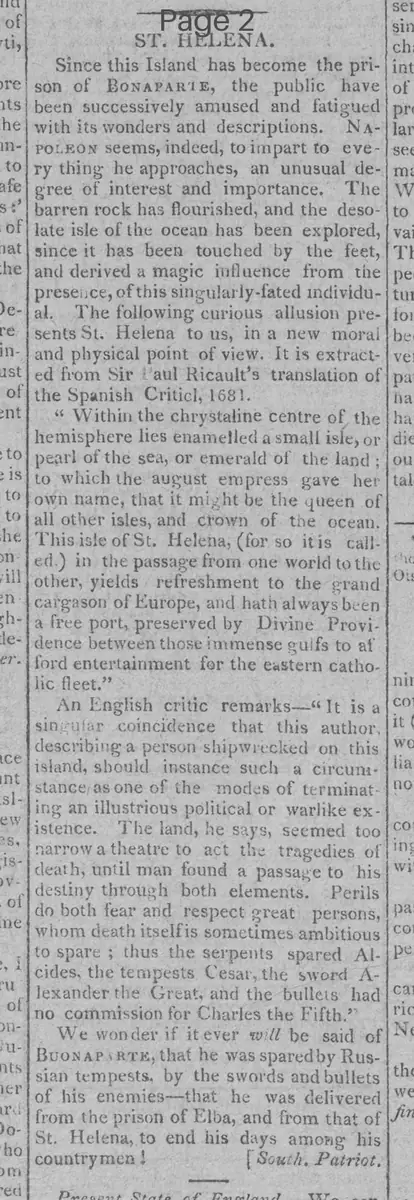
Since this Island has become the prison of Bonaparte, the public have been successively amused and fatigued with its wonders and descriptions. Napoleon seems, indeed, to impart to every thing he approaches, an unusual degree of interest and importance. The barren rock has flourished, and the desolate isle of the ocean has been explored, since it has been touched by the feet, and derived a magic influence from the presence, of this singularly-fated individual. The following curious allusion presents St. Helena to us, in a new moral and physical point of view. It is extracted from Sir Paul Rycaut's translation of the Spanish Critick, 1681.
"Within the chrystalline centre of the hemisphere lies enamelled a small isle, or pearl of the sea, or emerald of the land; to which the august empress gave her own name, that it might be the queen of all other isles, and crown of the ocean. This isle of St. Helena, (for so it is called in the passage from one world to the other, yields refreshment to the grand cargason of Europe, and hath always been a free port, preserved by Divine Providence between those immense gulfs to afford entertainment for the eastern catholic fleet."
An English critic remarks—"It is a singular coincidence that this author describing a person shipwrecked on this island, should instance such a circumstance as one of the modes of terminating an illustrious political or warlike existence. The land, he says, seemed too narrow a theatre to act the tragedies of death, until man found a passage to his destiny through both elements. Perils do both fear and respect great persons, whom death itself is sometimes ambitious to spare; thus the serpents spared Alcides, the tempests Cesar, the sword Alexander the Great, and the bullets had no commission for Charles the Fifth."
We wonder if it ever will be said of Buonaparte, that he was spared by Russian tempests, by the swords and bullets of his enemies—that he was delivered from the prison of Elba, and from that of St. Helena, to end his days among his countrymen!
[South. Patriot.]
What sub-type of article is it?
What keywords are associated?
What entities or persons were involved?
Where did it happen?
Foreign News Details
Primary Location
St. Helena
Key Persons
Event Details
Since this Island has become the prison of Bonaparte, the public have been successively amused and fatigued with its wonders and descriptions. Napoleon seems, indeed, to impart to every thing he approaches, an unusual degree of interest and importance. The barren rock has flourished, and the desolate isle of the ocean has been explored, since it has been touched by the feet, and derived a magic influence from the presence, of this singularly-fated individual. The following curious allusion presents St. Helena to us, in a new moral and physical point of view. It is extracted from Sir Paul Rycaut's translation of the Spanish Critick, 1681. "Within the chrystalline centre of the hemisphere lies enamelled a small isle, or pearl of the sea, or emerald of the land; to which the august empress gave her own name, that it might be the queen of all other isles, and crown of the ocean. This isle of St. Helena, (for so it is called in the passage from one world to the other, yields refreshment to the grand cargason of Europe, and hath always been a free port, preserved by Divine Providence between those immense gulfs to afford entertainment for the eastern catholic fleet." An English critic remarks—"It is a singular coincidence that this author describing a person shipwrecked on this island, should instance such a circumstance as one of the modes of terminating an illustrious political or warlike existence. The land, he says, seemed too narrow a theatre to act the tragedies of death, until man found a passage to his destiny through both elements. Perils do both fear and respect great persons, whom death itself is sometimes ambitious to spare; thus the serpents spared Alcides, the tempests Cesar, the sword Alexander the Great, and the bullets had no commission for Charles the Fifth." We wonder if it ever will be said of Buonaparte, that he was spared by Russian tempests, by the swords and bullets of his enemies—that he was delivered from the prison of Elba, and from that of St. Helena, to end his days among his countrymen! [South. Patriot.]