Thank you for visiting SNEWPapers!
Sign up free
Catoctin Clarion
Thurmont, Frederick County, Maryland
What is this article about?
Two Harvard law graduates, Laban Adams and the narrator, feud over a court case, leading to an insult, a strike, and a duel challenge driven by cowardice. Their fiancées, Clara Wolcott and Mary, intervene at the duel site, prompting reconciliation and renewed friendship.
Merged-components note: Text content clearly continues the story 'The Two Cowards' across components.
Clipping
OCR Quality
Full Text
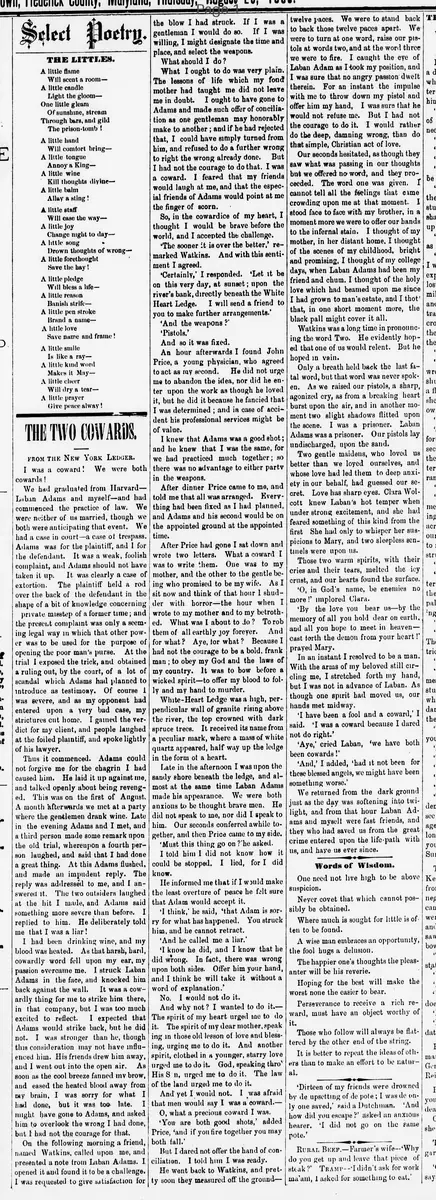
FROM THE NEW YORK LEDGER.
I was a coward! We were both
cowards!
We had graduated from Harvard—
Laban Adams and myself—and had
commenced the practice of law. We
were neither of us married, though we
both were anticipating that event. We
had a case in court—a case of trespass.
Adams was for the plaintiff, and I for
the defendant. It was a weak, foolish
complaint, and Adams should not have
taken it up.
It was clearly a case of
extortion. The plaintiff held a rod
over the back of the defendant in the
shape of a bit of knowledge concerning
private misstep of a former time; and
the present complaint was only a seeming
legal way in which that other pow-
er was to be used for the purpose of
opening the poor man's purse. At the
trial I exposed the trick, and obtained
a ruling out, by the court, of a lot of
scandal which Adams had planned to
introduce as testimony. Of course I
was severe, and as my opponent had
entered upon a very bad case, my
strictures cut home. I gained the ver-
dict for my client, and people laughed
at the foiled plaintiff, and spoke lightly
of his lawyer.
Thus it commenced. Adams could
not forgive me for the chagrin I had
caused him. He laid it up against me
and talked openly about being reveng-
ed. This was on the first of August.
A month afterwards we met at a party
where the gentlemen drank wine. Late
in the evening Adams and I met, and
a third person made some remark upon
the old trial, whereupon a fourth per-
son laughed, and said that I had done
a great thing. At this Adams flushed,
and made an impudent reply. The
reply was addressed to me, and I an-
swered it. The two outsiders laughed
at the hit I made, and Adams said
something more severe than before. I
replied to him. He deliberately told
me that I was a liar!
I had been drinking wine, and my
blood was heated. As that harsh, hard,
cowardly word fell upon my ear, my
passion overcame me. I struck Laban
Adams in the face, and knocked him
back against the wall. It was a cow-
ardly thing for me to strike him there,
in that company, but I was too much
excited to reflect. I expected that
Adams would strike back, but he did
not. I was stronger than he, though
this consideration may not have influ-
enced him. His friends drew him away,
and I went out into the open air. As
soon as the cool breeze fanned my brow,
and eased the heated blood away from
my brain, I was sorry for what I
had done, but it was too late.
I
might have gone to Adams, and asked
him to overlook the wrong I had done,
but I had not the courage for that.
On the following morning a friend,
named Watkins, called upon me, and
presented a note from Laban Adams. I
opened it and found it to be a challenge.
I was requested to give satisfaction for
the blow I had struck. If I was a
gentleman I would do so. If I was
willing, I might designate the time and
place, and select the weapons.
What should I do?
What I ought to do was very plain.
The lessons of life which my fond
mother had taught me did not leave
me in doubt. I ought to have gone to
Adams and made such offer of concilia-
tion as one gentleman may honorably
make to another; and if he had rejected
that, I could have simply turned from
him, and refused to do a further wrong
to right the wrong already done. But
I had not the courage to do that. I was
a coward. I feared that my friends
would laugh at me, and that the especial
friends of Adams would point at me
the finger of scorn.
So, in the cowardice of my heart, I
thought I would be brave before the
world, and I accepted the challenge.
'The sooner it is over the better,' re-
marked Watkins. And with this senti-
ment I agreed.
'Certainly,' I responded. 'Let it be
on this very day, at sunset; upon the
river's bank, directly beneath the White
Heart Ledge. I will send a friend to
you to make further arrangements.'
'And the weapons?'
'Pistols.'
And so it was fixed.
An hour afterwards I found John
Price, a young physician, who agreed
to act as my second.
He did not urge
me to abandon the idea, nor did he en-
ter upon the work as though he loved
it, but he did it because he fancied that
I was determined; and in case of acci-
dent his professional services might be
of value.
I knew that Adams was a good shot;
and he knew that I was the same, for
we had practiced much together; so
there was no advantage to either party
in the weapons.
After dinner Price came to me, and
told me that all was arranged. Every-
thing had been fixed as I had planned,
and Adams and his second would be on
the appointed ground at the appointed
time.
After Price had gone I sat down and
wrote two letters. What a coward I
was to write them. One was to my
mother, and the other to the gentle be-
ing who promised to be my wife. As I
sit now and think of that hour I shud-
der with horror—the hour when I
wrote to my mother and to my betroth-
ed. What was I about to do? To rob
them of all earthly joy forever. And
for what? Aye, for what? Because I
had not the courage to be a bold, frank
man; to obey my God and the laws of
my country. It was to bow before a
wicked spirit—to offer my blood to fol-
ly and my hand to murder.
White-Heart Ledge was a high, per-
pendicular wall of granite rising above
the river, the top crowned with dark
spruce trees. It received its name from
a peculiar mark, where a mass of white
quartz appeared, half way up the ledge
in the form of a heart.
Late in the afternoon I was upon the
sandy shore beneath the ledge, and al-
most at the same time Laban Adams
made his appearance. We were both
anxious to be thought brave men. He
did not speak to me, nor did I speak to
him. Our seconds conferred awhile to-
gether, and then Price came to my side.
'Must this thing go on?' he asked.
I told him I did not know how it
could be stopped. I lied, for I did
know.
He informed me that if I would make
the least overture of peace he felt sure
that Adams would accept it.
'I think,' he said, 'that Adams is sor-
ry for what has happened. You struck
him, and he cannot retract.
'And he called me a liar.'
'I know he did, and I know that he
did wrong. In fact, there was wrong
upon both sides. Offer him your hand,
and I think he will take it without a
word of explanation.'
No. I would not do it.
And why not? I wanted to do it.—
The spirit of my heart urged me to do
it. The spirit of my dear mother, speak-
ing in those old lessons of love and bless-
ing, urging me to do it. And another
spirit, clothed in a younger, starry love
urged me to do it. God, speaking thro
His Son, urged me to do it. The law
of the land urged me to do it.
And yet I would not. I was afraid
that men would say I was a coward.—
O, what a precious coward I was.
'You are both good shots,' added
Price, 'and if you fire together you may
both fall.'
But I dared not offer the hand of con-
ciliation. I told him I was ready.
He went back to Watkins, and pret-
ty soon they measured off the ground—
twelve paces. We were to stand back
to back those twelve paces apart. We
were to turn at one word, raise our pis-
tols at word two, and at the word three
we were to fire. I caught the eye of
Laban Adams as I took my position, and
I was sure that no angry passion dwelt
therein. For an instant the impulse
with me to throw down my pistol and
offer him my hand, I was sure that he
would not refuse me. But I had not
the courage to do it. I would rather
do the deep, damning wrong, than do
that simple, Christian act of love.
Our seconds hesitated, as though they
saw what was passing in our thoughts,
but we offered no word, and they pro-
ceeded. The word one was given. I
cannot tell all the feelings that came
crowding upon me at that moment. I
stood face to face with my brother. In a
moment more we were to offer our hands
to the infernal stain. I thought of my
mother, in her distant home. I thought
of the scenes of my childhood, bright
and promising. I thought of my college
days, when Laban Adams had been my
friend and chum. I thought of the holy
love which had beamed upon me since
I had grown to man's estate, and I thought
that, in one short moment more, the
black pall might cover it all.
Watkins was a long time in pronounc-
ing the word Two. He evidently hoped
that one of us would relent. But he
hoped in vain.
Only a breath held back the last fa-
tal word, but that word was never spok-
en. As we raised our pistols, a sharp
agonized cry, as from a breaking heart
burst upon the air, and in another mo-
ment two slight shadows flitted upon
the scene. I was a prisoner. Laban
Adams was a prisoner. Our pistols lay
undischarged upon the sand.
Two gentle maidens, who loved us
better than we loved ourselves, and
whose love had led them to deep anxi-
ety in our behalf, had guessed our se-
cret. Love has sharp eyes. Clara Wol-
cott knew Laban's hot temper when
under strong excitement, and she had
feared something of this kind from the
first. She had only to whisper her sus-
picions to Mary, and two sleepless sen-
tinels were upon us.
Those two warm spirits, with their
cries and their tears, melted the icy
crust, and our hearts found the surface.
'O, in God's name, be enemies no
more!' implored Clara.
'By the love you bear us—by the
memory of all you hold dear on earth,
and all you hope to meet in heaven—
cast forth the demon from your heart!' prayed Mary.
In an instant I resolved to be a man.
With the arms of my beloved still cir-
cling me, I stretched forth my hand.
but I was not in advance of Laban. As
though one spirit had moved us, our
hands met midway
'I have been a fool and a coward.' I
said. 'I was a coward because I dared
not do right.'
'Aye,' cried Laban, 'we have both
been cowards!'
'And,' I added, 'had it not been for
these blessed angels, we might have been
something worse.'
We returned from the dark ground
just as the day was softening into twi-
light, and from that hour Laban Adams
and myself were fast friends, and
they who had saved us from the great
crime entered upon the life-path with
us, and have us ever since.
What sub-type of article is it?
What themes does it cover?
What keywords are associated?
What entities or persons were involved?
Where did it happen?
Story Details
Key Persons
Location
River's Bank Beneath The White Heart Ledge
Event Date
First Of August And A Month Afterwards
Story Details
Two lawyer friends quarrel in court, leading to an insult at a party, a strike, and a pistol duel challenge due to mutual cowardice fearing social scorn. At the duel site, their fiancées Clara and Mary intervene with pleas, causing them to reconcile and affirm their friendship.