Thank you for visiting SNEWPapers!
Sign up free
Atlanta Daily World
Atlanta, Fulton County, Georgia
What is this article about?
The West Side Health Center in Atlanta was established in 1944 to address health needs of the Negro community, starting with venereal disease control and expanding to tuberculosis and ringworm clinics, staffed by Black professionals, with progress reported through 1948.
Clipping
OCR Quality
Full Text
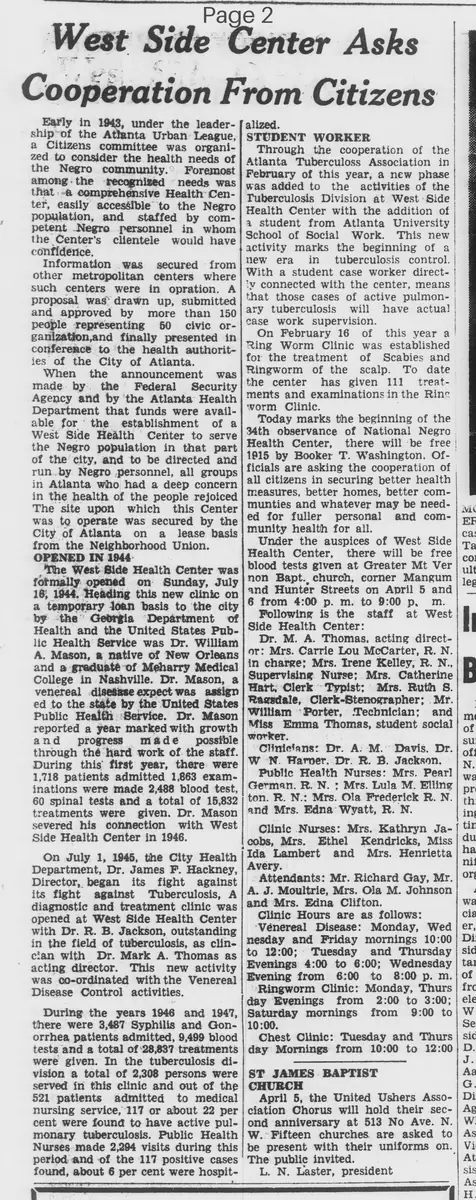
Cooperation From Citizens
Early in 1943, under the leadership of the Atlanta Urban League, a Citizens committee was organized to consider the health needs of the Negro community. Foremost among the recognized needs was that a comprehensive Health Center, easily accessible to the Negro population, and staffed by competent Negro personnel in whom the Center's clientele would have confidence.
Information was secured from other metropolitan centers where such centers were in operation. A proposal was drawn up, submitted and approved by more than 150 people representing 50 civic organizations, and finally presented in conference to the health authorities of the City of Atlanta.
When the announcement was made by the Federal Security Agency and by the Atlanta Health Department that funds were available for the establishment of a West Side Health Center to serve the Negro population in that part of the city, and to be directed and run by Negro personnel, all groups in Atlanta who had a deep concern in the health of the people rejoiced.
The site upon which this Center was to operate was secured by the City of Atlanta on a lease basis from the Neighborhood Union.
OPENED IN 1944
The West Side Health Center was formally opened on Sunday, July 16, 1944. Heading this new clinic on a temporary loan basis to the city by the Georgia Department of Health and the United States Public Health Service was Dr. William A. Mason, a native of New Orleans and a graduate of Meharry Medical College in Nashville. Dr. Mason, a venereal disease expert was assigned to the state by the United States Public Health Service. Dr. Mason reported a year marked with growth and progress made possible through the hard work of the staff.
During this first year, there were 1,718 patients admitted, 1,863 examinations were made, 2,488 blood tests, 60 spinal tests and a total of 15,832 treatments were given. Dr. Mason severed his connection with West Side Health Center in 1946.
On July 1, 1945, the City Health Department, Dr. James F. Hackney, Director, began its fight against Tuberculosis. A diagnostic and treatment clinic was opened at West Side Health Center with Dr. R. B. Jackson, outstanding in the field of tuberculosis, as clinician with Dr. Mark A. Thomas as acting director. This new activity was co-ordinated with the Venereal Disease Control activities.
During the years 1946 and 1947, there were 3,487 Syphilis and Gonorrhea patients admitted, 9,499 blood tests and a total of 28,837 treatments were given. In the tuberculosis division a total of 2,308 persons were served in this clinic and out of the 521 patients admitted to medical nursing service, 117 or about 22 per cent were found to have active pulmonary tuberculosis. Public Health Nurses made 2,294 visits during this period and of the 117 positive cases found, about 6 per cent were hospitalized.
alized.
STUDENT WORKER
Through the cooperation of the Atlanta Tuberculosis Association in February of this year, a new phase was added to the activities of the Tuberculosis Division at West Side Health Center with the addition of a student from Atlanta University School of Social Work. This new activity marks the beginning of a new era in tuberculosis control.
With a student case worker directly connected with the center, means that those cases of active pulmonary tuberculosis will have actual case work supervision.
On February 16 of this year a Ring Worm Clinic was established for the treatment of Scabies and Ringworm of the scalp. To date the center has given 111 treatments and examinations in the Ring Worm Clinic.
Today marks the beginning of the 34th observance of National Negro Health Week, there will be free lectures by Booker T. Washington. Officials are asking the cooperation of all citizens in securing better health measures, better homes, better communities and whatever may be needed for fuller personal and community health for all.
Under the auspices of West Side Health Center, there will be free blood tests given at Greater Mt. Vernon Bapt. church, corner Mangum and Hunter Streets on April 5 and 6 from 4:00 p. m. to 9:00 p. m.
Following is the staff at West Side Health Center:
Dr. M. A. Thomas, acting director; Mrs. Carrie Lou McCarter, R. N. in charge; Mrs. Irene Kelley, R. N. Supervising Nurse; Mrs. Catherine Hart, Clerk Typist; Mrs. Ruth S. Ragsdale, Clerk-Stenographer; Mr. William Porter, Technician; and Miss Emma Thomas, student social worker.
Clinicians: Dr. A. M. Davis, Dr. W. N. Harper, Dr. R. B. Jackson.
Public Health Nurses: Mrs. Pearl German, R. N.; Mrs. Lula M. Ellington, R. N.; Mrs. Ola Frederick R. N. and Mrs. Edna Wyatt, R. N.
Clinic Nurses: Mrs. Kathryn Jacobs, Mrs. Ethel Kendricks, Miss Ida Lambert and Mrs. Henrietta Avery.
Attendants: Mr. Richard Gay, Mr. A. J. Moultrie, Mrs. Ola M. Johnson and Mrs. Edna Clifton.
Clinic Hours are as follows:
Venereal Disease: Monday, Wednesday and Friday mornings 10:00 to 12:00; Tuesday and Thursday Evenings 4:00 to 6:00; Wednesday Evening from 6:00 to 8:00 p. m.
Ringworm Clinic: Monday, Thursday Evenings from 2:00 to 3:00; Saturday mornings from 9:00 to 10:00.
Chest Clinic: Tuesday and Thursday Mornings from 10:00 to 12:00
What sub-type of article is it?
What themes does it cover?
What keywords are associated?
What entities or persons were involved?
Where did it happen?
Story Details
Key Persons
Location
West Side, Atlanta, Georgia
Event Date
Early In 1943 To 1948
Story Details
Establishment of West Side Health Center in 1944 by Atlanta Urban League for Negro community health needs, staffed by Negro personnel; initial focus on venereal diseases under Dr. Mason; expansion to tuberculosis clinic in 1945; addition of student worker and ringworm clinic in 1948; statistics on patients, tests, and treatments; staff listing and clinic hours.