Thank you for visiting SNEWPapers!
Sign up free
The Patowmac Guardian, And Berkeley Advertiser
Martinsburg, Shepherdstown, Berkeley County, Jefferson County, West Virginia
What is this article about?
August 1790 analysis of the Nootka Sound crisis: Spain's dignified declaration offers Britain restitution for captured vessels but reserves exclusive rights claims; British ministry seeks more substantial concessions amid potential French support via family compact; historical parallels and reflections on dissolving Bourbon alliances.
Merged-components note: This is a continuation of the 'Political State of Europe' article that spans from page 1 to page 2, with sequential reading order and direct text flow; relabeled from 'editorial' to 'foreign_news' as it is political analysis of international affairs.
Clippings
1 of 2
OCR Quality
Full Text
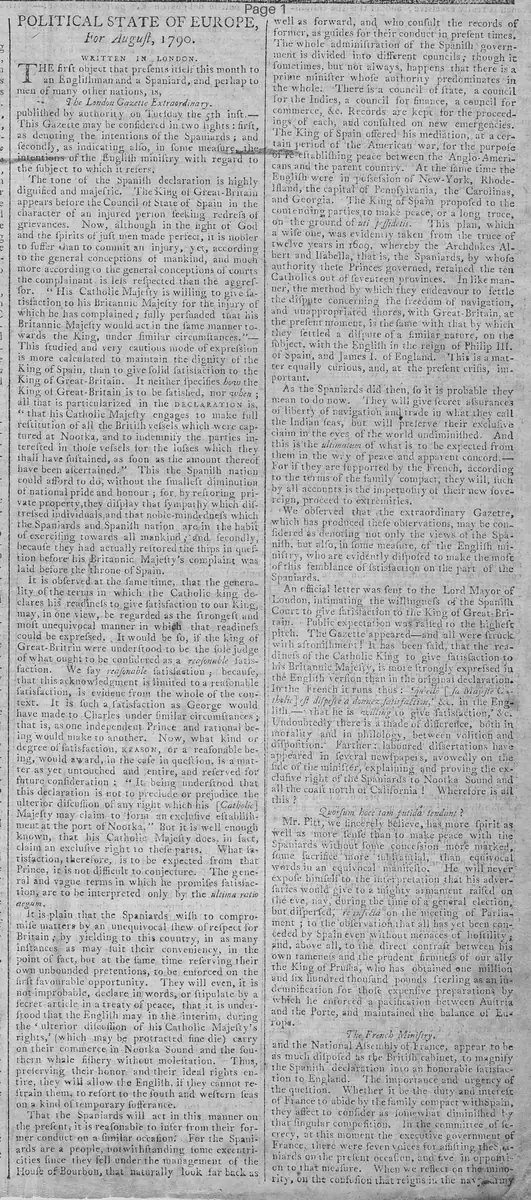
For August, 1790.
WRITTEN IN LONDON.
The first object that presents itself this month to an Englishman and a Spaniard, and perhaps to men of many other nations, is, The London Gazette Extraordinary, published by authority on Tuesday the 5th inst.--
This Gazette may be considered in two lights: first, as denoting the intentions of the Spaniards; and secondly, as indicating also, in some measure, the intentions of the English ministry with regard to the subject to which it refers.
The tone of the Spanish declaration is highly dignified and majestic. The King of Great-Britain appears before the Council of State of Spain in the character of an injured person seeking redress of grievances. Now, although in the sight of God and the spirits of just men made perfect, it is nobler to suffer than to commit an injury, yet, according to the general conceptions of mankind, and much more according to the general conceptions of courts the complainant is less respected than the aggressor. -- "His Catholic Majesty is willing to give satisfaction to his Britannic Majesty for the injury of which he has complained; fully persuaded that his Britannic Majesty would act in the same manner towards the King, under similar circumstances."
This studied and very cautious mode of expression is more calculated to maintain the dignity of the King of Spain, than to give solid satisfaction to the King of Great-Britain. It neither specifies how the King of Great-Britain is to be satisfied, nor when; all that is particularized in the DECLARATION is, "that his Catholic Majesty engages to make full restitution of all the British vessels which were captured at Nootka, and to indemnify the parties interested in those vessels for the losses which they shall have sustained, as soon as the amount thereof have been ascertained." This the Spanish nation could afford to do, without the smallest diminution of national pride and honour; for, by restoring private property, they display that sympathy which distressed individuals and that noble-mindedness which the Spaniards and Spanish nation are in the habit of exercising towards all mankind; and, secondly, because they had actually restored the ships in question before his Britannic Majesty's complaint was laid before the throne of Spain.
It is observed at the same time, that the generality of the terms in which the Catholic king declares his readiness to give satisfaction to our King, may, in one view, be regarded as the strongest and most unequivocal manner in which that readiness could be expressed. It would be so, if the king of Great-Britain were understood to be the sole judge of what ought to be considered as a reasonable satisfaction. We say reasonable satisfaction; because, that this acknowledgment is limited to a reasonable satisfaction, is evident from the whole of the context. It is such a satisfaction as George would have made to Charles under similar circumstances; that is, as one independent Prince and rational being would make to another. Now, what kind or degree of satisfaction, Reason, or a reasonable being, would award, in the case in question, is a matter as yet untouched and entire, and reserved for future consideration: "It being understood that this declaration is not to preclude or prejudice the ulterior discussion of any right which his [Catholic] Majesty may claim to form an exclusive establishment at the port of Nootka." But it is well enough known, that his Catholic Majesty does, in fact, claim an exclusive right in these parts. What satisfaction, therefore, is to be expected from that Prince, it is not difficult to conjecture. The general and vague terms in which he promises satisfaction, are to be interpreted only by the ultima ratio regum.
It is plain that the Spaniards wish to compromise matters by an unequivocal shew of respect for Britain; by yielding to this country, in as many instances as may suit their conveniency, in the point of fact, but at the same time reserving their own unbounded pretensions, to be enforced on the first favourable opportunity. They will even, it is not improbable, declare in words, or stipulate by a secret article in a treaty of peace, that it is understood that the English may in the interim, during the 'ulterior discussion of his Catholic Majesty's rights,' (which may be protracted sine die) carry on their commerce in Nootka Sound and the southern whale fishery without molestation. -- Thus, preserving their honor, and their ideal rights entire, they will allow the English, if they cannot restrain them, to resort to the south and western seas on a kind of temporary sufferance.
That the Spaniards will act in this manner on the present, it is reasonable to infer from their former conduct on a similar occasion: For the Spaniards are a people, notwithstanding some eccentricities since they fell under the management of the House of Bourbon, that naturally look far back as well as forward, and who consult the records of former, as guides for their conduct in present times.
The whole administration of the Spanish government is divided into different councils; though it sometimes, but not always, happens that there is a prime minister whose authority predominates in the whole: There is a council of state, a council for the Indies, a council for finance, a council for commerce, &c. Records are kept for the proceedings of each, and consulted on new emergencies.
The King of Spain offered his mediation, at a certain period of the American war, for the purpose of reestablishing peace between the Anglo-Americans and the parent country. At the same time the English were in possession of New-York, Rhode-Island, the capital of Pennsylvania, the Carolinas, and Georgia. The King of Spain proposed to the contending parties to make peace, or a long truce, on the ground of uti possidetis. This plan, which was a wise one, was evidently taken from the truce of twelve years in 1609, whereby the Archdukes Albert and Isabella, that is, the Spaniards, by whose authority these Princes governed, retained the ten Catholics out of seventeen provinces. In like manner, the method by which they endeavour to settle the dispute concerning the freedom of navigation, and unappropriated shores, with Great-Britain, at the present moment, is the same with that by which they settled a dispute of a similar nature, on the subject, with the English in the reign of Philip III. of Spain, and James I. of England. This is a matter equally curious, and, at the present crisis, important.
As the Spaniards did then, so it is probable they mean to do now. They will give secret assurances of liberty of navigation and trade in what they call the Indian seas, but will preserve their exclusive claim in the eyes of the world undiminished. And this is the ultimatum of what is to be expected from them in the way of peace and apparent concord.--
For if they are supported by the French, according to the terms of the family compact, they will; such by all accounts is the impetuosity of their new sovereign, proceed to extremities.
We observed that the extraordinary Gazette, which has produced these observations, may be considered as denoting not only the views of the Spanish, but also, in some measure, of the English ministry, who are evidently disposed to make the most of this semblance of satisfaction on the part of the Spaniards.
An official letter was sent to the Lord Mayor of London, intimating the willingness of the Spanish Court to give satisfaction to the King of Great-Britain. Public expectation was raised to the highest pitch. The Gazette appeared--and all were struck with astonishment! It has been said, that the readiness of the Catholic King to give satisfaction to his Britannic Majesty, is more strongly expressed in the English version than in the original declaration. In the French it runs thus: "qu'elle [a Majesté Catholique] est disposée à donner satisfaction," &c. in the English-- that he is willing to give satisfaction,' &c.
Undoubtedly there is a shade of difference, both in morality and in philology, between volition and disposition. Farther: laboured dissertations have appeared in several newspapers, avowedly on the side of the minister, explaining and proving the exclusive right of the Spaniards to Nootka Sound and all the coast north of California! Wherefore is all this?
Quorum hoet tam putida tendunt?
-- Mr. Pitt, we sincerely believe, has more spirit as well as more sense than to make peace with the Spaniards without some concession more marked, some sacrifice more substantial, than equivocal words in an equivocal manifesto. He will never expose himself to the interpretation that his adversaries would give to a mighty armament raised on the eve, nay, during the time of a general election, but dispersed, re infecta on the meeting of Parliament; to the observation that all has yet been conceded by Spain even without menaces of hostility: and, above all, to the direct contrast between his own tameness and the prudent firmness of our ally the King of Prussia, who has obtained one million and six hundred thousand pounds sterling as an indemnification for those expensive preparations by which he enforced a pacification between Austria and the Porte, and maintained the balance of Europe.
The French Ministry.
and the National Assembly of France, appear to be as much disposed as the British cabinet, to magnify the Spanish declaration into an honorable satisfaction to England. "The importance and urgency of the question, Whether it be the duty and interest of France to abide by the family compact with Spain, they affect to consider as somewhat diminished by that singular composition. In the committee of secrecy, at this moment the executive government of France, there were seven voices for assisting the Spaniards on the present occasion, and five in opposition to that measure. When we reflect on the minority, on the confusion that reigns in the navy army
Finances of France, there is no reason to apprehend that the exertions of that kingdom, in support of the Spaniards, will, in the first instance, be formidable. But if they be drawn into the contest—and put forth their strength in any degree, they will soon, very soon, be excited to strain every nerve in support of the cause in which they have embarked—and in opposition to England, against which national rivalry—and prejudice appear to be still alive and inveterate. The ardour of Frenchmen, notwithstanding present appearances, might be quickly diverted from the new into the old channel. The sensibility, and consequently the levity, of the French is really excessive; and of this the enlightened patriots who have effected the late revolution are not ignorant. The French of this day are still distinguished by the character that is given of the ancient Gauls by Polybius Caesar, Tacitus, and other writers. We may add, that there is something in the climate and soil of the country that gives lightness to claret, briskness to Champaign, and quickness to the people.
It is generally supposed that, although a small majority in what we call the council of state of France has declared their opinion that Spain is to be supported according to the terms of the family compact, the National Assembly will hesitate long before they give any cordial countenance and aid to the Spaniards in the present conjuncture. Their finances do not permit this; nor would it be consonant with sound policy if they did. But, on this subject, it is to be considered, that there is a very material distinction between a war by land, and a war at sea. In the former the formation of roads, the construction of forts, arsenals and magazines, the strengthening of garrisons and frontier towns; the raising of new regiments, and other circumstances, all tend to exalt the power of the crown, and to arm it for a while with a power little short of dictatorial. It is not so in a naval war. The power of the crown is increased, indeed, by this also, but not to such a degree: And, for this reason, our independent gentlemen, our real patriots, while they maintain a prudent jealousy of standing armies even open their purses to strengthen the wooden walls of England. The National Assembly of France, fully aware of this distinction, will enter more readily into a war at sea, than into a land war, with any of their neighbours.
Some years ago a report prevailed, and an opinion was fondly entertained, that the Prince of Asturias, the present king of Spain, was jealous of the influence of France, but prepossessed in favour of the English. It is not improbable that this high spirited Prince, at one time, and in certain circumstances, was more sensibly affected with the intrigues of the French, and their ascendancy over the mind of his father, the late king, than with the overbearing manner of the English. At that time, and in those circumstances, the Prince of Asturias was inclined to be the friend of Britain in preference to France. But the American war arose, the French assisted the Americans, and the Spaniards, according to the family compact, the French. The combined arms of France and Spain were repulsed before Gibraltar, in the sight of the attentive world. The Prince of Asturias witnessed their defeat with regret and wounded pride: And the irascible part of his mind, to speak in the language of the Platonic philosophy, was transferred from the arrogance of France to another object.
Reflections:
If Britain were wise she would have endeavoured, or would yet endeavour,—instead of provoking, to soothe and gain the great mind of his Catholic Majesty. Even the sacrifice of Gibraltar would not be too great, if it could dissolve the family compact among the different branches of the house of Bourbon, and establish permanent and perpetual harmony between Spain and England. But, in order to effect this great purpose, there would not be a necessity for making a sacrifice of Gibraltar—let it not be sacrificed, but exchanged—valuable as it even appears to our imaginations, the rich and widely extended dominions of Spain present a fund capable of affording a full equivalent—some fortress and harbour on the Barbary coast, with some island in the East and West-Indies, conceded to England, in lieu of Gibraltar, might dissolve the family compact and lead to an union between the two nations never to be dissolved—And this union, so naturally are Spain and England adapted to one another by a reciprocity of superfluities and wants, would raise the prosperity and glory of both nations to an elevation never before experienced by allied nations. It is to be hoped that our ministry, in the midst of their warlike preparations for hostilities, have in reality an alliance of the closest kind with Spain in contemplation. The court of Versailles surmounted more difficulties than are opposed to the formation of such a treaty, when they obtained the agreement of the king of Spain to the family compact. The history of this famous treaty of alliance is an object of extreme curiosity and importance at the present moment: And, if it were made the subject of due attention, it could not fail to suggest reflections, and would prepare the minds of both Spaniards and Englishmen, for the harmony which, according to the Spanish proverb, would be so eminently conducive to the interest of both nations. From the history of those intrigues, and circumstances improved by French address that led to the family compact, it appears that it was carried through in opposition to the general inclination of the noble Spaniards, to that of three successive prime ministers of state, the Marquis de Carvajal, the Duke of Huescar, and General Wall; nay in opposition to the very inclinations of the king and queen of Spain, who were strongly and avowedly on the side of that party
What sub-type of article is it?
What keywords are associated?
What entities or persons were involved?
Where did it happen?
Foreign News Details
Primary Location
Nootka Sound
Event Date
August 1790
Key Persons
Outcome
spanish declaration offering satisfaction to britain, including full restitution of captured british vessels at nootka and indemnification for losses; reserves discussion of exclusive rights at nootka.
Event Details
Analysis of the Spanish declaration in the London Gazette Extraordinary of August 5, 1790, regarding the Nootka Sound dispute; Spain expresses willingness to provide satisfaction to Britain for injuries, restores captured vessels, but maintains vague terms on broader rights; discusses potential French support via family compact and British ministry's response.