Thank you for visiting SNEWPapers!
Sign up free
Camden Journal
Camden, Kershaw County, South Carolina
What is this article about?
Opinion piece on the US-British fishery dispute, advocating for executive-led peaceful resolution to avoid war escalation, comparing to 1810-1815 tensions resolved by 1818 treaty, noting favorable current circumstances under Tory government.
Clipping
OCR Quality
Full Text
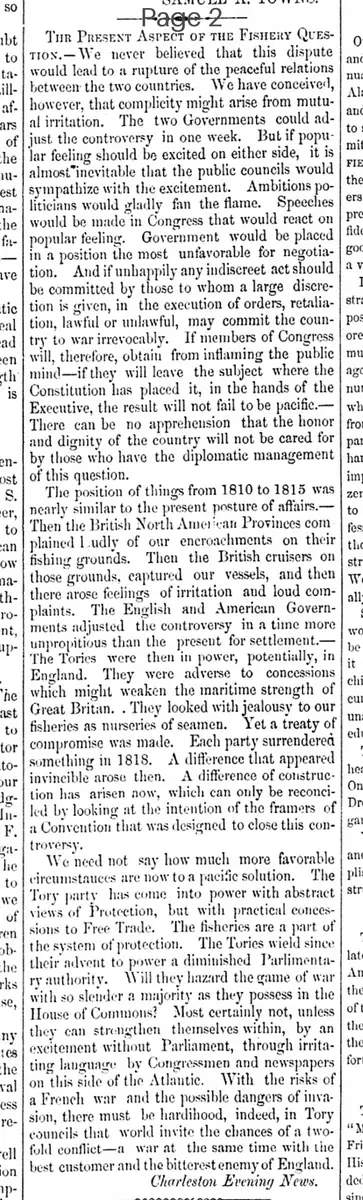
The position of things from 1810 to 1815 was nearly similar to the present posture of affairs.—Then the British North American Provinces complained loudly of our encroachments on their fishing grounds. Then the British cruisers on those grounds, captured our vessels, and then there arose feelings of irritation and loud complaints. The English and American Governments adjusted the controversy in a time more unpropitious than the present for settlement.—The Tories were then in power, potentially, in England. They were adverse to concessions which might weaken the maritime strength of Great Britain. They looked with jealousy to our fisheries as nurseries of seamen. Yet a treaty of compromise was made. Each party surrendered something in 1818. A difference that appeared invincible arose then. A difference of construction has arisen now, which can only be reconciled by looking at the intention of the framers of a Convention that was designed to close this controversy.
We need not say how much more favorable circumstances are now to a pacific solution. The Tory party has come into power with abstract views of Protection, but with practical concessions to Free Trade. The fisheries are a part of the system of protection. The Tories wield since their advent to power a diminished Parliamentary authority. Will they hazard the game of war with so slender a majority as they possess in the House of Commons? Most certainly not, unless they can strengthen themselves within, by an excitement without Parliament, through irritating language by Congressmen and newspapers on this side of the Atlantic. With the risks of a French war and the possible dangers of invasion, there must be hardihood, indeed, in Tory councils that would invite the chances of a two-fold conflict—a war at the same time with the best customer and the bitterest enemy of England.
What sub-type of article is it?
What keywords are associated?
Where did it happen?
Foreign News Details
Primary Location
British North American Provinces
Outcome
hopeful for pacific solution through negotiation; historical 1818 treaty as compromise precedent
Event Details
Discussion of ongoing US-British fishery dispute, warning against public and congressional agitation that could lead to war; compares to 1810-1815 tensions resolved by 1818 treaty despite Tory reluctance; current Tory government seen as unlikely to risk war given slim majority and other threats