Thank you for visiting SNEWPapers!
Sign up free
The Enquirer
Richmond, Henrico County, Virginia
What is this article about?
Napoleon's Imperial Decree of September 23, 1810, from the Tuileries Palace, establishes mechanisms to liquidate and pay arrears of the former Dutch government prior to its 1810 union with France. It creates a Council of Liquidation and Syndicate in Amsterdam, issues 24 million francs in bills, and addresses public debt interests via domain sales and revenues.
Clipping
OCR Quality
Full Text
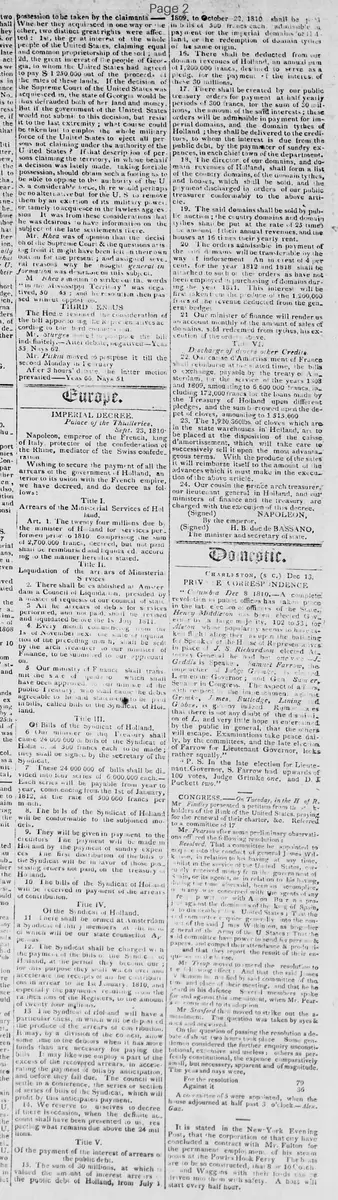
IMPERIAL DECREE.
Palace of the Thuilleries,
Sept. 23, 1810
Napoleon, emperor of the French, king of Italy, protector of the confederation of the Rhine, mediator of the Swiss confederation
Wishing to secure the payment of all the arrears of the government of Holland, anterior to its union with the French empire, we have decreed, and do decree as follows:
Title I.
Arrears of the Ministerial Services of Holland,
Art. 1. The twenty four millions due by the minister of Holland for services performed prior to 1810 comprising the sum of 2,700,000 francs, decreed, but not paid shall be reimbursed and liquidated, according to the manner hereinafter stated.
Title II.
Liquidation of the arrears of Ministerial Services
2. There shall be established at Amsterdam a Council of Liquidation, presided by a master of requests of our council of state.
3. The arrears of debts for services performed, and not paid, shall be revised and liquidated before the 1st July 1811.
4. Every month commencing from the 1st of November next the state of liquidation of the preceding month, shall be sent by the arch treasurer to our minister of finance, to be submitted to our approbation.
5. Our ministry of Finance shall transmit the state of liquidation which shall have been approved to our minister of the public treasury, who shall cause the debts agreeable to the said statement to be paid in bills, called bills of the Syndicat of Holland.
Title III.
Of Bills of the Syndicat of Holland.
6. Our minister of the Treasury shall cause 24,000,000 of bills of the Syndicat of Holland, of 500 francs each to be made; they shall be signed by the secretary of the Syndicat.
7. These 24,000,000 of bills shall be divided into four series of 6,000,000 each. Each series will be payable from year to year, commencing from the 1st of January, 1812, at the rate of 500,000 francs per month.
8. The bills of the Syndicat of Holland, will be conformable to the subjoined models.
9. They will be given in payment to the creditors. The payment will be made in Holland by the payment of sundry expenses.
The first distribution of the bills of the Syndicat will be in favor of those possessing orders not paid, on the treasury Holland.
10. The bills of the Syndicat of Holland will be received in payment of the arrears of contribution.
Title IV.
Of the Syndicat of Holland.
11. There shall be formed at Amsterdam a Syndicate of five members at the head of which will be our state councillor A. Peletus.
12. The Syndicat shall be charged with the payment of the bills of the Syndicate of Holland, at the period they become due; for on this purpose they shall watch over and accelerate the receipts of all the contributions in arrear to the 1st January, 1810, and especially the payments resulting from the rations of the Registers, to the amount of twenty four millions.
13. The Syndicat of Holland will have a particular chest, in which will be deposited the produce of the arrears of Contribution. It may, by a division of the council, allow some time to the debtors when it has more funds than are necessary for paying the bills. It may likewise employ a part of the excess of the recovered arrears, in accelerating the payment of bills by anticipation, and before they fall due. The council will settle in a Conference, the series or section of series of bills of the Syndicat, which will profit by this anticipated payment.
14. We reserve to ourselves to decree if there is occasion, when the definite account shall have been presented to us, respecting what remains due above the 24 millions.
Title V.
Of the payment of the interest of arrears of the public debt.
15. The sum of 30 millions, at which is valued the amount of interest arrears of the public debt of Holland, from July 1, 1809, to October 22, 1810 shall be in bills of 500 francs each, admissible in payment for the imperial domains or in Holland, or the redemption of domain tythes of the same origin.
16. There shall be deducted from our domain revenues of Holland, an annual sum of 1,200,000 francs, destined to serve as a pledge, for the payment of the interest of these 30 millions.
17. There shall be created by our public treasury orders for payment at half yearly periods of 500 francs, for the sum of 30 millions, the amount of the said interests; these orders will be admissible in payment for imperial domains, and the domain tythes of Holland; they shall be delivered to the creditors, to whom the interest is due from the public debt, by the paymaster of sundry expenses, in each chief town of the department.
18. The director of our domains, and domain revenues of Holland, shall form a list of the country domains, of the domain tythes, and houses, which shall be sold, and the payment discharged in orders of our public treasurer conformably to the above article.
19. The said domains shall be sold by public auction; the country domains and domain tythes shall be put at the rate of 25 times their annual revenues, and the houses at 16 times their yearly rent.
20. The orders admissible in payment of the said domains will be transferable by the way of indorsement. An interest of 4 per cent. for the year 1812 and 1813 shall be attached to such of the orders as have not been employed in purchasing of domains during the year 1811. This interest will be first taken from the produce of the 1,200,000 francs of the revenue deducted from the general budget.
21. Our minister of finance will render us an account monthly of the amount of sales of domains, sold redeemed from tythes, execution of the orders above.
Title VI.
Discharge of divers other Creditors.
22. Our caisse d'Amortissement of France shall reimburse at the stated time, the bills of exchange, payable by the treaty of Amsterdam, for the service of the years 1808 and 1809, amounting to 6,600,000 francs, including 172,000 francs for the loans made by the Treasury of Holland upon different pledges, and the sum borrowed upon the deposit of cloves, amounting to 1,515,000.
23. The 1,920,000 lbs. of cloves which are in the state warehouses in Holland, are to be placed at the disposition of the caisse d'amortissement, which will take care to successively sell it upon the most advantageous terms. With the produce of the sales it will reimburse itself to the amount of the advances which it must make in the execution of the above article.
24. Our cousin the prince arch treasurer, our lieutenant general in Holland, and our ministers of finance and the treasury are charged with the execution of this decree,
(Signed)
NAPOLEON,
By the emperor,
(Signed)
H. B. duc de BASSANO,
The minister and secretary of state.
What sub-type of article is it?
What keywords are associated?
What entities or persons were involved?
Where did it happen?
Foreign News Details
Primary Location
Holland
Event Date
Sept. 23, 1810
Key Persons
Outcome
establishes council of liquidation and syndicate in amsterdam to handle 24 million francs in arrears via bills payable from 1812; addresses 30 million francs in public debt interest through domain sales and revenues; reimburses additional 6.6 million francs via caisse d'amortissement using clove sales.
Event Details
Napoleon's decree outlines liquidation of Dutch ministerial arrears prior to 1810 union with France, creation of Amsterdam-based Council and Syndicate led by A. Peletus, issuance of 24 million francs in Syndicat bills for creditor payments, acceptance of bills for contributions, handling of public debt interests via 30 million francs in orders payable against imperial domains and tithes in Holland, annual 1.2 million francs pledge from domain revenues, public auctions of domains, and reimbursement of 1808-1809 bills by French caisse d'Amortissement using sales of 1,920,000 lbs. of cloves.