Thank you for visiting SNEWPapers!
Sign up free
Kentucky Gazette
Lexington, Fayette County, Kentucky
What is this article about?
Henry Clay delivers a passionate speech in the U.S. House of Representatives on January 8, 1813, defending the War of 1812 against British aggression, criticizing opposition hypocrisy, praising Jefferson's legacy, and advocating for continued military efforts to secure honorable peace.
Clipping
OCR Quality
Full Text
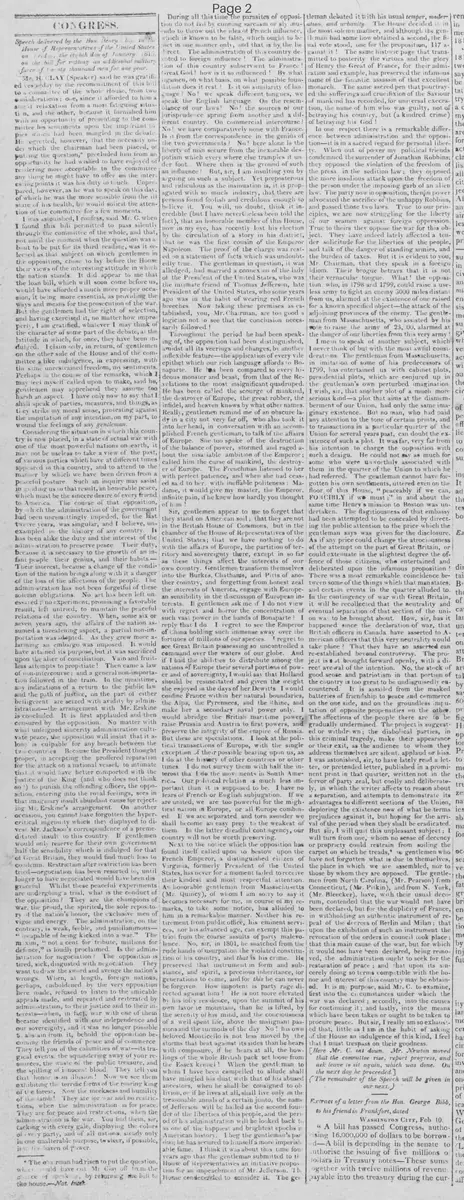
Speech delivered by the Hon. Henry Clay, in the House of Representatives of the United States, on Friday, the eighth day of January last, on the bill for raising an additional military force of twenty thousand men for one year.
Mr. H. CLAY (Speaker) said he was gratified yesterday by the recommitment of this bill to a committee of the whole House, from two considerations; One, since it afforded to him a slight relaxation from a most fatiguing situation, and the other, because it furnished him with an opportunity of presenting to the committee his sentiments upon the important topics which had been mingled in the debate. He regretted, however, that the necessity under which the chairman had been placed, of putting the question, precluded him from an opportunity he had wished to have enjoyed of rendering more acceptable to the committee any thing he might have to offer on the interesting points it was his duty to touch. Unprepared, however, as he was to speak on this day, of which he was the more sensible from the ill state of his health, he would solicit the attention of the committee for a few moments.
I was astonished, I confess, said Mr. C. when I found this bill permitted to pass silently through the committee of the whole, and that, not until the moment when the question was about to be put for its third reading, was it selected as that subject on which gentlemen in the opposition, chose to lay before the House their views of the interesting attitude in which the nation stands. It did appear to me that the loan bill, which will soon come before us, would have afforded a much more proper occasion, it being more essential, as providing the ways and means for the prosecution of the war. But the gentlemen had the right of selection, and having exercised it, no matter how improperly, I am gratified, whatever I may think of the character of some part of the debate, at the latitude in which, for once, they have been indulged. I claim only, in return, of gentlemen on the other side of the House and of the committee a like indulgence, in expressing, with the same unrestrained freedom, my sentiments. Perhaps in the course of the remarks, which I may feel myself called upon to make, said he, gentlemen may apprehend they assume too harsh an aspect. I have only now to say that I shall speak of parties, measures, and things, as they strike my moral sense, protesting against the imputation of any intention, on my part, to wound the feelings of any gentleman.
Considering the situation in which this country is now placed, in a state of actual war with one of the most powerful nations on earth, it may not be useless to take a view of the past, of various parties which have at different times appeared in this country, and to attend to the manner by which we have been driven from a peaceful posture. Such an inquiry may assist in guiding us to that result, an honorable peace, which must be the sincere desire of every friend to America. The course of that opposition, by which the administration of the government had been unremittingly impeded, for the last twelve years, was singular, and I believe, unexampled in the history of any country. It has been alike the duty and the interest of the administration to preserve peace. Their duty, because it is necessary to the growth of an infant people their genius, and their habits. Their interest, because a change of the condition of the nation brings along with it a danger of the loss of the affections of the people. The administration has not been forgetful of these solemn obligations. No art has been left unessayed; no experiment, promising a favorable result, left untried, to maintain the peaceful relations of the country. When, some six or seven years ago, the affairs of the nation assumed a threatening aspect, a partial non-importation was adopted. As they grew more alarming an embargo was imposed. It would have attained its purpose, but it was sacrificed upon the altar of conciliation. Vain and fruitless attempts to propitiate! Then came a law of non-intercourse; and a general non-importation followed in the train. In the meantime, any indications of a return to the public law and the path of justice, on the part of either belligerent are seized with avidity by administration—the arrangement with Mr. Erskine is concluded. It is first applauded and then censured by the opposition. No matter with what unfeigned sincerity administration cultivate peace, the opposition will insist that it alone is culpable for any breach between the two countries. Because the President thought proper, in accepting the proffered reparation for the attack on a national vessel, to intimate that it would have better comported with the justice of the King (and who does not think so) to punish the offending officer, the opposition, entering into the royal feelings, sees in that imaginary insult abundant cause for rejecting Mr. Erskine's arrangement. On another occasion, you cannot have forgotten the hypercritical ingenuity which they displayed to divest Mr. Jackson's correspondence of a premeditated insult to this country. If gentlemen would only reserve for their own government half the sensibility which is indulged for that of Great Britain, they would find much less to condemn. Restriction after restriction has been tried—negotiation has been resorted to, until longer to have negotiated would have been disgraceful. Whilst these peaceful experiments are undergoing a trial, what is the conduct of the opposition? They are the champions of war, the proud, the spirited, the sole repository of the nation's honor, the exclusive men of vigor and energy. The administration, on the contrary, is weak, feeble, and pusillanimous—'incapable of being kicked into a war.' The maxim, 'not a cent for tribute, millions for defense,' is loudly proclaimed. Is the administration for negotiation? The opposition is tired, sick, disgusted with negotiation. They want to draw the sword and avenge the nation's wrongs. When, at length, foreign nations, perhaps, emboldened by the very opposition here made, refused to listen to the amicable appeals made, and repeated and reiterated by administration, to their justice and to their interests—when, in fact, war with one of them became identified with our independence and our sovereignty, and it was no longer possible abstain from it, behold the opposition becoming the friends of peace and of commerce. They tell you of the calamities of war—its tragical events, the squandering away of your resources, the waste of the public treasure, and the spilling of innocent blood. They tell you that honor is an illusion! Now we see them exhibiting the terrific forms of the roaring king of the forest. Now the meekness and humility of the lamb! They are for war and no restrictions, when the administration is for peace. They are for peace and restrictions, when the administration is for war. You find them, sir, tacking with every gale, displaying the colors of every party, and of all nations, steady only in one unalterable purpose, to steer, if possible, into the haven of power.
* The chairman had risen to put the question, which would have cut Mr. Clay off from the chance of speaking, by returning the bill to the house.—Nat. Int.
During all this time the parasites of opposition do not fail by cunning sarcasm or sly innuendo to throw out the idea of French influence, which is known to be false, which ought to be met in one manner only, and that is by the lie direct. The administration of this country devoted to foreign influence! The administration of this country subservient to France! Great God! how is it so influenced! By what argument, on what basis, on what possible foundation does it rest? Is it on similarity of language? No! we speak different tongues, we speak the English language. On the resemblance of our laws? No! the sources of our jurisprudence spring from another and a different country. On commercial intercourse? No! we have comparatively none with France. Is it from the correspondence in the genius of the two governments? No! here alone is the liberty of man secure from the inexorable despotism which everywhere else tramples it under foot. Where then is the ground of such an influence? But, sir, I am insulting you by arguing on such a subject. Yet preposterous and ridiculous as the insinuation is, it is propagated with so much industry, that there are persons found foolish and credulous enough to believe it. You will, no doubt, think it incredible (but I have nevertheless been told the fact), that an honorable member of this House, now in my eye, has recently lost his election by the circulation of a story in his district, that he was the first cousin of the Emperor Napoleon. The proof of the charge was rested on a statement of facts which was undoubtedly true. The gentleman in question, it was alleged, had married a connexion of the lady of the President of the United States, who was the intimate friend of Thomas Jefferson, late President of the United States, who some years ago was in the habit of wearing red French breeches. Now taking these premises as established, you, Mr. Chairman, are too good a logician not to see that the conclusion necessarily followed!
Throughout the period he had been speaking of, the opposition had been distinguished, amidst all its veerings and changes, by another inflexible feature—the application of every vile epithet which our rich language affords to Bonaparte. He has been compared to every hideous monster and beast, from that of the Revelations to the most insignificant quadruped. He has been called the scourge of mankind, the destroyer of Europe, the great robber, the infidel, and heaven knows by what other names. Really, gentlemen remind me of an obscure lady in a city not very far off, who also took it into her head, in conversation with an accomplished French gentleman, to talk of the affairs of Europe. She too spoke of the destruction of the balance of power, stormed and raged about the insatiable ambition of the Emperor; called him the curse of mankind, the destroyer of Europe. The Frenchman listened to her with perfect patience, and when she had ceased said to her, with ineffable politeness: Madame, it would give my master, the Emperor, infinite pain, if he knew how hardly you thought of him!
Sir, gentlemen appear to me to forget that they stand on American soil; that they are not in the British House of Commons, but in the chamber of the House of Representatives of the United States; that we have nothing to do with the affairs of Europe, the partition of territory and sovereignty there, except in so far as these things affect the interests of our own country. Gentlemen transform themselves into the Burkes, Chathams, and Pitts of another country, and forgetting from honest zeal the interests of America, engage with European sensibility in the discussion of European interests. If gentlemen ask me if I do not view with regret and horror the concentration of such vast power in the hands of Bonaparte? I reply that I do. I regret to see the Emperor of China holding such immense sway over the fortunes of millions of our species. I regret to see Great Britain possessing so uncontrolled a command over the waters of our globe. And if I had the abilities to distribute among the nations of Europe their several portions of power and of sovereignty, I would say that Holland should be resuscitated and given the weight she enjoyed in the days of her DeWitts. I would confine France within her natural boundaries, the Alps, the Pyrenees, and the Rhine, and make her a secondary naval power only. I would abridge the British maritime power, raise Prussia and Austria to first powers, and preserve the integrity of the empire of Russia. But these are speculations. I look at the political transactions of Europe, with the single exception of their possible bearing upon us, as I do at the history of other countries or other times. I do not survey them with half the interest that I do the movements in South America. Our political relations much less important than it is supposed to be. I have no tears of French or English subjugation. If we are united, we are too powerful for the mightiest nation in Europe, or all Europe combined. If we are separated and torn asunder we shall become an easy prey to the weakest of them. In the latter dreadful contingency, our country will not be worth preserving.
Next to the notice which the opposition has found itself called upon to bestow upon the French Emperor, a distinguished citizen of Virginia, formerly President of the United States, has never for a moment failed to receive their kindest and most respectful attention. An honorable gentleman from Massachusetts (Mr. Quincy), of whom I am sorry to say it becomes necessary for me, in course of my remarks, to take some notice, has alluded to him in a remarkable manner. Neither his retirement from public office, his eminent services, nor his advanced age, can exempt this patriot from the coarse assaults of party malevolence. No, sir, in 1801, he snatched from the rude hands of usurpation the violated constitution of his country, and that is his crime. He preserved that instrument in form and substance, and spirit, a precious inheritance, for generations to come, and for this he can never be forgiven. How impotent is party rage directed against him! He is not more elevated by his lofty residence, upon the summit of his own favorite mountain, than he is lifted, by the serenity of his mind, and the consciousness of a well spent life, above the malignant passions and the turmoils of the day. No! his own beloved Monticello is not less moved by the storms that beat against its sides than he hears with composure, if he hears at all, the howlings of the whole British pack set loose from the Essex kennel! When the gentleman to whom I have been compelled to allude shall have mingled his dust with that of his abused ancestors, when he shall be consigned to oblivion, or if he lives at all, shall live only in the treasonable annals of a certain junto, the name of Jefferson will be hailed as the second founder of the liberties of this people, and the period of his administration will be looked back to as one of the happiest and brightest epochs in American history. I beg the gentleman's pardon; he has secured to himself a more imperishable fame. I think it was about this time four years ago that the gentleman submitted to the House of Representatives an initiatory proposition for an impeachment of Mr. Jefferson. The House condescended to consider it. The gentleman debated it with his usual temper, moderation, and urbanity. The House decided in the most solemn manner, and although the gentleman had some how obtained a second, the final vote stood, one for the proposition, 117 against it! The same historic page that transmitted to posterity the virtues and the glory of Henry the Great of France, for their admiration and example, has preserved the infamous name of the fanatic assassin of that excellent monarch. The same sacred pen that pourtrayed the sufferings and crucifixion of the Saviour of mankind has recorded, for universal execration, the name of him who was guilty, not of betraying his country, but (a kindred crime) of betraying his God!
In one respect there is a remarkable difference between administration and the opposition—it is in a sacred regard for personal liberty. When out of power my political friends condemned the surrender of Jonathan Robbins; they opposed the violation of the freedom of the press in the sedition law; they opposed the more insidious attack upon the freedom of the person under the imposing garb of an alien law. The party now in opposition, then in power, advocated the sacrifice of the unhappy Robbins, and passed those two laws. True to our principles, we are now struggling for the liberty of our seamen against foreign oppression. True to theirs they oppose the war for this object. They have indeed lately affected a tender solicitude for the liberties of the people, and talk of the danger of standing armies, and the burden of taxes. But it is evident to you, Mr. Chairman, that they speak in a foreign idiom. Their brogue betrays that it is not their vernacular tongue. What! the opposition who, in 1798 and 1799, could raise a useless army to fight an enemy 3000 miles distant from us, alarmed at the existence of one raised for a known specified object—the attack of the adjoining provinces of the enemy. The gentleman from Massachusetts, who assisted by his vote to raise the army of 25,000, alarmed at the danger of our liberties from this very army!
I mean to speak of another subject, which I never think of but with the most awful considerations. The gentleman from Massachusetts, in imitation of some of his predecessors of 1799, has entertained us with cabinet plots, presidential plots, which are conjured up in the gentleman's own perturbed imagination. I wish, sir, that another plot of a much more serious kind—a plot that aims at the dismemberment of our Union, had only the same imaginary existence. But no man, who had paid any attention to the tone of certain prints, and to transactions in a particular quarter of the Union for several years past, can doubt the existence of such a plot. It was far, very far from his intention to charge the opposition with such a design. He could not say as much for some who were unworthily associated with them in the quarter of the Union to which he had referred. The gentleman cannot have forgotten his own sentiments, uttered even on the floor of this House, 'peaceably if we can, FORCIBLY if we must;' in and about the same time Henry’s mission to Boston was undertaken. The flagitiousness of that embassy had been attempted to be concealed by directing the public attention to the price which the gentleman says was given for the disclosure. As if any price could change the atrociousness of the attempt on the part of Great Britain, or could extenuate in the slightest degree the offence of those citizens, who entertained and deliberated upon the infamous proposition. There was a most remarkable coincidence between some of the things which that man states, and certain events in the quarter alluded to. In the contingency of war with Great Britain, it will be recollected that the neutrality and eventual separation of that section of the union was to be brought about. How, sir, has it happened since the declaration of war, that British officers in Canada have asserted to American officers that this very neutrality would take place? That they have so asserted can be established beyond controversy. The project is not brought forward openly, with a direct avowal of the intention. No, the stock of good sense and patriotism in that portion of the country is too great to be undisguisedly encountered. It is assailed from the masked batteries of friendship to peace and commerce on the one side, and on the groundless imputation of opposite propensities on the other. The affections of the people there are to be gradually undermined. The project is suggested or withdrawn; the diabolical parties, in this criminal tragedy, make their appearance or their exit, as the audience to whom they address themselves are silent, applaud or hiss. I was astonished, sir, to have lately read a letter, or pretended letter, published in a prominent print in that quarter, written not in the fervor of party zeal, but coolly and deliberately, in which the writer affects to reason about a separation, and attempts to demonstrate its advantages to different sections of the Union, deploring the existence now of what he terms prejudices against it, but hoping for the arrival of the period when they shall be eradicated. But sir, I will quit this unpleasant subject; I will turn from one, whom no sense of decency or propriety could restrain from soiling the carpet on which he treads,* gentlemen who have not forgotten what is due to themselves, the place in which we are assembled, nor to those by whom they are opposed. The gentlemen from North Carolina, (Mr. Pearson) from Connecticut, (Mr. Pitkin), and from N. York, (Mr. Bleecker), have, with their usual decorum, contended that the war would not have been declared, but for the duplicity of France, in withholding an authentic instrument of repeal of the decrees of Berlin and Milan: that upon the exhibition of such an instrument the revocation of the orders in council took place; that this main cause of the war, but for which it would not have been declared, being removed, the administration ought to seek for the restoration of peace; and that upon its sincerely doing so terms compatible with the honor and interest of this country may be obtained. It is my purpose, said Mr. C. to examine, first into the circumstances under which the war was declared; secondly, into the causes for continuing it: and lastly, into the means which have been taken or ought to be taken to procure peace. But sir, I really am so exhausted that, little as I am in the habit of asking of the House an indulgence of this kind, I feel that I must trespass on their goodness.
Here Mr. C. sat down. Mr. Newton moved that the committee rise, report progress, and ask leave to sit again, which was done. On the next day he proceeded.
The remainder of the Speech will be given in our next.)
What sub-type of article is it?
What themes does it cover?
What keywords are associated?
What entities or persons were involved?
Where did it happen?
Story Details
Key Persons
Location
House Of Representatives Of The United States
Event Date
Friday, The Eighth Day Of January Last
Story Details
Henry Clay defends the administration's efforts to maintain peace before declaring war on Britain, criticizes opposition's inconsistency and pro-British bias, praises Jefferson's legacy, warns of plots to dismember the Union, and supports raising troops for the war's prosecution toward honorable peace.