Thank you for visiting SNEWPapers!
Sign up free
Phenix Gazette
Alexandria, Virginia
What is this article about?
French Foreign Minister's speech in the Chamber of Peers details diplomatic efforts to pacify Greece amid Ottoman resistance, the Battle of Navarino as a defensive action, suspended but unbroken relations with the Porte, and ongoing harmony among the allied powers.
Clipping
OCR Quality
Full Text
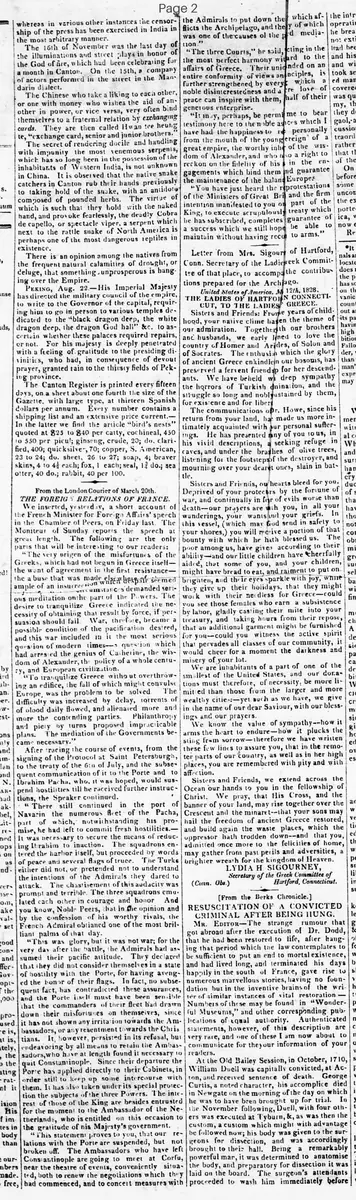
THE FOREIGN RELATIONS OF FRANCE.
We inserted, yesterday, a short account of the French Minister for Foreign Affairs' speech in the Chamber of Peers, on Friday last. The Moniteur of Sunday reports the speech at great length. The following are the only parts that will be interesting to our readers:
"The very origin of the misfortunes of the Greeks, which had not begun in Greece itself—the want of agreement in the first resistance—the abuse that was made over the sad example of an insurrection—circumstances demanded serious meditation on the part of the Powers. The desire to tranquilize Greece indicated the necessity of obtaining that result by force, if persuasion should fail (War, therefore, became a possible condition of the pacification desired, and this war included in it the most serious question of modern times—a question which had arrested the genius of Catherine, the wisdom of Alexander, the policy of a whole century, and European civilization.
"To tranquilize Greece without overthrowing an edifice, the fall of which might convulse Europe, was the problem to be solved. The difficulty was increased by delay, torrents of blood daily flowed, and alienated more and more the contending parties. Philanthropy and piety by turns proposed impracticable plans. The mediation of the Governments became necessary.
After tracing the course of events, from the signing of the Protocol at Saint Petersburg, to the treaty of the 6th of July, and the subsequent communication of it to the Porte and to Ibrahim Pacha, who, it was hoped, would suspend hostilities till he received further instructions, the Speaker continued.
There still continued in the port of Navarin the numerous fleet of the Pacha, part of which, notwithstanding his promise, he had left to commit fresh hostilities. It was necessary to secure the means of reducing Ibrahim to inaction. The squadrons entered the harbor itself, but proceeded by words of peace and several flags of truce. The Turks either did not, or pretended not to understand the intentions of the Admirals they dared to attack. The chastisement of this audacity was prompt and terrible. The three squadrons emulated each other in courage and honor. And you know, Noble Peers, that in the opinion and by the confession of his worthy rivals, the French Admiral obtained one of the most brilliant palms of that day.
"This was glory, but it was not war; for the very day after the battle, the Admirals had assumed their pacific attitude. They declared that they did not consider themselves in a state of hostility with the Porte, for having avenged the honor of their flags. In fact, no subsequent fact, has contradicted these assurances, and the Porte itself must have been sensible that the commanders of their fleet had drawn down their misfortunes on themselves, since it has not shown any irritation towards the Ambassadors, or any resentment towards the Christians. It, however, persisted in its refusal, but endeavoring by all means to retain the Ambassadors, who have at length found it necessary to quit Constantinople. Since their departure the Porte has applied directly to their Cabinets, in order still to keep up some intercourse with them. It has also taken under its special protection the subjects of the three Powers. The interest of those of the King are besides entrusted for the moment to the Ambassador of the Netherlands, who is entitled on this occasion to the gratitude of his Majesty's government.
"This statement proves to you, that our relations with the Porte are suspended, but not broken off. The Ambassadors who have left Constantinople are going to meet at Corfu, near the theatre of events, conveniently situated, both to renew the negotiations which they had commenced, and to concert measures with the Admirals to put down the pirates which infest the Archipelago, and they of which was one of the causes of the bad mediation.
"The three Courts," he said, acting in the most perfect harmony with regard to the entire conformity of views and principles, is further strengthened by every which a noble disinterestedness and a true love of peace can inspire with them, half of their generous enterprise.
"It may, perhaps, be permitted me to bear testimony here to the noble ashes which I have had the happiness to represent personally from the mouth of the young sovereign of a great empire, the worthy heir of the wisdom of Alexander, and who also has a right to reckon on the fidelity of his in the engagements which bind them and guarantee the maintenance of the balance of Europe.
"Of the Ministers of Great Britain and the firm You have just heard the reprotestations intention manifested to you on part of the King, to execute scrupulously treaty which he has subscribed, completes guarantee of a success which we still hope be able to maintain without having recd to arms."
What sub-type of article is it?
What keywords are associated?
What entities or persons were involved?
Where did it happen?
Foreign News Details
Primary Location
Greece
Event Date
Treaty Of The 6th Of July; Battle At Navarin
Key Persons
Outcome
chastisement of turkish audacity at navarin was prompt and terrible; relations with porte suspended but not broken off; ambassadors to meet at corfu
Event Details
French Minister recounts origins of Greek misfortunes, diplomatic mediation from Protocol at Saint Petersburg to treaty of July 6 communicated to Porte and Ibrahim Pacha; squadrons entered Navarin harbor peacefully but faced attack, leading to battle; admirals resumed pacific attitude post-battle; ambassadors left Constantinople, Porte protects subjects and seeks intercourse; plans to renew negotiations and combat pirates at Corfu; harmony among three Courts and fidelity to treaties for European balance.