Thank you for visiting SNEWPapers!
Sign up free
The Recorder, Or, Lady's And Gentleman's Miscellany
Richmond, Virginia
What is this article about?
US Consul Lear reports French fleet of 14 ships of the line and 9 frigates arriving off Cape Francois, St. Domingo on Feb 2, 1802. Blacks under Gen. Christophe resist entry; town burned after cannonade. French under Gen. Leclerc land, clear blacks, save some houses. American shipping protected; property losses ~$200,000, one American killed.
Clipping
OCR Quality
Full Text
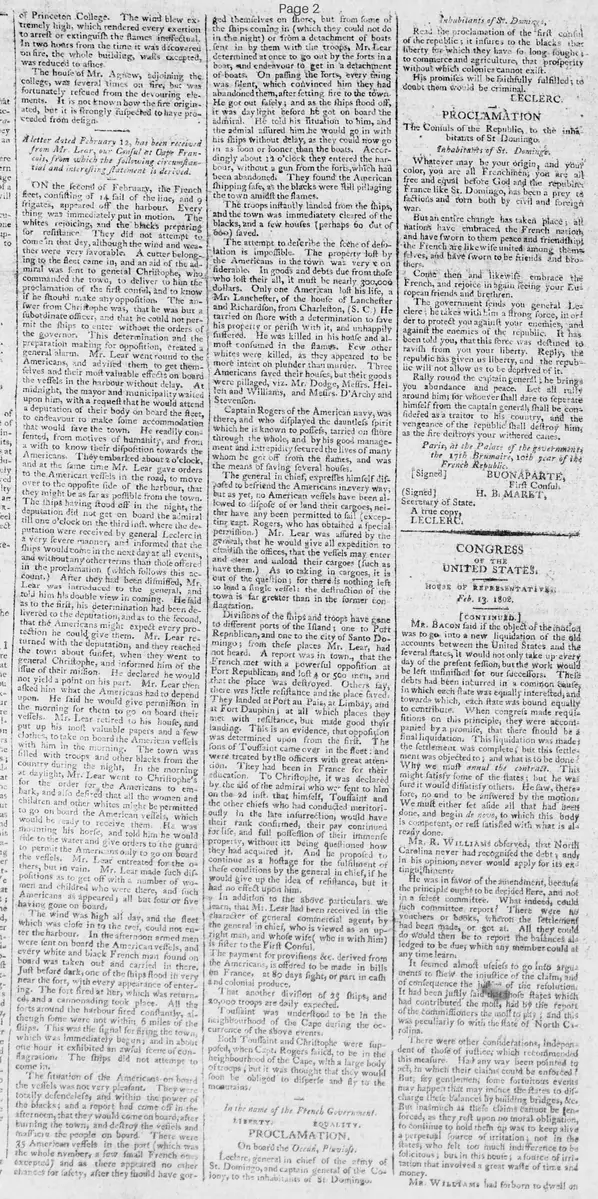
On the Second of February, the French fleet, consisting of 14 sail of the line, and 9 frigates, appeared off the harbour. Every thing was immediately put in motion. The whites rejoicing, and the blacks preparing for resistance. They did not attempt to come in that day, although the wind and weather were very favorable. A cutter belonging to the fleet came in, and an aid of the admiral was sent to general Christophe, who commanded the town, to deliver to him the proclamation of the first consul, and to know if he should make any opposition. The answer from Christophe was, that he was but a subordinate officer, and that he could not permit the ships to enter without the orders of the governor. This determination and the preparation making for opposition, created a general alarm. Mr. Lear went round to the Americans, and advised them to get themselves and their most valuable effects on board the vessels in the harbour without delay. At midnight, the mayor and municipality waited upon him, with a request that he would attend a deputation of their body on board the fleet, to endeavour to make some accommodation that would save the town. He readily consented, from motives of humanity, and from a wish to know their disposition towards the Americans. They embarked about 2 o'clock, and at the same time Mr. Lear gave orders to the American vessels in the road, to move over to the opposite side of the harbour, that they might be as far as possible from the town. The ships having stood close in the night, the deputation did not get on board the admiral till one o'clock on the third inst. where the deputation were received by general Leclerc in a very severe manner, and informed that the ships would come in the next day at all events, and without any other terms than those offered in the proclamation (which follows this account.) After they had been dismissed, Mr. Lear was introduced to the general, and told him his double view in coming. He said as to the first, his determination had been delivered to the deputation, and as to the second, that the Americans might expect every protection he could give them. Mr. Lear returned with the deputation, and they reached the town about sunset, when they went to general Christophe, and informed him of the issue of their mission. He declared he would not yield a point on his part. Mr. Lear then asked him what the Americans had to depend upon. He said he would give permission in the morning for them to go on board their vessels. Mr. Lear retired to his house, and put up his most valuable papers and a few clothes, to take on board the American vessels with him in the morning. The town was filled with troops and other blacks from the country during the night. In the morning at daylight, Mr. Lear went to Christophe's for the order for the Americans to embark, and also desired that all the women and children and other whites might be permitted to go on board the American vessels, which would be ready to receive them. He was mounting his horse, and told him he would ride to the water and give orders to the guard to permit the Americans only to go on board the vessels. Mr. Lear entreated for the others, but in vain. Mr. Lear made such dispositions as to get off with a number of women and children who were there, and such Americans as appeared all but four or five having gone on board. The wind was high all day, and the fleet which was close in to the reef, could not enter the harbour. In the afternoon armed men were sent on board the American vessels, and every white and black French man found on board was taken out and carried in there. Just before dark, one of the ships stood in very near the fort, with every appearance of entering. The fort fired at her, which was returned and a cannonading took place. All the forts around the harbour fired constantly, although some were not within 6 miles of the ships. This was the signal for firing the town, which was immediately begun; and in about one hour it exhibited an awful scene of conflagration. The ships did not attempt to come in.
The situation of the Americans on board the vessels was not very pleasant. They were totally defenceless, and within the power of the blacks; and a report had come off in the afternoon, that they would come on board, after burning the town, and destroy the vessels and massacre the people on board. There were 35 American vessels in the port (which was the whole number, a few small French ones excepted) and as there appeared no other chances for safety, after they should have got themselves on shore, but from some of the ships coming in (which they could not do in the night) or from a detachment of boats sent in by them with the troops. Mr. Lear determined at once to go out by the forts in a boat, and endeavour to get in a detachment of boats. On passing the Forts, every thing was silent, which convinced him they had abandoned them, after setting fire to the town. He got out safely; and as the Ships stood off, it was daylight before he got on board the admiral. He told his situation to him, and the admiral assured him he would go in with his ships without delay, as they could now go in as soon or sooner than the boats. Accordingly about 12 o'clock they entered the harbour, without a gun from the forts, which had been abandoned. They found the American shipping safe, as the blacks were still pillaging the town amidst the flames. The troops instantly landed from the ships, and the town was immediately cleared of the blacks, and a few houses (perhaps 60 out of 660) saved.
The attempt to describe the scene of desolation is impossible. The property lost by the Americans in the town was very considerable. In goods and debts due from those who lost their all, it must be nearly 200,000 dollars. Only one American lost his life, a Mr. Lanchester, of the house of Lanchester and Richardson, from Charleston, (S. C.) He tarried on shore with a determination to save his property or perish with it, and unhappily suffered. He was killed in his house and almost consumed in the flames. Few other whites were killed, as they appeared to be more intent on plunder than murder. Three Americans saved their houses, but their goods were pillaged, viz. Mr. Dodge, Messrs. Helieh and Williams, and Messrs. D'Archy and Stevenson.
Captain Rogers of the American navy, was there, and who displayed the dauntless spirit which he is known to possess, tarried on shore through the whole, and by his good management and intrepidity secured the lives of many whom he got off from the flames, and was the means of saving several houses.
The general in chief, expresses himself disposed to befriend the Americans in every way; but as yet, no American vessels have been allowed to dispose of or land their cargoes, neither have any been permitted to sail (excepting capt. Rogers, who has obtained a special permission.) Mr. Lear was assured by the general, that he would give all expedition to establish the offices, that the vessel may enter and clear and unload their cargoes (such as have them.) As to taking in cargoes, it is out of the question; for there is nothing left to load a single vessel: the destruction of the town is far greater than in the former conflagration.
Divisions of the ships and troops have gone to different ports of the Island; one to Port Republican, and one to the city of Santo Domingo; from these places Mr. Lear, had not heard. A report was in town, that the French met with a powerful opposition at Port Republican, and lost 4 or 500 men, and that the place was destroyed. Others say, there was little resistance and the place saved: They landed at Port au Prince, at Limbé, and at Fort Dauphin; at all which places they met with resistance, but made good their landing. This is an evidence, that opposition was determined upon from the first. The sons of Toussaint came over in the fleet: and were treated by the officers with great attention. They had been in France for their education. To Christophe, it was declared by the aid of the admiral who was sent to him on the 2d inst. that himself, Toussaint and the other chiefs who had conducted meritoriously in the late insurrection; would have their rank confirmed, their pay continued for life, and full possession of their immense property, without its being questioned how they had acquired it. And he proposed to continue as a hostage for the fulfilment of these conditions by the general in chief, if he would give up the idea of resistance, but it had no effect upon him.
In addition to the above particulars we learn, that Mr. Lear had been received in the character of general commercial agent, by the general in chief, who is viewed as an upright man, and whose wife (who is with him) is sister to the First Consul.
The payment for provisions &c. derived from the Americans, is offered to be made in bills on France, at 80 days sight or part in cash and colonial produce.
That another division of 25 ships, and 20,000 troops are daily expected.
Toussaint was understood to be in the neighbourhood of the Cape during the occurrence of the above events:
Both Toussaint and Christophe were supposed, when Capt. Rogers sailed, to be in the neighbourhood of the Cape, with a large body of troops; but it was thought that they would soon be obliged to disperse and fly to the mountains.
In the name of the French Government.
LIBERTY
EQUALITY.
PROCLAMATION.
On board the Océan, Pluviose Leclerc, general in chief of the army of St. Domingo, and captain general of the Colony, to the inhabitants of St. Domingos
Inhabitants of St. Domingo,
Read the proclamation of the first consul of the republic; it insures to the blacks that liberty for which they have so long sought; to commerce and agriculture, that prosperity without which colonies cannot exist.
His promises will be faithfully fulfilled: to doubt them would be criminal.
LECLERC.
PROCLAMATION
The Consuls of the Republic, to the inhabitants of St. Domingo:
Inhabitants of St. Domingo.
Whatever may be your origin, and your color, you are all Frenchmen; you are all free and equal before God and the republic: France like St. Domingo, has been a prey to factions and torn both by civil and foreign war.
But an entire change has taken place: all nations have embraced the French nation and have sworn to them peace and friendship the French are likewise united among themselves, and have sworn to be friends and brothers.
Come then and likewise embrace the French, and rejoice in again seeing your European friends and brethren.
The government sends you general Leclerc: he takes with him a strong force, in order to protect you against your enemies, and against the enemies of the republic. It has been told you, that this force was destined to ravish from you your liberty. Reply, the republic has given us liberty, and the republic will not allow us to be deprived of it.
Rally round the captain general; he brings you abundance and peace. Let all rally around him; for whoever shall dare to separate himself from the captain general, shall be considered as a traitor to his country, and the vengeance of the Republic shall destroy him as the fire destroys your withered canes.
Paris at the Palace of the government the 17th Brumaire, 10th year of the French Republic.
[Signed]
BUONAPARTE.
First Consul
(Signed)
H. B. MARET,
Secretary of State.
A true copy,
LECLERC.
What sub-type of article is it?
What keywords are associated?
What entities or persons were involved?
Where did it happen?
Foreign News Details
Primary Location
Cape Francois, St. Domingo
Event Date
February 2 3, 1802
Key Persons
Outcome
town of cape francois largely destroyed by fire (60 of 660 houses saved); american property losses nearly 200,000 dollars; one american (mr. lanchester) killed; french troops land and clear blacks; american shipping protected; french divisions proceed to other ports with mixed reports of resistance.
Event Details
French fleet arrives off Cape Francois on Feb 2; Christophe refuses entry without governor's orders. Deputation including Lear fails to negotiate; Americans evacuate to ships. Cannonade leads to town burning by blacks. Lear secures French entry on Feb 3; troops land, expel blacks. Proclamations from Leclerc and First Consul urge submission. Reports of landings at other ports; Toussaint nearby with troops.