Thank you for visiting SNEWPapers!
Sign up free
Literary
March 29, 1853
Daily Evening Star
Washington, District Of Columbia
What is this article about?
A moral tale about three carpenters and their wives in Bell Air. Jones's home is obsessively neat but uncomfortable due to his wife's nagging. Yates's is disorderly and quarrelsome. Fields's is clean, cheerful, and welcoming, making him happiest. The other wives reform, learning the 'magic of neatness' for happy homes.
Merged-components note: Continuation of the story 'The Three Homes; Or, The Magic of Neatness' across pages, maintaining coherent narrative flow.
Clippings
1 of 2
OCR Quality
95%
Excellent
Full Text
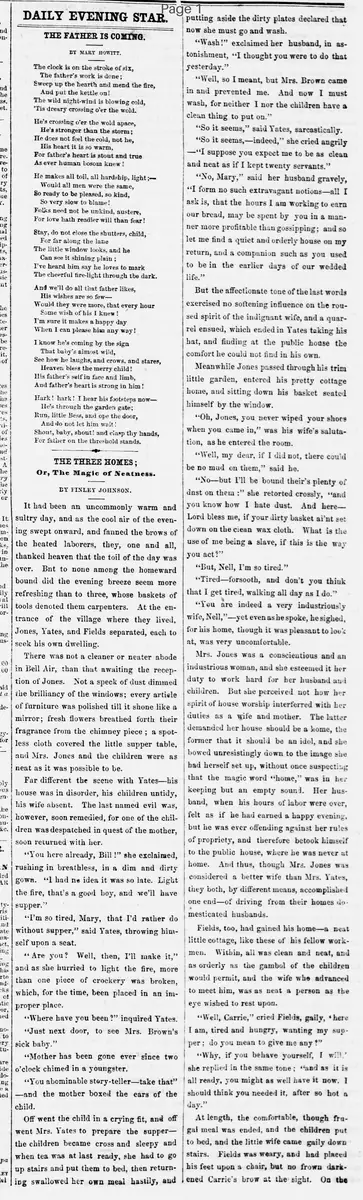
THE THREE HOMES;
Or, The Magic of Neatness.
BY FINLEY JOHNSON.
It had been an uncommonly warm and sultry day, and as the cool air of the evening swept onward, and fanned the brows of the heated laborers, they, one and all, thanked heaven that the toil of the day was over.
But to none among the homeward bound did the evening breeze seem more refreshing than to three, whose baskets of tools denoted them carpenters. At the entrance of the village where they lived, Jones, Yates, and Fields separated, each to seek his own dwelling.
There was not a cleaner or neater abode in Bell Air, than that awaiting the reception of Jones. Not a speck of dust dimmed the brilliancy of the windows; every article of furniture was polished till it shone like a mirror; fresh flowers breathed forth their fragrance from the chimney piece; a spotless cloth covered the little supper table, and Mrs. Jones and the children were as neat as it was possible to be.
Far different the scene with Yates-his house was in disorder, his children untidy, his wife absent. The last named evil was, however, soon remedied, for one of the children was despatched in quest of the mother, soon returned with her.
"You here already, Bill!" she exclaimed, rushing in breathless, in a dim and dirty gown. "I had no idea it was so late. Light the fire, that's a good boy, and we'll have supper."
"I'm so tired, Mary, that I'd rather do without supper," said Yates, throwing himself upon a seat.
"Are you? Well, then, I'll make it," and as she hurried to light the fire, more than one piece of crockery was broken, which, for the time, had been placed in an improper place.
"Where have you been?" inquired Yates.
"Just next door, to see Mrs. Brown's sick baby."
"Mother has been gone ever since two o'clock chimed in a youngster."
"You abominable story-teller--take that"-and the mother boxed the ears of the child.
Off went the child in a crying fit, and off went Mrs. Yates to prepare the supper-the children became cross and sleepy and when tea was at last ready, she had to go up stairs and put them to bed, then returning swallowed her own meal hastily, and putting aside the dirty plates declared that now she must go and wash.
"Wash!" exclaimed her husband, in astonishment, "I thought you were to do that yesterday."
"Well, so I meant, but Mrs. Brown came in and prevented me. And now I must wash, for neither I nor the children have a clean thing to put on."
"So it seems," said Yates, sarcastically.
"So it seems,--indeed," she cried angrily-"I suppose you expect me to be as clean and neat as if I kept twenty servants."
"No, Mary," said her husband gravely, "I form no such extravagant notions-all I ask is, that the hours I am working to earn our bread, may be spent by you in a manner more profitable than gossipping; and so let me find a quiet and orderly house on my return, and a companion such as you used to be in the earlier days of our wedded life."
But the affectionate tone of the last words exercised no softening influence on the roused spirit of the indignant wife, and a quarrel ensued, which ended in Yates taking his hat, and finding at the public house the comfort he could not find in his own.
Meanwhile Jones passed through his trim little garden, entered his pretty cottage home, and sitting down his basket seated himself by the window.
"Oh, Jones, you never wiped your shoes when you came in," was his wife's salutation, as he entered the room.
"Well, my dear, if I did not, there could be no mud on them," said he.
"No-but I'll be bound there's plenty of dust on them:" she retorted crossly, "and you know how I hate dust. And here-Lord bless me, if your dirty basket ain't set down on the clean wax cloth. What is the use of me being a slave, if this is the way you act?"
"But, Nell, I'm so tired."
"Tired-forsooth, and don't you think that I get tired, walking all day as I do."
"You are indeed a very industrious wife, Nell,"-yet even as he spoke, he sighed, for his home, though it was pleasant to look at, was very uncomfortable.
Mrs. Jones was a conscientious and an industrious woman, and she esteemed it her duty to work hard for her husband and children. But she perceived not how her spirit of house worship interfered with her duties as a wife and mother. The latter demanded her house should be a home, the former that it should be an idol, and she bowed unresistingly down to the image she had herself set up, without once suspecting that the magic word "home," was in her keeping but an empty sound. Her husband, when his hours of labor were over, felt as if he had earned a happy evening, but he was ever offending against her rules of propriety, and therefore betook himself to the public house, where he was never at home. And thus, though Mrs. Jones was considered a better wife than Mrs. Yates, they both, by different means, accomplished one end-of driving from their homes domesticated husbands.
Fields, too, had gained his home-a neat little cottage, like those of his fellow workmen.
Within, all was clean and neat, and as orderly as the gambol of the children would permit, and the wife who advanced to meet him, was as neat a person as the eye wished to rest upon.
"Well, Carrie," cried Fields, gaily, "here I am, tired and hungry, wanting my supper; do you mean to give me any?"
"Why, if you behave yourself, I will," she replied in the same tone: "and as it is all ready, you might as well have it now. I should think you needed it, after so hot a day."
At length, the comfortable, though frugal meal was ended, and the children put to bed, and the little wife came gaily down stairs. Fields was weary, and had placed his feet upon a chair, but no frown darkened Carrie's brow at the sight. On the contrary, she drew her seat near him, and with her hand in his, talked of their future prospects, and of the time when they would have a better home, and more of the comforts of life. And as Fields looked into the bright face of his cheerful wife, he felt that he was indeed a happy man, and that no palace could be more beautiful than the neat little cottage he called his home.
Contrary, she advanced good humoredly to his side, and inquired if she should go on with the book she had been reading the previous evening, or if he would rather chat, while she worked. But the pleasure of listening to an interesting book was far greater to the weary man, than that of hearing the village gossip, and so Carrie read on till bed time.
Time passed on, and with it Mrs. Yates grew more careless, and fond of gossip; Mrs. Jones a more devoted house slave; and their husbands as a necessary consequence, grew more attached to ale house company; while Carrie Fields pursued the even tenor of her way, contented, neat, cheerful and good tempered. Her house a heaven of peace and happiness, to which her husband ever returned with pleasure, and herself most happy in making him so.
One day Carrie was busily engaged in weeding her little garden, when Mrs. Yates passed by, and seeing her, paused to chat a bit.
"You have not seen the new cloak Fields bought me on my birth-day," said Carrie.
"No. I've not, but I'll come in now." And Mrs. Yates entered.
"Upon my word, it's a pretty cloak—I wish I could afford such a one," said Mrs. Y. "And how nice you have everything around you, I wish I could be as comfortable."
"And why should you not?" said Carrie. "Your husband has the same wages as mine."
"Ah! but your husband does not spend so much of his money at the public house."
"No, he never enters it."
"And yet, when we were both married, everybody said mine was the best match, because Yates was the steadiest man. I can't think how you manage to keep him at home."
"By making it neat, clean, and comfortable, by letting him find his supper waiting for him and his wife and children ready to welcome him and keep him company."
Mrs. Yates stood for a moment silent and self-convicted. She said little to Mrs. Field, but bidding her soon, "good day," sped home resolving as she went, that if her husband's reformation depended on hers, it should be set about without delay.
That evening, at the usual hour, the three men returned to Bell Air; Fields jesting on the way, for his heart was light, the others dull and weary, for they were exhausted by their day's work, and had no bright home thoughts to cheer them. At length Yates parted with his companions, and sauntered slowly homeward, knowing that however late he might be, he always was too soon. At last he reached his home but stood still in astonishment at the scene before him, almost doubting whether he had not entered the wrong door. The room was swept and dusted, and everything was put in its place, the supper was ready, and the children neat.
But the next moment his wife entered, and then he knew his home again, for her own dress was a matter that, amid all her reformations, she had quite overlooked. But these she had effected, sufficed for the time, for, pleased with the unwonted comfort, her husband remained contented at home.
A proud and happy woman that night was Mrs. Yates. She looked upon the victory as already gained, and great was her disappointment when on the following evening, Yates went to a public house. The next morning she took her way to Mrs. Fields cottage, to communicate to her the hopes and fears of the last two days.
"You must not be downhearted," said Carrie, "only go on in the way you have began, and before long your husband will sit at home of an evening as happy and contented as mine does."
"Do you really think so?" said Mrs. Yates, wiping away the tears.
"To be sure I do," said Carrie, gaily; "and now I'll tell you what I'll do—I'll lend you a book, read a little of it to Mr. Yates of an evening, and when it is ended you shall have another."
"Thank you"—and Mrs. Yates, full of hope, departed. Carrie looked after her a moment, and then calling her back, exclaimed:
"Whatever you do, Mrs. Yates, don't forget to put on a clean gown before evening."
Mrs. Yates took both pieces of advice—she put on the clean gown, and she read the book, and they both answered excellently.
Carrie had proved a true prophet, and at the end of a year or two both seemed reformed, and were as happy and peaceful in their neat little cottage, as any couple in Bell Air.
Meanwhile months came and went, and brought no spell upon their wings for Jones' happiness. One evening there had been the usual display of great anger for little sins, when Jones, weary of the share that fell upon himself, pushed back his chair, and rising, turned to leave the house.
"And now," said Mrs. Jones, drily, "I suppose because you are not allowed to make everything in a mess, you are going to the public house to spend your money."
"No," replied he, quietly, "I am going down to Yates."
"To Yates," repeated his wife, contemptuously. "Truly you have a good taste to choose a dirty house like that."
"Mrs. Yates does not keep a house dirty now; it is as neat and clean as any one need to see," replied Jones, "and what is more, she lets her husband live in it in peace and quietness, and good temper."
Peace, and quietness, and good temper—how those words echoed in Mrs. Jones's ears, long after her husband had left the house.
Yet, peace, quietness and good temper, conscience whispered her, were not to be found in her dwelling. There was an error somewhere—she had always been used to ascribe it wholly to her husband, but could it be possible that it existed as much, perhaps more, in herself.
Mrs. Jones took council of none save her own heart and her own conscience. But, in the end they guided her aright; though painful indeed were the efforts made to follow their dictates, and much it cost her to sacrifice, even in part, the habits which had grown upon her, until they almost seemed a portion of herself. But time and good intentions on both sides brought back the peace and happiness which seemed to have deserted their dwelling; and at length the faces within it grew as bright as the tables which were ready to mirror them; for the neatest cottage in Bell Air became one of its most cheerful and best loved homes.
Or, The Magic of Neatness.
BY FINLEY JOHNSON.
It had been an uncommonly warm and sultry day, and as the cool air of the evening swept onward, and fanned the brows of the heated laborers, they, one and all, thanked heaven that the toil of the day was over.
But to none among the homeward bound did the evening breeze seem more refreshing than to three, whose baskets of tools denoted them carpenters. At the entrance of the village where they lived, Jones, Yates, and Fields separated, each to seek his own dwelling.
There was not a cleaner or neater abode in Bell Air, than that awaiting the reception of Jones. Not a speck of dust dimmed the brilliancy of the windows; every article of furniture was polished till it shone like a mirror; fresh flowers breathed forth their fragrance from the chimney piece; a spotless cloth covered the little supper table, and Mrs. Jones and the children were as neat as it was possible to be.
Far different the scene with Yates-his house was in disorder, his children untidy, his wife absent. The last named evil was, however, soon remedied, for one of the children was despatched in quest of the mother, soon returned with her.
"You here already, Bill!" she exclaimed, rushing in breathless, in a dim and dirty gown. "I had no idea it was so late. Light the fire, that's a good boy, and we'll have supper."
"I'm so tired, Mary, that I'd rather do without supper," said Yates, throwing himself upon a seat.
"Are you? Well, then, I'll make it," and as she hurried to light the fire, more than one piece of crockery was broken, which, for the time, had been placed in an improper place.
"Where have you been?" inquired Yates.
"Just next door, to see Mrs. Brown's sick baby."
"Mother has been gone ever since two o'clock chimed in a youngster."
"You abominable story-teller--take that"-and the mother boxed the ears of the child.
Off went the child in a crying fit, and off went Mrs. Yates to prepare the supper-the children became cross and sleepy and when tea was at last ready, she had to go up stairs and put them to bed, then returning swallowed her own meal hastily, and putting aside the dirty plates declared that now she must go and wash.
"Wash!" exclaimed her husband, in astonishment, "I thought you were to do that yesterday."
"Well, so I meant, but Mrs. Brown came in and prevented me. And now I must wash, for neither I nor the children have a clean thing to put on."
"So it seems," said Yates, sarcastically.
"So it seems,--indeed," she cried angrily-"I suppose you expect me to be as clean and neat as if I kept twenty servants."
"No, Mary," said her husband gravely, "I form no such extravagant notions-all I ask is, that the hours I am working to earn our bread, may be spent by you in a manner more profitable than gossipping; and so let me find a quiet and orderly house on my return, and a companion such as you used to be in the earlier days of our wedded life."
But the affectionate tone of the last words exercised no softening influence on the roused spirit of the indignant wife, and a quarrel ensued, which ended in Yates taking his hat, and finding at the public house the comfort he could not find in his own.
Meanwhile Jones passed through his trim little garden, entered his pretty cottage home, and sitting down his basket seated himself by the window.
"Oh, Jones, you never wiped your shoes when you came in," was his wife's salutation, as he entered the room.
"Well, my dear, if I did not, there could be no mud on them," said he.
"No-but I'll be bound there's plenty of dust on them:" she retorted crossly, "and you know how I hate dust. And here-Lord bless me, if your dirty basket ain't set down on the clean wax cloth. What is the use of me being a slave, if this is the way you act?"
"But, Nell, I'm so tired."
"Tired-forsooth, and don't you think that I get tired, walking all day as I do."
"You are indeed a very industrious wife, Nell,"-yet even as he spoke, he sighed, for his home, though it was pleasant to look at, was very uncomfortable.
Mrs. Jones was a conscientious and an industrious woman, and she esteemed it her duty to work hard for her husband and children. But she perceived not how her spirit of house worship interfered with her duties as a wife and mother. The latter demanded her house should be a home, the former that it should be an idol, and she bowed unresistingly down to the image she had herself set up, without once suspecting that the magic word "home," was in her keeping but an empty sound. Her husband, when his hours of labor were over, felt as if he had earned a happy evening, but he was ever offending against her rules of propriety, and therefore betook himself to the public house, where he was never at home. And thus, though Mrs. Jones was considered a better wife than Mrs. Yates, they both, by different means, accomplished one end-of driving from their homes domesticated husbands.
Fields, too, had gained his home-a neat little cottage, like those of his fellow workmen.
Within, all was clean and neat, and as orderly as the gambol of the children would permit, and the wife who advanced to meet him, was as neat a person as the eye wished to rest upon.
"Well, Carrie," cried Fields, gaily, "here I am, tired and hungry, wanting my supper; do you mean to give me any?"
"Why, if you behave yourself, I will," she replied in the same tone: "and as it is all ready, you might as well have it now. I should think you needed it, after so hot a day."
At length, the comfortable, though frugal meal was ended, and the children put to bed, and the little wife came gaily down stairs. Fields was weary, and had placed his feet upon a chair, but no frown darkened Carrie's brow at the sight. On the contrary, she drew her seat near him, and with her hand in his, talked of their future prospects, and of the time when they would have a better home, and more of the comforts of life. And as Fields looked into the bright face of his cheerful wife, he felt that he was indeed a happy man, and that no palace could be more beautiful than the neat little cottage he called his home.
Contrary, she advanced good humoredly to his side, and inquired if she should go on with the book she had been reading the previous evening, or if he would rather chat, while she worked. But the pleasure of listening to an interesting book was far greater to the weary man, than that of hearing the village gossip, and so Carrie read on till bed time.
Time passed on, and with it Mrs. Yates grew more careless, and fond of gossip; Mrs. Jones a more devoted house slave; and their husbands as a necessary consequence, grew more attached to ale house company; while Carrie Fields pursued the even tenor of her way, contented, neat, cheerful and good tempered. Her house a heaven of peace and happiness, to which her husband ever returned with pleasure, and herself most happy in making him so.
One day Carrie was busily engaged in weeding her little garden, when Mrs. Yates passed by, and seeing her, paused to chat a bit.
"You have not seen the new cloak Fields bought me on my birth-day," said Carrie.
"No. I've not, but I'll come in now." And Mrs. Yates entered.
"Upon my word, it's a pretty cloak—I wish I could afford such a one," said Mrs. Y. "And how nice you have everything around you, I wish I could be as comfortable."
"And why should you not?" said Carrie. "Your husband has the same wages as mine."
"Ah! but your husband does not spend so much of his money at the public house."
"No, he never enters it."
"And yet, when we were both married, everybody said mine was the best match, because Yates was the steadiest man. I can't think how you manage to keep him at home."
"By making it neat, clean, and comfortable, by letting him find his supper waiting for him and his wife and children ready to welcome him and keep him company."
Mrs. Yates stood for a moment silent and self-convicted. She said little to Mrs. Field, but bidding her soon, "good day," sped home resolving as she went, that if her husband's reformation depended on hers, it should be set about without delay.
That evening, at the usual hour, the three men returned to Bell Air; Fields jesting on the way, for his heart was light, the others dull and weary, for they were exhausted by their day's work, and had no bright home thoughts to cheer them. At length Yates parted with his companions, and sauntered slowly homeward, knowing that however late he might be, he always was too soon. At last he reached his home but stood still in astonishment at the scene before him, almost doubting whether he had not entered the wrong door. The room was swept and dusted, and everything was put in its place, the supper was ready, and the children neat.
But the next moment his wife entered, and then he knew his home again, for her own dress was a matter that, amid all her reformations, she had quite overlooked. But these she had effected, sufficed for the time, for, pleased with the unwonted comfort, her husband remained contented at home.
A proud and happy woman that night was Mrs. Yates. She looked upon the victory as already gained, and great was her disappointment when on the following evening, Yates went to a public house. The next morning she took her way to Mrs. Fields cottage, to communicate to her the hopes and fears of the last two days.
"You must not be downhearted," said Carrie, "only go on in the way you have began, and before long your husband will sit at home of an evening as happy and contented as mine does."
"Do you really think so?" said Mrs. Yates, wiping away the tears.
"To be sure I do," said Carrie, gaily; "and now I'll tell you what I'll do—I'll lend you a book, read a little of it to Mr. Yates of an evening, and when it is ended you shall have another."
"Thank you"—and Mrs. Yates, full of hope, departed. Carrie looked after her a moment, and then calling her back, exclaimed:
"Whatever you do, Mrs. Yates, don't forget to put on a clean gown before evening."
Mrs. Yates took both pieces of advice—she put on the clean gown, and she read the book, and they both answered excellently.
Carrie had proved a true prophet, and at the end of a year or two both seemed reformed, and were as happy and peaceful in their neat little cottage, as any couple in Bell Air.
Meanwhile months came and went, and brought no spell upon their wings for Jones' happiness. One evening there had been the usual display of great anger for little sins, when Jones, weary of the share that fell upon himself, pushed back his chair, and rising, turned to leave the house.
"And now," said Mrs. Jones, drily, "I suppose because you are not allowed to make everything in a mess, you are going to the public house to spend your money."
"No," replied he, quietly, "I am going down to Yates."
"To Yates," repeated his wife, contemptuously. "Truly you have a good taste to choose a dirty house like that."
"Mrs. Yates does not keep a house dirty now; it is as neat and clean as any one need to see," replied Jones, "and what is more, she lets her husband live in it in peace and quietness, and good temper."
Peace, and quietness, and good temper—how those words echoed in Mrs. Jones's ears, long after her husband had left the house.
Yet, peace, quietness and good temper, conscience whispered her, were not to be found in her dwelling. There was an error somewhere—she had always been used to ascribe it wholly to her husband, but could it be possible that it existed as much, perhaps more, in herself.
Mrs. Jones took council of none save her own heart and her own conscience. But, in the end they guided her aright; though painful indeed were the efforts made to follow their dictates, and much it cost her to sacrifice, even in part, the habits which had grown upon her, until they almost seemed a portion of herself. But time and good intentions on both sides brought back the peace and happiness which seemed to have deserted their dwelling; and at length the faces within it grew as bright as the tables which were ready to mirror them; for the neatest cottage in Bell Air became one of its most cheerful and best loved homes.
What sub-type of article is it?
Prose Fiction
What themes does it cover?
Moral Virtue
Social Manners
What keywords are associated?
Domestic Life
Neatness
Home
Marriage
Moral Tale
Carpenters
Wives
Reform
Gossip
Public House
What entities or persons were involved?
By Finley Johnson.
Literary Details
Title
The Three Homes; Or, The Magic Of Neatness.
Author
By Finley Johnson.
Key Lines
"By Making It Neat, Clean, And Comfortable, By Letting Him Find His Supper Waiting For Him And His Wife And Children Ready To Welcome Him And Keep Him Company."
"Peace, And Quietness, And Good Temper—How Those Words Echoed In Mrs. Jones's Ears, Long After Her Husband Had Left The House."
The Magic Word "Home," Was In Her Keeping But An Empty Sound.
Her House A Heaven Of Peace And Happiness, To Which Her Husband Ever Returned With Pleasure