Thank you for visiting SNEWPapers!
Sign up free
Domestic News
September 9, 1887
The Semi Weekly Fisherman & Farmer
Edenton, Chowan County, North Carolina
What is this article about?
Collection of practical farming and gardening advice, including tips on attracting birds, feeding pigs and poultry, weed control, tree pruning, and animal care to improve yields and health.
Clipping
OCR Quality
98%
Excellent
Full Text
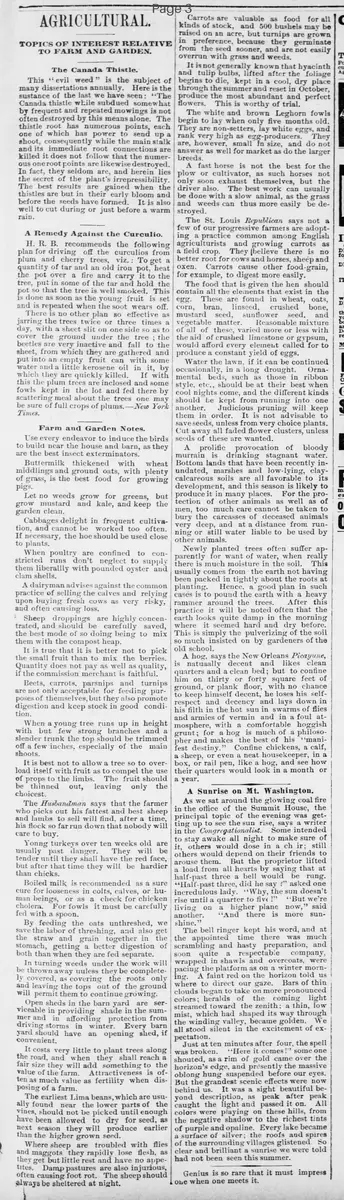
Farm and Garden Notes.
Use every endeavor to induce the birds to build near the house and barn, as they are the best insect exterminators.
Buttermilk thickened with wheat middlings and ground oats, with plenty of grass, is the best food for growing pigs.
Let no weeds grow for greens, but grow mustard and kale, and keep the garden clean.
Cabbages delight in frequent cultivation, and cannot be worked too often. If necessary, the hoe should be used close to plants.
When poultry are confined to constricted runs don't neglect to supply them liberally with pounded oyster and clam shells.
A dairyman advises against the common practice of selling the calves and relying upon buying fresh cows as very risky, and often causing loss.
Sheep droppings are highly concentrated, and should be carefully saved, the best mode of so doing being to mix them with the compost heap.
It is true that it is better not to pick the small fruit than to mix the berries. Quantity does not pay as well as quality, if the commission merchant is faithful.
Beets, carrots, parsnips and turnips are not only acceptable for feeding purposes of themselves, but they also promote digestion and keep stock in good condition.
When a young tree runs up in height with but few strong branches and a slender trunk the top should be trimmed off a few inches, especially of the main shoots.
It is best not to allow a tree so to overload itself with fruit as to compel the use of props to the limbs. The fruit should be thinned out, leaving only the choicest.
The Husbandman says that the farmer who picks out his fattest and best sheep and lambs to sell will find, after a time, his flock so far run down that nobody will care to buy.
Young turkeys over ten weeks old are usually past danger. They will be tender until they shall have the red face, but after that time they will be hardier than chicks.
Boiled milk is recommended as a sure cure for looseness in colts, calves, or human beings, or as a check for chicken cholera. For fowls it must be carefully fed with a spoon.
By feeding the oats unthreshed, we save the labor of threshing, and also get the straw and grain together in the stomach, getting a better digestion of both than when they are fed separate.
In turning weeds under the work will be thrown away unless they be completely covered, as covering the roots only and leaving the tops out of the ground will permit them to continue growing.
Open sheds in the barn yard are serviceable in providing shade in the summer and in affording protection from driving storms in winter. Every barn yard should have an opening shed, if convenient.
It costs very little to plant trees along the road, and when they shall reach a fair size they will add something to the value of the farm. Attractiveness is often as much value as fertility when disposing of a farm.
The earliest Lima beans, which are usually found near the lower parts of the vines, should not be picked until enough have been allowed to dry for seed, as next season they will produce earlier than the higher grown seed.
Where sheep are troubled with flies and maggots they rapidly lose flesh, as they get but little rest and have no appetites. Damp pastures are also injurious, often causing foot rot. The sheep should always be sheltered at night.
Carrots are valuable as food for all kinds of stock, and 500 bushels may be raised on an acre, but turnips are grown in preference, because they germinate from the seed sooner, and are not easily overrun with grass and weeds.
It is not generally known that hyacinth and tulip bulbs, lifted after the foliage begins to die, kept in a cool, dry place through the summer and reset in October, produce the most abundant and perfect flowers. This is worthy of trial.
The white and brown Leghorn fowls begin to lay when only five months old. They are non-setters, lay white eggs, and rank very high as egg-producers. They are, however, small in size, and do not answer as well for market as do the larger breeds.
A fast horse is not the best for the plow or cultivator, as such horses not only soon exhaust themselves, but the driver also. The best work can usually be done with a slow animal, as the grass and weeds can thus more easily be destroyed.
The St. Louis Republican says not a few of our progressive farmers are adopting a practice common among English agriculturists and growing carrots as a field crop. They believe there is no better root for cows and horses, sheep and oxen. Carrots cause other food-grain, for example, to digest more easily.
The food that is given the hens should contain all the elements that exist in the egg. These are found in wheat, oats, corn, bran, linseed, crushed bone, mustard seed, sunflower seed, and vegetable matter. Reasonable mixture of all of these, varied more or less with the aid of crushed limestone or gypsum, would afford every element called for to produce a constant yield of eggs.
Water the lawn, if it can be continued occasionally, in a long drought. Ornamental beds, such as those in ribbon style, etc., should be at their best when cool nights come, and the different kinds should be kept from running into one another. Judicious pruning will keep them in order. It is not advisable to save seeds, unless from very choice plants. Cut away all faded flower clusters, unless seeds of these are wanted.
A prolific provocation of bloody murrain is drinking stagnant water. Bottom lands that have been recently inundated, marshes and low-lying, clay-calcareous soils are all favorable to its development, and this season is likely to produce it in many places. For the protection of other animals as well as of men, too much care cannot be taken to bury the carcasses of deceased animals very deep, and at a distance from running or still water liable to be used by other animals.
Newly planted trees often suffer apparently for want of water, when really there is much moisture in the soil. This usually comes from the earth not having been packed in tightly about the roots at planting. Hence, a good plan in such cases is to pound the earth with a heavy rammer around the trees. After this practice it will be noted often that the earth looks quite damp in the morning where it seemed hard and dry before. This is simply the pulverizing of the soil so much insisted on by gardeners of the old school.
A hog, says the New Orleans Picayune, is naturally decent and likes clean quarters and a clean bed; but to confine him on thirty or forty square feet of ground, or plank floor, with no chance to keep himself decent, he loses his self-respect and decency and lays down in his filth in the hot sun in swarms of flies and armies of vermin and in a foul atmosphere, with a comfortable hoggish grunt; for a hog is much of a philosopher and makes the best of his "manifest destiny." Confine chickens, a calf, a sheep, or even a neat housekeeper, in a box, or rail pen, like a hog, and see how their quarters would look in a month or a year.
Use every endeavor to induce the birds to build near the house and barn, as they are the best insect exterminators.
Buttermilk thickened with wheat middlings and ground oats, with plenty of grass, is the best food for growing pigs.
Let no weeds grow for greens, but grow mustard and kale, and keep the garden clean.
Cabbages delight in frequent cultivation, and cannot be worked too often. If necessary, the hoe should be used close to plants.
When poultry are confined to constricted runs don't neglect to supply them liberally with pounded oyster and clam shells.
A dairyman advises against the common practice of selling the calves and relying upon buying fresh cows as very risky, and often causing loss.
Sheep droppings are highly concentrated, and should be carefully saved, the best mode of so doing being to mix them with the compost heap.
It is true that it is better not to pick the small fruit than to mix the berries. Quantity does not pay as well as quality, if the commission merchant is faithful.
Beets, carrots, parsnips and turnips are not only acceptable for feeding purposes of themselves, but they also promote digestion and keep stock in good condition.
When a young tree runs up in height with but few strong branches and a slender trunk the top should be trimmed off a few inches, especially of the main shoots.
It is best not to allow a tree so to overload itself with fruit as to compel the use of props to the limbs. The fruit should be thinned out, leaving only the choicest.
The Husbandman says that the farmer who picks out his fattest and best sheep and lambs to sell will find, after a time, his flock so far run down that nobody will care to buy.
Young turkeys over ten weeks old are usually past danger. They will be tender until they shall have the red face, but after that time they will be hardier than chicks.
Boiled milk is recommended as a sure cure for looseness in colts, calves, or human beings, or as a check for chicken cholera. For fowls it must be carefully fed with a spoon.
By feeding the oats unthreshed, we save the labor of threshing, and also get the straw and grain together in the stomach, getting a better digestion of both than when they are fed separate.
In turning weeds under the work will be thrown away unless they be completely covered, as covering the roots only and leaving the tops out of the ground will permit them to continue growing.
Open sheds in the barn yard are serviceable in providing shade in the summer and in affording protection from driving storms in winter. Every barn yard should have an opening shed, if convenient.
It costs very little to plant trees along the road, and when they shall reach a fair size they will add something to the value of the farm. Attractiveness is often as much value as fertility when disposing of a farm.
The earliest Lima beans, which are usually found near the lower parts of the vines, should not be picked until enough have been allowed to dry for seed, as next season they will produce earlier than the higher grown seed.
Where sheep are troubled with flies and maggots they rapidly lose flesh, as they get but little rest and have no appetites. Damp pastures are also injurious, often causing foot rot. The sheep should always be sheltered at night.
Carrots are valuable as food for all kinds of stock, and 500 bushels may be raised on an acre, but turnips are grown in preference, because they germinate from the seed sooner, and are not easily overrun with grass and weeds.
It is not generally known that hyacinth and tulip bulbs, lifted after the foliage begins to die, kept in a cool, dry place through the summer and reset in October, produce the most abundant and perfect flowers. This is worthy of trial.
The white and brown Leghorn fowls begin to lay when only five months old. They are non-setters, lay white eggs, and rank very high as egg-producers. They are, however, small in size, and do not answer as well for market as do the larger breeds.
A fast horse is not the best for the plow or cultivator, as such horses not only soon exhaust themselves, but the driver also. The best work can usually be done with a slow animal, as the grass and weeds can thus more easily be destroyed.
The St. Louis Republican says not a few of our progressive farmers are adopting a practice common among English agriculturists and growing carrots as a field crop. They believe there is no better root for cows and horses, sheep and oxen. Carrots cause other food-grain, for example, to digest more easily.
The food that is given the hens should contain all the elements that exist in the egg. These are found in wheat, oats, corn, bran, linseed, crushed bone, mustard seed, sunflower seed, and vegetable matter. Reasonable mixture of all of these, varied more or less with the aid of crushed limestone or gypsum, would afford every element called for to produce a constant yield of eggs.
Water the lawn, if it can be continued occasionally, in a long drought. Ornamental beds, such as those in ribbon style, etc., should be at their best when cool nights come, and the different kinds should be kept from running into one another. Judicious pruning will keep them in order. It is not advisable to save seeds, unless from very choice plants. Cut away all faded flower clusters, unless seeds of these are wanted.
A prolific provocation of bloody murrain is drinking stagnant water. Bottom lands that have been recently inundated, marshes and low-lying, clay-calcareous soils are all favorable to its development, and this season is likely to produce it in many places. For the protection of other animals as well as of men, too much care cannot be taken to bury the carcasses of deceased animals very deep, and at a distance from running or still water liable to be used by other animals.
Newly planted trees often suffer apparently for want of water, when really there is much moisture in the soil. This usually comes from the earth not having been packed in tightly about the roots at planting. Hence, a good plan in such cases is to pound the earth with a heavy rammer around the trees. After this practice it will be noted often that the earth looks quite damp in the morning where it seemed hard and dry before. This is simply the pulverizing of the soil so much insisted on by gardeners of the old school.
A hog, says the New Orleans Picayune, is naturally decent and likes clean quarters and a clean bed; but to confine him on thirty or forty square feet of ground, or plank floor, with no chance to keep himself decent, he loses his self-respect and decency and lays down in his filth in the hot sun in swarms of flies and armies of vermin and in a foul atmosphere, with a comfortable hoggish grunt; for a hog is much of a philosopher and makes the best of his "manifest destiny." Confine chickens, a calf, a sheep, or even a neat housekeeper, in a box, or rail pen, like a hog, and see how their quarters would look in a month or a year.
What sub-type of article is it?
Agriculture
What keywords are associated?
Farming Tips
Garden Advice
Animal Care
Crop Cultivation
Livestock Feeding
Domestic News Details
Event Details
Assortment of short notes providing guidance on farm and garden practices, such as using birds for pest control, optimal feeds for livestock, cultivation techniques for vegetables, tree management, and warnings against poor animal husbandry.