Thank you for visiting SNEWPapers!
Sign up free
Virginia Argus
Richmond, Virginia
What is this article about?
On June 4, 1798, in Albemarle County, Virginia, Col. John Nicholas rallied citizens against a prior anti-administration address, defending President Adams' policies amid tensions with France. Opposed by Wilson Nicholas, the meeting ended with a failed vote for a pro-administration address, revealing divided sentiments.
Clipping
OCR Quality
Full Text
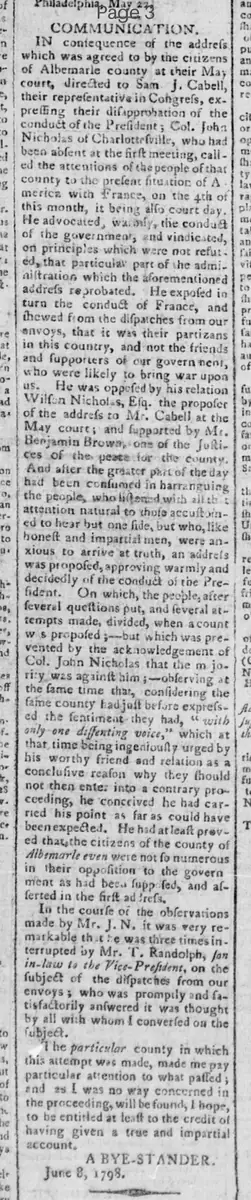
In consequence of the address which was agreed to by the citizens of Albemarle county at their May court, directed to Sam J. Cabell, their representative in Congress, expressing their disapprobation of the conduct of the President; Col. John Nicholas of Charlottesville, who had been absent at the first meeting, called the attention of the people of that county to the present situation of America with France, on the 4th of this month, it being also court day.
He advocated, warmly, the conduct of the government, and vindicated, on principles which were not refuted, that particular part of the administration which the aforementioned address reprobated. He exposed in turn the conduct of France, and showed from the dispatches from our envoys, that it was their partisans in this country, and not the friends and supporters of our government, who were likely to bring war upon us. He was opposed by his relation Wilson Nicholas, Esq. the proposer of the address to Mr. Cabell at the May court; and supported by Mr. Benjamin Brown, one of the Justices of the peace for the county.
And after the greater part of the day had been consumed in haranguing the people, who listened with all the attention natural to those accustomed to hear but one side, but who, like honest and impartial men, were anxious to arrive at truth, an address was proposed, approving warmly and decidedly of the conduct of the President. On which, the people, after several questions put, and several attempts made, divided, when a count was proposed;—but which was prevented by the acknowledgement of Col. John Nicholas that the majority was against him;—observing at the same time that, considering the same county had just before expressed the sentiment they had, "with only one dissenting voice," which at that time being ingeniously urged by his worthy friend and relation as a conclusive reason why they should not then enter into a contrary proceeding, he conceived he had carried his point as far as could have been expected. He had at least proved that the citizens of the county of Albemarle even were not so numerous in their opposition to the government as had been supposed, and asserted in the first address.
In the course of the observations made by Mr. J. N. it was very remarkable that he was three times interrupted by Mr. T. Randolph, son-in-law to the Vice-President, on the subject of the dispatches from our envoys; who was promptly and satisfactorily answered it was thought by all with whom I conversed on the subject.
The particular county in which this attempt was made, made me pay particular attention to what passed; and as I was no way concerned in the proceeding, will be found, I hope, to be entitled at least to the credit of having given a true and impartial account.
A BYE-STANDER.
June 8, 1798.
What sub-type of article is it?
What keywords are associated?
What entities or persons were involved?
Where did it happen?
Domestic News Details
Primary Location
Albemarle County
Event Date
June 4, 1798
Key Persons
Outcome
majority voted against the proposed pro-administration address, revealing division in sentiments previously shown as nearly unanimous opposition.
Event Details
Col. John Nicholas addressed citizens on court day, defending the President's conduct amid U.S.-France tensions, citing envoys' dispatches. Opposed by Wilson Nicholas and interrupted by T. Randolph, he was supported by Benjamin Brown. After debate, a vote on an approving address failed due to majority opposition.