Thank you for visiting SNEWPapers!
Sign up free
Story
September 13, 1822
The Virginian
Lynchburg, Virginia
What is this article about?
Frenchman Mr. Neal exhibits tame rattlesnakes at the Eagle, demonstrating their docility by handling them fearlessly, sharing bite remedies, and explaining their habits and anatomy to educate spectators on natural history.
Clipping
OCR Quality
98%
Excellent
Full Text
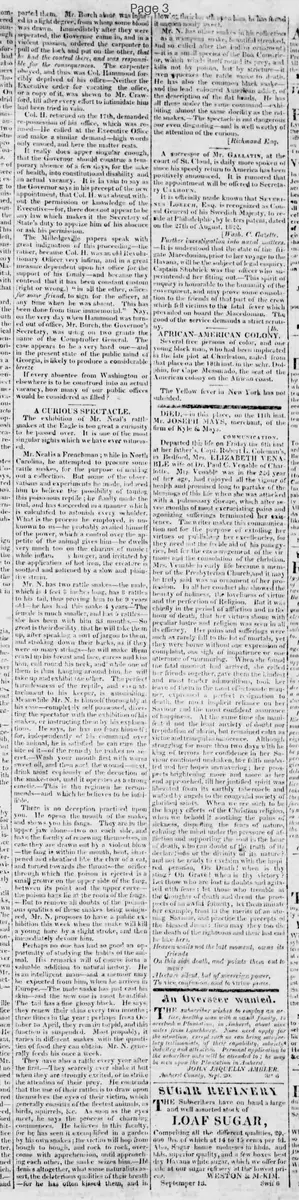
A CURIOUS SPECTACLE.
The exhibition of Mr. Neal's rattle snakes at the Eagle is too great a curiosity to be passed over. It is one of the most singular sights which we have ever witnessed.
Mr. Neal is a Frenchman: While in North Carolina, he attempted to procure some rattle snakes, for the purpose of making out a collection. But some of the observations and experiments he made, induced him to believe the possibility of taming this poisonous reptile; he finally made the trial, and has succeeded in a manner which is calculated to astonish every beholder. What is the process he employed, is unknown to us—he probably availed himself of the power, which a control over the appetite of the animal gives him—he dwells very much too on the charms of music: while inflamed by hunger, and irritated by the application of hot iron, the creature is soothed and softened by a slow and plaintive strain.
Mr. N. has two rattle snakes—the male, which is 4 feet 8 inches long, has 8 rattles to his tail, thus proving him to be 9 years old—he has had this snake 4 years—The female is much smaller, and has 5 rattles—she has been with him 3 months.—So great is their docility, that he will take them up, after speaking a sort of jargon to them, and stroking down their backs, as if they were so many strings—he will make them crawl up his breast and face, caress and kiss him, coil round his neck, and while one of them, is thus hanging around him, he will take up and exhibit the other. The perfect harmlessness of the reptile, and even attachment to his keeper, is astonishing.
Meanwhile Mr. N. is himself thoroughly at his ease—completely self possessed, diverting the spectator with the exhibition of his snakes, or instructing them by his explanations. He says, he has no fears himself: for, independently of his command over the animal, he is satisfied he can cure the bite of it—of the remedy he makes no secret.—Wash your mouth first with warm sweet oil, and then suck the wound—next, drink most copiously of the decoction of the snake-root, until it operates as a strong emetic.—This is the regimen he recommends—and which he believes to be infallible.
There is no deception practised upon you. He opens the mouth of the snake and shows you his fangs. They are in the upper jaw alone—two on each side, and have the faculty of renewing themselves, in case they are drawn out by a violent blow—the fang is within the mouth, bent, sharpened and sheathed like the claw of a cat, and turned towards the throat—the orifice through which the poison is ejected is a small groove on the upper side of the fang, between its point and the upper curve—the poison bags lie at the roots of the fangs.—But to remove all doubts of the poisonous qualities of these snakes being uninjured, Mr. N. proposes to have a public exhibition this week when the snake will kill a young hare by a slight stroke, and then immediately devour him.
Perhaps no one has had so good an opportunity of studying the habits of the animal. His remarks will of course form a valuable addition to natural history. He is an intelligent man—and a memoir may be expected from him, when he arrives in Europe.—The male snake has just cast his skin—and the new one is most beautiful. The tail has a fine glossy black. He says they renew their skins every two months; three times in the year: perhaps from October to April, they remain torpid, and this function is suspended. Most probably, it varies in different snakes with the quantities of food they can obtain. Mr. N. generally feeds his once a week.
They have also a rattle every year after the first.—They scarcely ever shake it but when they are strongly excited, or to strike the attention of their prey. He contends that the use of their rattles is to draw upon themselves the eyes of their victim, which generally consists of the fleetest animals, as birds, squirrels, &c. As soon as the eyes meet, he says the process of charming commences." He believes in this faculty, for he has seen it exemplified in a garden by his own snakes: the victim will hop from bough to bough, and rock to rock, overcome with apprehension, until approaching each other, the snake seizes him.—He denies altogether, what some naturalists assert, the deleterious qualities of their breath—for he has often kissed them, and in breathing the air upon him, he has found it uncommonly sweet.
Mr. N. has other snakes in his collection as a wampum snake, beautifully streaked, and so called after the Indian ornament—it is a small species of the Boa Constrictor, which winds itself round its prey, and kills not by poison, but by stricture—it even squeezes the rattle snake to death. He has also the common black snake—and the lead coloured American adder, of the description of the flat heads. He has all these under the same command—exhibiting almost the same docility as the rattle snakes.—The spectacle is not dangerous nor even disgusting—and is well worthy of the attention of the curious.
The exhibition of Mr. Neal's rattle snakes at the Eagle is too great a curiosity to be passed over. It is one of the most singular sights which we have ever witnessed.
Mr. Neal is a Frenchman: While in North Carolina, he attempted to procure some rattle snakes, for the purpose of making out a collection. But some of the observations and experiments he made, induced him to believe the possibility of taming this poisonous reptile; he finally made the trial, and has succeeded in a manner which is calculated to astonish every beholder. What is the process he employed, is unknown to us—he probably availed himself of the power, which a control over the appetite of the animal gives him—he dwells very much too on the charms of music: while inflamed by hunger, and irritated by the application of hot iron, the creature is soothed and softened by a slow and plaintive strain.
Mr. N. has two rattle snakes—the male, which is 4 feet 8 inches long, has 8 rattles to his tail, thus proving him to be 9 years old—he has had this snake 4 years—The female is much smaller, and has 5 rattles—she has been with him 3 months.—So great is their docility, that he will take them up, after speaking a sort of jargon to them, and stroking down their backs, as if they were so many strings—he will make them crawl up his breast and face, caress and kiss him, coil round his neck, and while one of them, is thus hanging around him, he will take up and exhibit the other. The perfect harmlessness of the reptile, and even attachment to his keeper, is astonishing.
Meanwhile Mr. N. is himself thoroughly at his ease—completely self possessed, diverting the spectator with the exhibition of his snakes, or instructing them by his explanations. He says, he has no fears himself: for, independently of his command over the animal, he is satisfied he can cure the bite of it—of the remedy he makes no secret.—Wash your mouth first with warm sweet oil, and then suck the wound—next, drink most copiously of the decoction of the snake-root, until it operates as a strong emetic.—This is the regimen he recommends—and which he believes to be infallible.
There is no deception practised upon you. He opens the mouth of the snake and shows you his fangs. They are in the upper jaw alone—two on each side, and have the faculty of renewing themselves, in case they are drawn out by a violent blow—the fang is within the mouth, bent, sharpened and sheathed like the claw of a cat, and turned towards the throat—the orifice through which the poison is ejected is a small groove on the upper side of the fang, between its point and the upper curve—the poison bags lie at the roots of the fangs.—But to remove all doubts of the poisonous qualities of these snakes being uninjured, Mr. N. proposes to have a public exhibition this week when the snake will kill a young hare by a slight stroke, and then immediately devour him.
Perhaps no one has had so good an opportunity of studying the habits of the animal. His remarks will of course form a valuable addition to natural history. He is an intelligent man—and a memoir may be expected from him, when he arrives in Europe.—The male snake has just cast his skin—and the new one is most beautiful. The tail has a fine glossy black. He says they renew their skins every two months; three times in the year: perhaps from October to April, they remain torpid, and this function is suspended. Most probably, it varies in different snakes with the quantities of food they can obtain. Mr. N. generally feeds his once a week.
They have also a rattle every year after the first.—They scarcely ever shake it but when they are strongly excited, or to strike the attention of their prey. He contends that the use of their rattles is to draw upon themselves the eyes of their victim, which generally consists of the fleetest animals, as birds, squirrels, &c. As soon as the eyes meet, he says the process of charming commences." He believes in this faculty, for he has seen it exemplified in a garden by his own snakes: the victim will hop from bough to bough, and rock to rock, overcome with apprehension, until approaching each other, the snake seizes him.—He denies altogether, what some naturalists assert, the deleterious qualities of their breath—for he has often kissed them, and in breathing the air upon him, he has found it uncommonly sweet.
Mr. N. has other snakes in his collection as a wampum snake, beautifully streaked, and so called after the Indian ornament—it is a small species of the Boa Constrictor, which winds itself round its prey, and kills not by poison, but by stricture—it even squeezes the rattle snake to death. He has also the common black snake—and the lead coloured American adder, of the description of the flat heads. He has all these under the same command—exhibiting almost the same docility as the rattle snakes.—The spectacle is not dangerous nor even disgusting—and is well worthy of the attention of the curious.
What sub-type of article is it?
Curiosity
Extraordinary Event
Animal Story
What themes does it cover?
Nature
Triumph
What keywords are associated?
Rattlesnakes
Taming
Exhibition
Snake Charming
Natural History
Poisonous Reptiles
Docility
What entities or persons were involved?
Mr. Neal
Where did it happen?
At The Eagle
Story Details
Key Persons
Mr. Neal
Location
At The Eagle
Story Details
Mr. Neal, a Frenchman, tames rattlesnakes using music and appetite control, exhibits their docility by handling them intimately, explains their anatomy and habits, and plans to demonstrate their poison on a hare.