Thank you for visiting SNEWPapers!
Sign up free
Jeffersonian Republican
Stroudsburg, East Stroudsburg, Milford, Monroe County, Pike County, Pennsylvania
What is this article about?
Pennsylvania State Treasurer Gideon J. Ball responds to a Senate resolution defending his refusal to pay certain Canal Commissioners' claims, criticizing their overcharges and mismanagement of locomotives, and calling for further investigation into the Canal Board's conduct.
Clipping
OCR Quality
Full Text
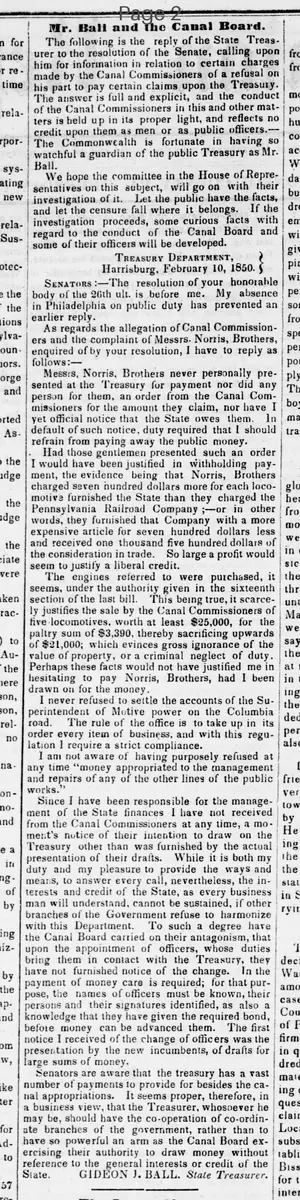
The following is the reply of the State Treasurer to the resolution of the Senate, calling upon him for information in relation to certain charges made by the Canal Commissioners of a refusal on his part to pay certain claims upon the Treasury. The answer is full and explicit, and the conduct of the Canal Commissioners in this and other matters is held up in its proper light, and reflects no credit upon them as men or as public officers.-- The Commonwealth is fortunate in having so watchful a guardian of the public Treasury as Mr. Ball. We hope the committee in the House of Representatives on this subject, will go on with their investigation of it. Let the public have the facts, and let the censure fall where it belongs. If the investigation proceeds, some curious facts with regard to the conduct of the Canal Board and some of their officers will be developed.
Treasury Department,
Harrisburg, February 10, 1850.
Senators:--The resolution of your honorable body of the 26th ult. is before me. My absence in Philadelphia on public duty has prevented an earlier reply.
As regards the allegation of Canal Commissioners and the complaint of Messrs. Norris, Brothers, enquired of by your resolution, I have to reply as follows:
Messrs. Norris, Brothers never personally presented at the Treasury for payment nor did any person for them, an order from the Canal Commissioners for the amount they claim, nor have I yet official notice that the State owes them. In default of such notice, duty required that I should refrain from paying away the public money.
Had those gentlemen presented such an order I would have been justified in withholding payment, the evidence being that Norris, Brothers charged seven hundred dollars more for each locomotive furnished the State than they charged the Pennsylvania Railroad Company; or in other words, they furnished that Company with a more expensive article for seven hundred dollars less and received one thousand five hundred dollars of the consideration in trade. So large a profit would seem to justify a liberal credit.
The engines referred to were purchased, it seems, under the authority given in the sixteenth section of the last bill. This being true, it scarcely justifies the sale by the Canal Commissioners of five locomotives, worth at least $25,000, for the paltry sum of $3,390, thereby sacrificing upwards of $21,000; which evinces gross ignorance of the value of property, or a criminal neglect of duty.
Perhaps these facts would not have justified me in hesitating to pay Norris, Brothers, had I been drawn on for the money.
I never refused to settle the accounts of the Superintendent of Motive power on the Columbia road. The rule of the office is to take up in its order every item of business, and with this regulation I require a strict compliance.
I am not aware of having purposely refused at any time money appropriated to the management and repairs of any of the other lines of the public works."
Since I have been responsible for the management of the State finances I have not received from the Canal Commissioners at any time, a moment's notice of their intention to draw on the Treasury other than was furnished by the actual presentation of their drafts. While it is both my duty and my pleasure to provide the ways and means, to answer every call, nevertheless, the interests and credit of the State, as every business man will understand, cannot be sustained, if other branches of the Government refuse to harmonize with this Department. To such a degree have the Canal Board carried on their antagonism, that upon the appointment of officers, whose duties bring them in contact with the Treasury, they have not furnished notice of the change. In the payment of money care is required; for that purpose, the names of officers must be known, their persons and their signatures identified, as also a knowledge that they have given the required bond, before money can be advanced them. The first notice I received of the change of officers was the presentation by the new incumbents, of drafts for large sums of money,
Senators are aware that the treasury has a vast number of payments to provide for besides the canal appropriations. It seems proper, therefore, in a business view, that the Treasurer, whosoever he may be, should have the co-operation of co-ordinate branches of the government, rather than to have so powerful an arm as the Canal Board exercising their authority to draw money without reference to the general interests or credit of the State.
GIDEON J. BALL, State Treasurer.
What sub-type of article is it?
What keywords are associated?
What entities or persons were involved?
Where did it happen?
Domestic News Details
Primary Location
Harrisburg
Event Date
February 10, 1850
Key Persons
Outcome
treasurer ball withholds payments due to lack of official notice and evidence of overcharges by norris brothers (700 dollars more per locomotive than to pennsylvania railroad); criticizes canal commissioners for selling locomotives worth $25,000 for $3,390, sacrificing over $21,000; calls for investigation into canal board conduct.
Event Details
State Treasurer Gideon J. Ball replies to Senate resolution of January 26, 1850, regarding Canal Commissioners' charges of refusal to pay claims by Norris Brothers and others; explains no official orders presented, evidence of overpricing locomotives, and Commissioners' poor sale of engines; defends strict office rules and lack of cooperation from Canal Board on officer changes and drafts.