Thank you for visiting SNEWPapers!
Sign up free
The Hillsborough Recorder
Hillsboro, Orange County, North Carolina
What is this article about?
Henry Clay's Senate speech on February 13, 1838, opposes the Sub-Treasury bill as a government bank controlled by the executive, fulfilling Jackson's policies that destroyed the Bank of the US and state banks, causing national economic distress.
Merged-components note: Continuous report of Mr. Clay's speech in the Senate on the Sub-Treasury bill, spanning pages 1-3; relabeled from 'editorial' parts to 'story' as it is a narrative report of a political speech.
Clippings
1 of 3
OCR Quality
Full Text
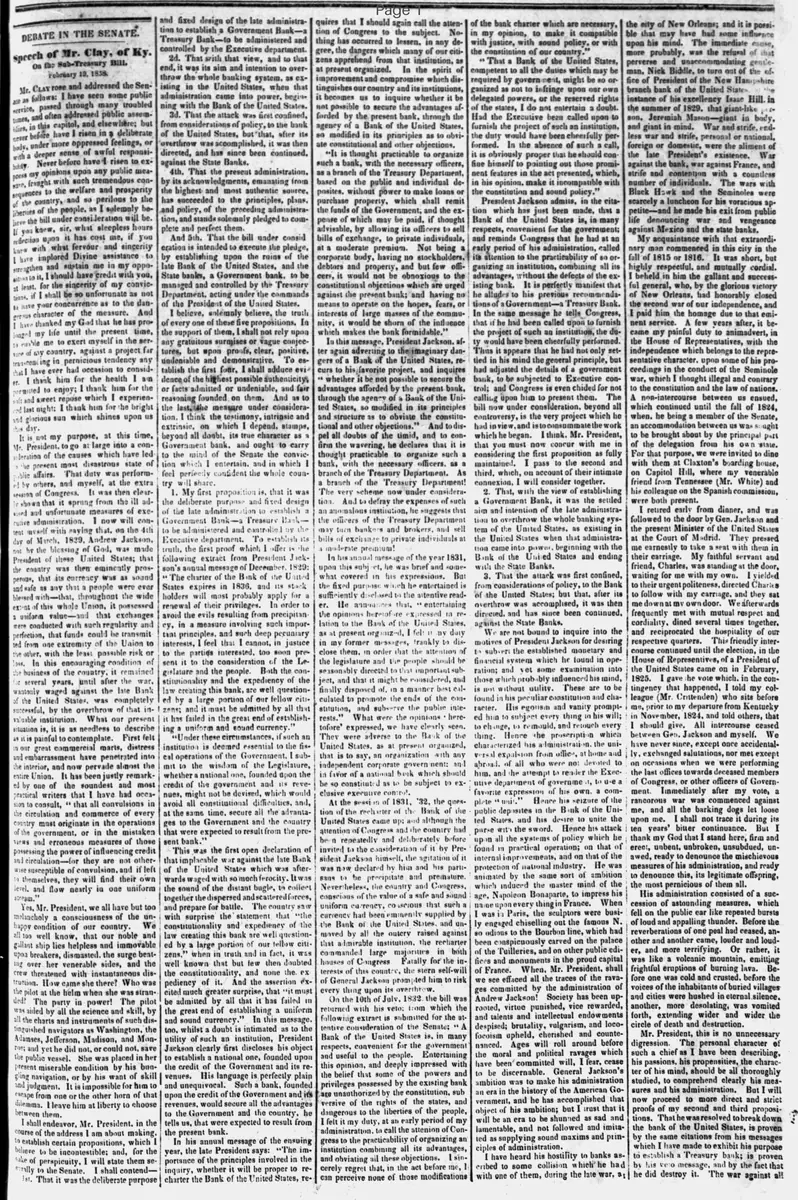
Speech of Mr. Clay, of Ky.
On A Sub-Treasury,
February 13, 1838.
Mr. Clay rose and addressed the Senate as follows: I have seen some public service, passed through many troubled times, and often addressed public assemblies, in this capitol, and elsewhere; but never before have I risen in a deliberate body, under more oppressed feelings, or with a deeper sense of awful responsibility. Never before have I risen to express, fraught with such tremendous consequences to the welfare and prosperity of the country, and so perilous to the liberties of the people, as I solemnly believe the bill under consideration will be.
If you knew, sir, what sleepless hours of reflection upon it has cost me, if you knew with what fervor and sincerity I have implored Divine assistance to strengthen and sustain me in my opposition to it, I should have credit with you, at least, for the sincerity of my convictions, if I shall be so unfortunate as not to gain your concurrence as to the dangerous character of the measure. And I have thanked my God that he has prolonged my life until the present time, to enable me to exert myself in the service of my country, against a project far transcending in pernicious tendency any that I have ever had occasion to consider. I thank him for the health I am permitted to enjoy; I thank him for the soft and sweet repose which I experienced last night; I thank him for the bright and glorious sun which shines upon us this day.
It is not my purpose, at this time, Mr. President, to go at large into a consideration of the causes which have led to the present most disastrous state of public affairs. That duty was performed by others, and myself, at the extra session of Congress. It was then clearly shown that it sprung from the ill advised and unfortunate measures of executive administration. I now will content myself with saying that, on the 4th day of March, 1829, Andrew Jackson, not by the blessing of God, was made President of these United States; that the country was then eminently prosperous, that its currency was as sound and safe as any that a people were ever blessed with—that, throughout the wide extent of this whole Union, it possessed a uniform value—and that exchanges were conducted with such regularity and perfection, that funds could be transmitted from one extremity of the Union to the other, with the least possible risk or loss. In this encouraging condition of the business of the country, it remained for several years, until after the war, wantonly waged against the late Bank of the United States, was completely successful, by the overthrow of that invaluable institution. What our present situation is, it is as needless to describe as it is painful to contemplate. First felt in our great commercial marts, distress and embarrassment have penetrated into the interior, and now pervade almost the entire Union. It has been justly remarked by one of the soundest and most practical writers that I have had occasion to consult, 'that all convulsions in the circulation and commerce of every country must originate in the operations of the government, or in the mistaken views and erroneous measures of those possessing the power of influencing credit and circulation—for they are not otherwise susceptible of convulsion, and if left to themselves, they will find their own level, and flow nearly in one uniform stream.'
Yes, Mr. President, we all have but too melancholy a consciousness of the unhappy condition of our country. We all too well know, that our noble and gallant ship lies helpless and immovable upon breakers, dismasted, the surge beating over her venerable sides, and the crew threatened with instantaneous destruction. How came she there? Who was the pilot at the helm when she was stranded? The party in power! The pilot was aided by all the science and skill, by all the charts and instruments of such distinguished navigators as Washington, the Adamses, Jefferson, Madison, and Monroe; and yet he did not, or could not, save the public vessel. She was placed in her present miserable condition by his bungling navigation, or by his want of skill and judgment. It is impossible for him to escape from one or the other horn of that dilemma. I leave him at liberty to choose between them.
I shall endeavor, Mr. President, in the course of the address I am about making, to establish certain propositions, which I believe to be incontestable; and, for the sake of perspicuity, I will state them severally to the Senate. I shall contend—
1st. That it was the deliberate purpose and fixed design of the late administration to establish a Government Bank—a Treasury Bank—to be administered and controlled by the Executive department.
2d. That with that view, and to that end, it was its aim and intention to overthrow the whole banking system, as existing in the United States, when that administration came into power, beginning with the Bank of the United States.
3d. That the attack was first confined, from considerations of policy, to the bank of the United States, but that, after its overthrow was accomplished, it was then directed, and has since been continued, against the State Banks.
4th. That the present administration, by its acknowledgments, emanating from the highest and most authentic source, has succeeded to the principles, plans, and policy, of the preceding administration, and stands solemnly pledged to complete and perfect them.
And 5th. That the bill under consideration is intended to execute the pledge, by establishing upon the ruins of the late Bank of the United States, and the State banks, a Government bank, to be managed and controlled by the Treasury Department, acting under the commands of the President of the United States.
I believe, solemnly believe, the truth of every one of these five propositions. In the support of them, I shall not rely upon any gratuitous surmises or vague conjectures, but upon proofs, clear, positive, undeniable and demonstrative. To establish the first four, I shall adduce evidence of the highest possible authenticity, or facts admitted or undeniable, and fair reasoning founded on them. And as to the last, the measure under consideration, I think the testimony, intrinsic and extrinsic, on which I depend, stamps, beyond all doubt, its true character as a Government bank, and ought to carry to the mind of the Senate the conviction which I entertain, and in which I feel perfectly confident the whole country will share.
1. My first proposition is, that it was the deliberate purpose and fixed design of the late administration to establish a Government Bank—a Treasury Bank—to be administered and controlled by the Executive department. To establish its truth, the first proof which I offer is the following extract from President Jackson's annual message of December, 1829:
'The charter of the Bank of the United States expires in 1836, and its stock holders will most probably apply for a renewal of their privileges. In order to avoid the evils resulting from precipitancy, in a measure involving such important principles, and such deep pecuniary interests, I feel that I cannot, in justice to the parties interested, too soon present it to the consideration of the Legislature and the people. Both the constitutionality and the expediency of the law creating this bank, are well questioned by a large portion of our fellow citizens; and it must be admitted by all that it has failed in the great end of establishing a uniform and sound currency.'
'Under these circumstances, if such an institution is deemed essential to the fiscal operations of the Government, I submit to the wisdom of the Legislature, whether a national one, founded upon the credit of the government and its revenues, might not be devised, which would avoid all constitutional difficulties, and, at the same time, secure all the advantages to the Government and the country that were expected to result from the present bank.'
This was the first open declaration of that implacable war against the late Bank of the United States which was afterwards waged with so much ferocity. It was the sound of the distant bugle, to collect together the dispersed and scattered forces, and prepare for battle. The country saw with surprise the statement that 'the constitutionality and expediency of the law creating this bank are well questioned by a large portion of our fellow citizens,' when in truth and in fact, it was well known that but few then doubted the constitutionality, and none the expediency of it. And the assertion excited much greater surprise, that 'it must be admitted by all that it has failed in the great end of establishing a uniform and sound currency.' In this message, too, whilst a doubt is intimated as to the utility of such an institution, President Jackson clearly first discloses his object to establish a national one, founded upon the credit of the Government and its revenues. His language is perfectly plain and unequivocal. Such a bank, founded upon the credit of the Government and its revenues, would secure all the advantages to the Government and the country, he tells us, that were expected to result from the present bank.
In his annual message of the ensuing year, the late President says: 'The importance of the principles involved in the inquiry, whether it will be proper to re-charter the Bank of the United States, requires that I should again call the attention of Congress to the subject. Nothing has occurred to lessen, in any degree, the dangers which many of our citizens apprehend from that institution, as at present organized. In the spirit of improvement and compromise which distinguishes our country and its institutions, it becomes us to inquire whether it be not possible to secure the advantages afforded by the present bank, through the agency of a Bank of the United States, so modified in its principles as to obviate constitutional and other objections.'
'It is thought practicable to organize such a bank, with the necessary officers, as a branch of the Treasury Department, based on the public and individual deposits, without power to make loans or purchase property, which shall remit the funds of the Government; and the expense of which may be paid, if thought advisable, by allowing its officers to sell bills of exchange, to private individuals, at a moderate premium. Not being a corporate body, having no stockholders, debtors and property, and but few officers, it would not be obnoxious to the constitutional objections which are urged against the present bank; and having no means to operate on the hopes, fears, or interests of large masses of the community, it would be shorn of the influence which makes the bank formidable.'
In this message, President Jackson, after again adverting to the imaginary dangers of a Bank of the United States, recurs to his favorite project, and inquires whether it be not possible to secure the advantages afforded by the present bank, through the agency of a Bank of the United States, so modified in its principles and structure as to obviate the constitutional and other objections. And to dispel all doubts of the timid, and to confirm the wavering, he declares that it is thought practicable to organize such a bank, with the necessary officers, as a branch of the Treasury Department. As a branch of the Treasury Department! The very scheme now under consideration. And to defray the expenses of such an anomalous institution, he suggests that the officers of the Treasury Department may turn bankers and brokers, and sell bills of exchange to private individuals at a moderate premium!
In his annual message of the year 1831, upon this subject, he was brief and somewhat covered in his expressions. But the fixed purpose which he entertained is sufficiently disclosed to the attentive reader. He announces that, 'entertaining the opinions heretofore expressed in relation to the Bank of the United States, as at present organized, I feel it my duty in my former messages, frankly to disclose them, in order that the attention of the legislature and the people should be seasonably directed to that important subject, and that it might be considered, and finally disposed of, in a manner best calculated to promote the ends of the constitution, and subserve the public interests.' What were the opinions 'heretofore' expressed, we have clearly seen. They were adverse to the Bank of the United States, as at present organized, that is to say, an organization with any independent corporate government; and in favor of a national bank which should be so constituted as to be subject to exclusive executive control.
At the session of 1831, '32, the question of the recharter of the Bank of the United States came up: and although the attention of Congress and the country had been repeatedly and deliberately before invited to the consideration of it by President Jackson himself, the agitation of it was now declared by him and his partisans to be precipitate and premature. Nevertheless, the country and Congress, conscious of the value of a safe and sound uniform currency, so conscious that such a currency had been eminently supplied by the Bank of the United States, and unmoved by all the outcry raised against that admirable institution, the recharter commanded large majorities in both houses of Congress. Fatally for the interests of this country, the stern self-will of General Jackson prompted him to risk everything upon its overthrow.
On the 10th of July, 1832, the bill was returned with his veto: from which the following extract is submitted for the attentive consideration of the Senate; 'A Bank of the United States is, in many respects, convenient for the government and useful to the people. Entertaining this opinion, and deeply impressed with the belief that some of the powers and privileges possessed by the existing bank are unauthorized by the constitution, subversive of the rights of the states, and dangerous to the liberties of the people, I felt it my duty, at an early period of my administration, to call the attention of Congress to the practicability of organizing an institution combining all its advantages, and obviating all these objections. I sincerely regret that, in the act before me, I can perceive none of those modifications of the bank charter which are necessary, in my opinion, to make it compatible with justice, with sound policy, or with the constitution of our country.'
'That a Bank of the United States, competent to all the duties which may be required by government, might be so organized as not to infringe upon our own delegated powers, or the reserved rights of the states, I do not entertain a doubt. Had the Executive been called upon to furnish the project of such an institution, the duty would have been cheerfully performed. In the absence of such a call, it is obviously proper that he should confine himself to pointing out those prominent features in the act presented, which, in his opinion, make it incompatible with the constitution and sound policy.'
President Jackson admits, in the citation which has just been made, that a Bank of the United States is, in many respects, convenient for the government; and reminds Congress that he had at an early period of his administration, called its attention to the practicability of so organizing an institution, combining all its advantages, without the defects of the existing bank. It is perfectly manifest that he alludes to his previous recommendations of a Government Treasury Bank. In the same message he tells Congress, that if he had been called upon to furnish the project of such an institution, the duty would have been cheerfully performed. Thus it appears that he had not only settled in his mind the general principle, but had adjusted the details of a government bank, to be subjected to Executive control; and Congress is even chided for not calling upon him to present them. The bill now under consideration, beyond all controversy, is the very project which he had in view, and is to consummate the work which he began. I think, Mr. President, that you must now concur with me in considering the first proposition as fully maintained. I pass to the second and third, which, on account of their intimate connexion, I will consider together.
2. That, with the view of establishing a Government Bank, it was the settled aim and intention of the late administration to overthrow the whole banking system of the United States, as existing in the United States when that administration came into power, beginning with the Bank of the United States and ending with the State Banks.
3. That the attack was first confined, from considerations of policy, to the Bank of the United States; but that, after its overthrow was accomplished, it was then directed, and has since been continued, against the State Banks.
We are not bound to inquire into the motives of President Jackson for desiring to subvert the established monetary and financial system which he found in operation; and yet some examination into those which probably influenced his mind, is not without utility. These are to be found in his peculiar constitution and character. His egotism and vanity prompted him to subject every thing to his will; to change, to remould, and retouch every thing. Hence the proscription which characterized his administration, the universal expulsion from office, at home and abroad, of all who were not devoted to him, and the attempt to render the Executive department of government, to use a favorite expression of his own, a complete 'union.' Hence his seizure of the public deposits in the Bank of the United States, and his desire to unite the purse with the sword. Hence his attack upon all the systems of policy which he found in practical operation; on that of internal improvements, and on that of the protection of national industry. He was animated by the same sort of ambition which induced the master mind of the age, Napoleon Bonaparte, to impress his name upon every thing in France. When I was in Paris, the sculptors were busily engaged chiselling out the famous N, so odious to the Bourbon line, which had been conspicuously carved on the palace of the Tuilleries, and on other public edifices and monuments in the proud capital of France. When, Mr. President, shall we see effaced all the traces of the ravages committed by the administration of Andrew Jackson! Society has been up-rooted, virtue punished, vice rewarded, and talents and intellectual endowments despised; brutality, vulgarism, and loco-focoism upheld, cherished and countenanced. Ages will roll around before the moral and political ravages which have been committed will, I fear, cease to be discernible. General Jackson's ambition was to make his administration an era in the history of the American Government, and he has accomplished that object of his ambition; but I trust that it will be an era to be shunned as sad and lamentable, and not followed and imitated as supplying sound maxims and principles of administration.
I have heard his hostility to banks ascribed to some collision which he had with one of them, during the late war, at the city of New Orleans; and it is possible that may have had some influence upon his mind. The immediate cause, more probably, was the refusal of that perverse and unaccommodating gentleman, Nick Biddle, to turn out of the office of President of the New Hampshire branch bank of the United States, he instance of his excellency Isaac Hill, in the summer of 1829, that giant-like person, Jeremiah Mason—giant in body, and giant in mind. War and strife, endless war and strife, personal or national, foreign or domestic, were the aliment of the late President's existence. War against the bank, war against France, and strife and contention with a countless number of individuals. The wars with Black Hawk and the Seminoles were scarcely a luncheon for his voracious appetite—and he made his exit from public life denouncing war and vengeance against Mexico and the state banks.
My acquaintance with that extraordinary man commenced in this city in the fall of 1815 or 1816. It was short, but highly respectful, and mutually cordial. I beheld in him the gallant and successful general, who, by the glorious victory of New Orleans, had honorably closed the second war of our independence, and I paid him the homage due to that eminent service. A few years after, it became my painful duty to animadvert, in the House of Representatives, with the independence which belongs to the representative character, upon some of his proceedings in the conduct of the Seminole war, which I thought illegal and contrary to the constitution and the law of nations. A non-intercourse between us ensued, which continued until the fall of 1824, when, he being a member of the Senate, an accommodation between us was sought to be brought about by the principal part of the delegation from his own state. For that purpose, we were invited to dine with them at Claxton's boarding house, on Capitol Hill, where my venerable friend from Tennessee (Mr. White) and his colleague on the Spanish commission, were both present.
I retired early from dinner, and was followed to the door by Gen. Jackson and the present Minister of the United States at the Court of Madrid. They pressed me earnestly to take a seat with them in their carriage. My faithful servant and friend, Charles, was standing at the door, waiting for me with my own. I yielded to their urgent politeness, directed Charles to follow with my carriage, and they sat me down at my own door. We afterwards frequently met with mutual respect and cordiality, dined several times together, and reciprocated the hospitality of our respective quarters. This friendly intercourse continued until the election, in the House of Representatives, of a President of the United States came on in February, 1825. I gave the vote which, in the contingency that happened, I told my colleague (Mr. Crittenden) who sits before me, prior to my departure from Kentucky in November, 1824, and told others, that I should give. All intercourse ceased between Gen. Jackson and myself. We have never since, except once accidentally, exchanged salutations, nor met except on occasions when we were performing the last offices towards deceased members of Congress, or other officers of Government. Immediately after my vote, a rancorous war was commenced against me, and all the barking dogs let loose upon me. I shall not trace it during its ten years' bitter continuance. But I thank my God that I stand here, firm and erect, unbent, unbroken, unsubdued, una wed, ready to denounce the mischievous measures of his administration, and ready to denounce this, its legitimate offspring, the most pernicious of them all.
His administration consisted of a succession of astounding measures, which fell on the public ear like repeated bursts of loud and appalling thunder. Before the reverberations of one peal had ceased, another and another came, louder and louder, and more terrifying. Or rather, it was like a volcanic mountain, emitting frightful eruptions of burning lava. Before one was cold and crusted, before the voices of the inhabitants of buried villages and cities were hushed in eternal silence, another, more desolating, was vomited forth, extending wider and wider the circle of death and destruction.
Mr. President, this is no unnecessary digression. The personal character of such a chief as I have been describing, his passions, his propensities, the character of his mind, should be all thoroughly studied, to comprehend clearly his measures and his administration. But I will now proceed to more direct and strict proofs of my second and third propositions. That he was resolved to break down the bank of the United States, is proven by the same citations from his messages which I have made to exhibit his purpose to establish a Treasury bank; is proven by his veto message, and by the fact that he did destroy it. The war against all
other banks was not originally announced, because he wished the State banks to be auxiliaries in overthrowing the Bank of the United States, and because such an annunciation would have been too rash and shocking upon the people of the United States, for even his tremendous influence. It was necessary to proceed in the work with caution, and to begin with that institution against which could be embodied the greatest amount of prejudice. The refusal to recharter the Bank of the United States was followed by a determination to remove from its custody the public money of the United States. That determination was first whispered in this place, denied, again intimated, and finally in September, 1833, executed. The agitation of the American public which ensued, the warm and animated discussions in the country and in Congress, to which that unconstitutional measure gave rise, are all fresh in our recollection. It was necessary to quiet the public mind, and to reconcile the people to what had been done, before President Jackson seriously entered upon his new career of hostility to the state banks. At the commencement of the session of Congress in 1834, he imagined a sufficient calm had been produced, and, in his annual message of that year, the war upon the State banks was opened. In that message he says:
"It seems due to the safety of the public funds remaining in that bank, and to the honor of the American people, that measures be taken to separate the Government entirely from an institution so mischievous to the public prosperity, and so regardless of the Constitution and laws. By transferring the public deposits, by appointing other pension agents, as far as it had the power, by ordering the discontinuance of the receipt of bank checks in payment of the public dues after the first day of January next, the Executive has exerted all its lawful authority to sever the connexion between the Government and this faithless corporation."
In this quotation it will be seen that the first germ is contained of that separation and divorce of the Government from the banks, which has recently made such a conspicuous figure. It relates, it is true, to the late Bank of the United States, and he speaks of separating and severing the connexion between the Government and that institution. But the idea, once developed, was easily susceptible of application to all banking institutions. In the message of the succeeding year, his meditated attack upon the State Banks is more distinctly disclosed. Speaking of a sound currency, he says:
"In considering the means of obtaining so important an end, [that is, a sound currency,] we must set aside all calculations of temporary convenience, and be influenced by those only that are in harmony with the true character and permanent interests of the Republic. We must recur to first principles, and see what it is that has prevented the legislation of Congress and the States on the subject of currency from satisfying the public expectation, and realizing results corresponding to those which have attended the action of our system when truly consistent with the great principles of equality upon which it rests, and with that spirit of forbearance and mutual concession and generous patriotism which was originally, and must ever continue to be, the vital element of our Union."
"On this subject, I am sure that I cannot be mistaken in ascribing our want of success to the undue countenance which has been afforded to the spirit of monopoly. All the serious dangers which our system has yet encountered may be traced to the resort to implied powers, and the use of corporations clothed with privileges, the effect of which is to advance the interests of the few at the expense of the many. We have felt but one class of these dangers, exhibited in the contest waged by the Bank of the United States against the Government for the last four years. Happily they have been obviated for the present by the indignant resistance of the People, but we should recollect that the principle whence they sprang is an ever active one, which will not fail to renew its efforts in the same and in other forms, so long as there is a hope of success, founded either on the inattention of the People, or on the treachery of their representatives to the subtle progress of its influence."
"We are now to see whether, in the present favorable condition of the country, we cannot take an effectual stand against this spirit of monopoly, and practically prove, in respect to the currency, as well as other important interests, that there is no necessity for so extensive a resort to it as that which has been heretofore practised."
It has been seen that without the agency of a great moneyed monopoly the revenue can be collected, and conveniently and safely applied to all the purposes of public expenditure. It is also ascertained that, instead of being necessarily made to promote the evils of an unchecked paper system, the management of the revenue can be made auxiliary to the reform which the legislatures of several of the states have already commenced in regard to the suppression of small bills; and which has only to be fostered by proper regulations on the part of Congress, to secure a practical return, to the extent required for the security of the currency, to the constitutional medium."
As in the instance of the attack upon the bank of the United States, the approach to the State banks is slow, cautious, and insidious. He reminds Congress and the country that all calculations of temporary convenience must be set aside; that we must recur to first principles; and that we must see what it is that has prevented the legislation of Congress and the States on the subject of the currency from satisfying public expectation. He declares his conviction that the want of success has proceeded from the undue countenance which has been afforded to the spirit of monopoly. All the serious dangers which our system has yet encountered may be traced to the resort to implied powers, and to the use of corporations. We have felt, he says, but one class of these dangers in the contest with the Bank of the United States, and he clearly intimates that the other class is the State banks. We are now to see, he proceeds, whether in the present favorable condition of the country, we cannot take an effectual stand against this spirit of monopoly. Reverting to his favorite scheme of a Government bank, he says it is ascertained that, instead of being made necessary to promote the evils of an unchecked paper system, the management of the revenue can be made auxiliary to the reform which he is desirous to introduce. The designs of President Jackson against the State banks are more fully developed and enlarged upon in his annual message of 1836, from which I beg leave to quote the following passages:
"I beg leave to call your attention to another subject intimately associated with the preceding one—the currency of the country."
"It is apparent, from the whole context of the constitution, as well as the history of the times that gave birth to it, that it was the purpose of the convention to establish a currency consisting of the precious metals. These, from their peculiar properties, which render them the standard of value in all other countries, were adopted in this, as well to establish its commercial standard in reference to foreign countries, by a permanent rule, as to exclude the use of a mutable medium of exchange, such as of certain agricultural commodities, recognised by the statutes of some states, as a tender for debts, or the still more pernicious expedient of a paper currency."
"Variableness must ever be the characteristic of a currency of which the precious metals are not the chief ingredient, or which can be expanded or contracted without regard to the principles that regulate the value of those metals as a standard in the general trade of the world. With us, bank issues constitute such a currency, and must ever do so, until they are made dependent on those just proportions of gold and silver as a circulating medium, which experience has proved to be necessary, not only in this, but in all other commercial countries."
Where those proportions are not infused into the circulation, and do not control it, it is manifest that prices must vary according to the tide of bank issues, and the value and stability of property must stand exposed to all the uncertainty which attends the administration of institutions that are constantly liable to the temptation of an interest distinct from that of the community in which they are established."
But although various dangers to our Republican institutions have been obviated by the failure of that bank to extort from the Government a renewal of its charter, it is obvious that little has been accomplished, except a salutary change of public opinion, towards restoring to the country the sound currency provided for in the Constitution. In the acts of several of the States, prohibiting the circulation of small notes, and the auxiliary enactments of Congress at the last session, forbidding their reception or payment on public account, the true policy of the country has been advanced, and a larger portion of the precious metals infused into our circulating medium. These measures will probably be followed up in due time by the enactment of State laws, banishing from circulation bank notes of still higher denominations; and the object may be materially promoted by further acts of Congress, forbidding the employment, as fiscal agents, of such banks as issue notes of low denominations, and throw impediments in the way of the circulation of gold and silver.
"The effects of an extension of bank credits and over-issues of bank paper have been strikingly illustrated in the sales of the public lands. From the returns made by the various registers and receivers in the early part of last summer, it was perceived that the receipts arising from the sales of public lands were increasing to an unprecedented amount. In effect, however, these receipts amount to nothing more than credits in banks. The banks lent out their notes to speculators; they were paid to the receivers, and immediately returned to the banks, to be lent out again and again, being mere instruments to transfer to speculators the most valuable public land, and pay the Government by a credit on the books of the bank. Those credits on the books of some of the Western banks, usually called deposits, were already greatly beyond their immediate means of payment, and were rapidly increasing. Indeed, each speculation furnishes means for another; for no sooner had one individual or company paid in the notes, than they were immediately lent to another for a like purpose; and the banks were extending their business and their issues so largely as to alarm considerate men, and render it doubtful whether these bank credits, if permitted to accumulate, would ultimately be of the least value to the Government.
The spirit of expansion and speculation was not confined to the deposit banks, but pervaded the whole multitude of banks throughout the Union, and was giving rise to new institutions to aggravate the evil.
"The safety of the public funds, and the interest of the people generally, required that these operations should be checked, and it became the duty of every branch of the General and State governments to adopt all legitimate and proper means to produce that salutary effect. Under this view of my duty, I directed the issuing of the order, which will be laid before you by the Secretary of the Treasury, requiring payment of the public lands sold, to be made in specie, with an exception until the 15th of the present month, in favor of actual settlers. This measure has produced many salutary consequences. It checked the career of the Western banks, and gave them additional strength in anticipation of the pressure which has since pervaded our Eastern, as well as the European commercial cities. By preventing the expansion of the credit system, it measurably cut off the means of speculation, and retarded its progress in monopolizing the most valuable of the public lands. It has tended to save the new states from a non-resident proprietorship—one of the greatest obstacles to the advancement of a new country, and the prosperity of an old one. It has tended to keep open the public lands for entry by emigrants at Government prices, instead of their being compelled to purchase of speculators at double or treble prices. And it is conveying into the interior large sums in silver and gold, there to enter permanently into the currency of the country, and place it on a firmer foundation. It is confidently believed that the country will find, in the motives which induced that order, and the happy consequences which have ensued, much to commend, and nothing to condemn."
It is seen that he again calls the attention of Congress to the currency of the country, alleges that it was apparent from the whole context of the constitution, as well as the history of the times that gave birth to it, that it was the purpose of the convention to establish a sound currency consisting of the precious metals; imputes variableness and a liability to inordinate contraction and expansion to the existing paper system, and denounces bank issues, as being an uncertain standard. He felicitates himself upon the dangers which have been obviated by the overthrow of the Bank of the United States, but declares that little has been yet done, except to produce a salutary change of public opinion towards restoring to the country the sound currency provided for in the constitution. I will here say, in passing, that all this outcry about the precious metals, gold, and the constitutional currency, has been put forth to delude the people, and to use the precious metals as an instrument to break down the banking institutions of the States, and to thus pave the way for the ultimate establishment of a great Government bank. In the present advanced state of civilization, in the present condition of the commerce of the world, and in the actual relations of trade and intercourse between the different nations of the world, it is perfectly chimerical to suppose that the currency of the United States should consist exclusively, or principally, of the precious metals.
In the quotations which I have made from the last annual message of General Jackson, he speaks of the extension of bank credits, and the over issues of bank paper, in the operations upon the sales of public lands. In his message of only the preceding year, the vast amount of those sales had been dwelt upon with peculiar complaisance as illustrating the general prosperity of the country, and as proof of the wisdom of his administration. But now that which had been announced as a blessing is deprecated as a calamity. Now, his object being to assail the banking institutions of the States, and to justify that fatal Treasury order, which I shall hereafter have occasion to notice, he expressed his apprehension of the danger to which we were exposed of losing the public domain, and getting nothing for it but bank credits. He describes minutely the circular process by which the notes of the banks passed out of those institutions to be employed in the purchase of the public lands, and returned again to them in the form of credits to the government. He forgets that Mr. Secretary Taney, to reconcile the people of the United States to the daring measure of removing the public deposits, had stimulated the banks to the exercise of great liberality in the grant of loans. He informs us, in that message, that the safety of the public funds, and the interests of the people generally, required that these copious issues of the banks should be checked, and that the conversion of the public lands into mere bank credits should be arrested. And his measure to accomplish these objects was that famous Treasury order, already adverted to. Let us pause here for a moment, and contemplate the circumstances under which it was issued. The principle of the order had been proposed and discussed in Congress. But one senator, as far as I know, in this branch of the Legislature, and not a solitary member, within my knowledge, in the House of Representatives, was in favor of it. And yet, in about a week after the adjournment of Congress, the principle which met with no countenance from the legislative authority, was embodied in the form of a Treasury edict, and promulgated under the Executive authority, to the astonishment of the people of the United States!
If we possessed no other evidence whatever of the hostility of President Jackson to the state banks of the United States, that order would supply conclusive proof. Bank notes, bank issues, bank credits, were distrusted and denounced by him. It was proclaimed to the people that they were unworthy of confidence. The government could no longer trust in their security. And at a moment when the banking operations were extended, and stretched to their utmost tension; when they were almost all tottering and ready to fall, for the want of that metallic basis on which they all rested, the Executive announces its distrust, issues the Treasury order, and enters the market for specie, by a demand for an extraordinary amount to supply the means of purchasing public lands. If the sales had continued in the same ratio they had been made during the previous year, that is, at about the rate of twenty-four millions per annum, this unprecedented demand created by government for specie must have exhausted the vaults of most of the banks, and produced much sooner the catastrophe which occurred in May last. And what is most extraordinary, this wanton demand for specie upon all the banks of the commercial capitals, and in the busy and thickly peopled portions of the country, was, that it might be transported into the wilderness, and after having been used in the purchase of public lands, deposited to the credit of the government in the books of western banks, in some of which, according to the message, there were already credits to the government greatly beyond their immediate means of payment. Government, therefore, did not itself receive, or rather, did not retain, the very specie which it professed to demand, as the only medium worthy of the public lands. The specie, which was so uselessly exacted, was transferred from one set of banks, to the derangement of the commerce and business of the country, and placed in the vaults of another set of banks in the interior, forming only those bank credits to the government upon which President Jackson placed so slight a value.
Finally, when General Jackson was about to retire from the cares of government, he favored his countrymen with a farewell address. The solemnity of the occasion gives to any opinions which he has expressed in that document a claim to peculiar attention. It will be seen on perusing it, that he denounces, more emphatically than in any of his previous addresses, the bank paper of the country, corporations, and what he chooses to nominate the spirit of monopoly. The Senate will indulge me in calling its attention to certain parts of that address, in the following extracts:
"The Constitution of the United States unquestionably intended to secure to the people a circulating medium of gold and silver. But the establishment of a national bank by Congress, with the privilege of issuing paper money receivable in payment of the public dues, and the unfortunate course of legislation in the several States upon the same subject, drove from general circulation the constitutional currency, and substituted one of paper in its place."
"The mischief springs from the power which the monied interest derives from a paper currency, which they are able to control; from the multitude of corporations, with exclusive privileges, which they have succeeded in obtaining in the different States, and which are employed altogether for their benefit; and unless you become more watchful in your states, and check this spirit of monopoly and thirst for exclusive privileges, you will, in the end, find that the most important powers of Government have been given or bartered away, and the control over your dearest interests has passed into the hands of these corporations."
But it will require steady and persevering exertions on your part to rid yourselves of the iniquities and mischiefs of the paper system, and to check the spirit of monopoly and other abuses which have sprung up with it, and of which it is the main support. So many interests are united to resist all reform on this subject, that you must not hope that the conflict will be a short one, nor success easy. My humble efforts have not been spared, during my Administration of the Government, to restore the constitutional currency of gold and silver, and something, I trust, has been done towards the accomplishment of this most desirable object. But enough yet remains to require all your energy and perseverance. The power, however, is in your hands, and the remedy must and will be applied, if you determine upon it."
The mask is now thrown off, and he boldly says that the Constitution of the United States unquestionably intended to secure the people a circulating medium of gold and silver. They have not enjoyed, he says, that benefit, because of the establishment of a National Bank, and the unfortunate course of legislation in the several states. He does not limit his condemnation of the past policy of his country to the Federal Government, of which he had just ceased to be the chief, but he extends it to the states also, as they were incompetent to judge of the interests of their respective citizens. He tells us that the mischief springs from the power which the moneyed interest derives from a paper currency, which they are able to control, and the multitude of corporations; and he stimulates the people to become more watchful in their several states to check this spirit of monopoly. To invigorate their fortitude, he tells the people that it will require steady and persevering exertions on their part, to rid themselves of the iniquities and mischiefs of the paper system, and to check the spirit of monopoly. They must not hope that the conflict will be a short one, nor the success easy. His humble efforts have not been spared during his administration, to restore the constitutional currency of gold and silver; and although he has been able to do something towards the accomplishment of that object, enough yet remains to require all the energy and perseverance of the people.
Such, Mr. President, are the proofs and the argument on which I rely to establish the second and third propositions which I have been considering. Are they not successfully maintained? Is it possible that any thing could be more conclusive on such a subject? I pass to the consideration of the fourth proposition.
4. That the present administration, by acknowledgments emanating from the highest and most authentic source, has succeeded to the principles, plans, and policy, of the preceding Administration, and stands solemnly pledged to complete and perfect them.
The proofs on this subject are brief: but they are clear, direct, and plenary. It is impossible for any unbiased mind to doubt for a moment about them. You, sir, will be surprised, when I shall array them before you, at their irresistible force. The first that I shall offer is an extract from Mr. Van Buren's letter of acceptance of the nomination of the Baltimore convention, dated May 23d, 1835. In the letter he says: "I content myself on this occasion, with saying that I consider myself the honored instrument, selected by the friends of the present administration, to carry out its principles and policy, and that, as well from inclination as from duty, I shall, if honored with the choice of the American people, endeavor generally to follow in the footsteps of President Jackson—happy if I shall be able to perfect the work which he has so gloriously begun."
Mr. Van Buren announces that he was the honored instrument selected by the friends of the present administration, to carry out its principles and policy. The honored instrument! That word, according to the most approved definition, means tool. He was, then, the honored tool—to do what? to promote the honor, and advance the welfare, of the people of the United States, and to add to the glory of his country? No, no; his country was not in his thoughts. Party, party, filled the place in his bosom which country should have occupied. He was the honored tool to carry out the principles and policy of General Jackson's administration; and, if elected, he should, as well from inclination as from duty, endeavor, generally, to tread in the footsteps of General Jackson—happy if he should be able to perfect the work which he had so gloriously begun. Duty to whom? to the country, to the whole people of the United States? No such thing: but duty to the friends of the then administration; and that duty required him to tread in the footsteps of his illustrious predecessor, and to perfect the work which he had begun! Now, the Senate will bear in mind that the most distinguished features of General Jackson's administration related to the currency; that he had denounced the banking institutions of the country; that he had overthrown the Bank of the United States, that he had declared, when that object was accomplished, only one half the work was completed; that he then commenced war against the State banks in order to finish the other half; that he constantly persevered in, and never abandoned, his favorite object of a great Government Treasury bank; and that he retired from the office of Chief Magistrate, pouring out, in his farewell address, anathemas against paper money, corporations, and the spirit of monopoly. When all these things are recollected, it is impossible not to comprehend clearly what Mr. Van Buren means by carrying out the principles and policy of the late administration. No one can mistake that those principles and that policy require him to break down the local institutions of the States, and to discredit and destroy the paper medium which they issue. No one can be at a loss to understand that, in following in the foot-steps of President Jackson, and in perfecting the work which he began, Mr. Van Buren means to continue attacking, systematically, the banks of the States, and to erect on their ruins that great Government Bank, begun by his predecessor, and which he is the honored instrument selected to complete.
The next proof which I shall offer is supplied by Mr. Van Buren's inaugural address, from which I request permission of the Senate to read the following extract:
"In receiving from the people the sacred trust twice confided to my illustrious predecessor, and which he has discharged so faithfully and so well, I know that I cannot expect to perform the arduous task with equal ability and success. But, as I have been in his counsels, a daily witness of his extensive and unsurpassed devotion to his country's welfare, agreeing with him in sentiments which his countrymen have warmly supported, and permitted to partake largely of his confidence, I may hope that somewhat of the same cheering approbation will be found to attend upon my path."
Here we had Mr. Van Buren distinctly avowing, that the American people well knew before that he had been united in the counsels of, General Jackson; that he had agreed with him in sentiments, and that he had partaken largely of his confidence. This intimacy and confidential intercourse could not have existed without the concurrence of Mr. Van Buren in all those leading and prominent measures of his friend which related to the establishment of a government bank, the overthrow of the bank of the United States, and attack upon the State institutions, and the denunciation of the paper currency, the spirit of monopoly, and corporations. Is it credible to believe that Gen. Jackson should have aimed at the accomplishment of all those objects, and entertain all these sentiments, without Mr. Van Buren's participation?
(To be continued.)
What sub-type of article is it?
What themes does it cover?
What keywords are associated?
What entities or persons were involved?
Where did it happen?
Story Details
Key Persons
Location
United States Senate, Washington
Event Date
1838 02 13
Story Details
Henry Clay delivers a passionate speech opposing the Sub-Treasury bill, arguing it creates an executive-controlled government bank, building on Jackson's destruction of the Bank of the US and attacks on state banks, which caused economic ruin; he outlines five propositions supported by Jackson's messages and personal history.