Thank you for visiting SNEWPapers!
Sign up free
The National Intelligencer And Washington Advertiser
Washington, District Of Columbia
What is this article about?
On Dec. 18, 1801, the U.S. House debated and handled bills on fugitives from justice/escaped slaves (committed), printing government documents (partly agreed), and apportionment of representatives (debate on 30,000 vs. 33,000 ratio; committee rose due to census issues). Key speakers included Macon, Giles, Randolph.
Merged-components note: Continuation of the congressional debate on the apportionment bill, split across pages.
Clippings
1 of 2
OCR Quality
Full Text
OF THE UNITED STATES,
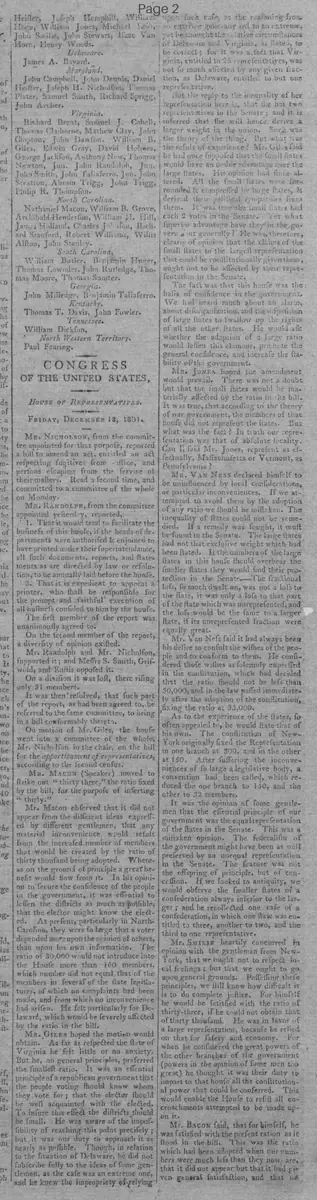
HOUSE OF REPRESENTATIVES.
FRIDAY, December 18, 1801.
MR. Nicholson, from the committee appointed for that purpose, reported a bill to amend an act, entitled an act respecting fugitives from justice, and persons escaping from the service of their masters. Read a second time, and committed to a committee of the whole on Monday.
Mr. RANDOLPH, from the committee appointed yesterday, reported,
1. That it would tend to facilitate the business of this house, if the heads of departments were authorized & enjoined to have printed under their superintendence, all such documents, reports, and statements as are directed by law or resolution, to be annually laid before the house.
2. That it is expedient to appoint a printer, who shall be responsible for the prompt and faithful execution of all business confided to him by the house.
The first member of the report was unanimously agreed to.
On the second member of the report, a diversity of opinion existed.
Mr. Randolph and Mr. Nicholson, supported it; and Messrs S. Smith, Griswold, and Eustis opposed it.
On a division it was lost, there rising only 31 members.
It was then resolved, that such part of the report, as had been agreed to, be referred to the same committee, to bring in a bill conformably thereto.
On motion of Mr. Giles, the house went into a committee of the whole. Mr. Nicholson in the chair, on the bill for the apportionment of representatives, according to the second census.
MR. Macon (Speaker) moved to strike out "thirty three," the ratio fixed by the bill, for the purpose of inserting "thirty."
Mr. Macon observed that it did not appear from the different ideas expressed by different gentlemen, that any material inconvenience would result from the increased number of members that would be created by the ratio of thirty thousand being adopted. Whereas on the ground of principle a great benefit would flow from it. In his opinion to secure the confidence of the people in the government, it was essential to lessen the districts as much as possible, that the elector might know the elected. At present, particularly in North-Carolina, they were so large that a voter depended more upon the opinion of others, than upon his own information. The ratio of 30,000 would not introduce into the House more than 160 members, which number did not equal that of the members in several of the state legislatures, of which no complaints had been made, and from which no inconvenience had arisen. He felt particularly for Delaware, which would be severely affected by the ratio in the bill.
MR. Giles hoped the motion would obtain. As far as respected the state of Virginia he felt little or no anxiety. But he, on general principles, preferred the smallest ratio. It was an essential principle of a republican government that the people voting should know whom they vote for; that the elector should be well acquainted with the elected. To insure this effect the districts should be small. He was aware of the impossibility of reaching this point precisely; but it was our duty to approach it as nearly as possible. Though, in relation to the situation of Delaware, he did not subscribe fully to the ideas of some gentlemen, as the case was an extreme one, and he knew the impropriety of relying upon such case, as the reasoning from an extreme generally led to an extreme, yet he thought the relative circumstances of Delaware and Virginia, as stated, to be correct; for it was a fact that Virginia, entitled to 22 representatives, was not so much affected by any given fraction, as Delaware, entitled to but one representative.
But the reply to the inequality of her representation here is, that she has two representatives in the Senate; and it is inferred that she will hence derive a larger weight in the union. Such was the theory of the thing. But what was the result of experience? Mr. Giles said he had once supposed that the small states would have an undue advantage over the large states. His opinion had since altered. All the small states were surrounded & compressed by large states, & derived their political sympathies from them. It was true the small states had each 2 votes in the Senate. Yet what superior advantage have they in the government generally? He was therefore, clearly of opinion that the claims of the small states to the largest representation that could be constitutionally given them, ought not to be affected by their representation in the Senate.
The fact was that this house was the basis of confidence in the government. We had heard much about an alarm, about disorganization, and the disposition of large states to swallow up the rights of all the other states. He would ask whether the adoption of a large ratio would lessen this clamour, promote the general confidence, and increase the stability of the government.
Mr. Jones hoped the amendment would prevail. There was not a doubt but that the small states would be materially affected by the ratio in the bill. It was true, that according to the theory of our government, the members of that house did not represent the states. But what was the fact? In truth our representation was that of absolute locality. Can I, said Mr. Jones, represent as effectually, Massachusetts or Vermont, as Pennsylvania?
Mr. Van Ness declared himself to be uninfluenced by local considerations, or particular inconveniences. If we attempted to avoid them by the adoption of any ratio we should be mistaken. The inequality of states could not be remedied. If a remedy was sought, it must be found in the Senate. The large states had not that exclusive weight which had been stated. If the numbers of the large states in this house should overbear the smaller states they would find their protection in the Senate. The fractional loss, so much dwelt on, was not a loss to the state, it was only a loss to that part of the state which was unrepresented, and the loss would be the same to a larger state, if its unrepresented fraction were equally great.
Mr. Van Ness said it had always been his desire to consult the wishes of the people and to conform to them. He considered those wishes as solemnly expressed in the constitution, which had decided that the ratio should not be less than 30,000, and in the law passed immediately after the adoption of the constitution, fixing the ratio at 33,000.
As to the experience of the states, so often appealed to, he would state that of his own. The constitution of New-York originally fixed the Representation in one branch at 300, and in the other at 150. After suffering the inconveniences of so large a legislative body, a convention had been called, which reduced the one branch to 150, and the other to 32 members.
It was the opinion of some gentlemen that the essential principle of our government was the equal representation of the states in the Senate. This was a mistaken opinion. The federalism of the government might have been as well preserved by an unequal representation in the Senate. The feature was not the offspring of principle, but of concession. If we looked to antiquity, we would observe the smaller states of a confederation always inferior to the larger; and he recollected one case of a confederation, in which one state was entitled to three, another to two, and the third to one representative.
Mr. SMILIE heartily concurred in opinion with the gentleman from New-York, that we ought not to repeat local feelings; but that we ought to go upon general grounds. Possessing these principles, we still know how difficult it is to do complete justice. For himself he would be satisfied with the ratio of thirty-three, if he could not obtain that of thirty thousand. He was in favor of a large representation, because he relied on that for safety and economy. For when he considered the great powers of the other branches of the government (powers in the opinion of some men too great) he thought it was their duty to impart to that house all the constitutional power that could be conferred. This would enable the House to resist all encroachments attempted to be made upon it.
Mr. Bacon said, that for himself, he was satisfied with the present ratio as it stood in the bill. This was the ratio which had been adopted when our numbers were much less than they now are. That it did not appear but that it had given general satisfaction, and that no
other inconveniences bid accrued, that such as might be expected to follow from the adoption of any other ratio whatever.
It would seem to be rather unnatural, and the reverse of what was contemplated by those who enacted the constitution, as our numbers increase, to lessen the ratio of representation. He was therefore against striking out the number 33, with a view to insert a lower number.
A divisor of 33,000, would now give a house consisting of at least 140 members, which even on the present ratio, must soon become, not only too expensive, but unwieldy.
It had been repeatedly urged, that the present ratio leaves a very large fraction to the state of Delaware. This, it was admitted, was matter of regret; but that, let what ratio might be adopted, such fractional parts must be expected to fall somewhere—that such fractions would be likely to vary from time to time, and shift from state to state, as the population may increase and vary in the several states. And Mr. B. did not conceive that the particular case of Delaware, hard as it might seem, furnished a sufficient reason for altering an entire system.
As to what had been urged of the disadvantage to which electors were subjected in large districts, of not knowing the characters of their representatives & candidates, Mr. B. observed that this was an advantage which was lessening with rapidity from year to year, and from one election to another—last to whatever inconvenience electors may heretofore have been subjected by the want of a knowledge of their candidate, from this inconvenience they are already in a great measure relieved, and it must in a very short time entirely cease to exist. If any inconvenience of this kind still remains, by an election or two more it would be entirely removed.
It had been urged that Delaware had but one representative, and every state ought to have two. But why two, Mr. B. queried, rather than three? It is true that two are better than one; and three are better than either one or two; for, as we have long since been told, "A three-fold cord is not easily broken."
Mr. Bacon concluded by averring that, as 33,000 was the ratio which had been adopted when our population was much less than it now is: and as it has been practiced upon without any inconvenience or general dissatisfaction, he was unwilling to risk the uncertain consequences of an innovation at this particular time.
Mr. T. Morris was of opinion that the arguments drawn from the representation in the Senate had nothing to do with this question. The House had a constitutional duty to perform, that was highly interesting. The only question is how it shall be performed. The people ought to be fully represented; that is, the number of their representatives should be increased until that number become inconvenient for the transaction of business. He had never been a friend to an enormous legislature; such as that in France, a mob convention. He thought the idea incorrect that this House should acquire a weight that might enable it to bear down the other branch of the legislature. He hoped, if any such attempt should be made, that body would have sufficient spirit to resist it; and he trusted there would always be firmness enough here to resist any encroachment attempted.
As to the present ratio guiding, he did not think that the House should be governed by any uniform rule. They ought, on the contrary, to be governed by the existing circumstances. Not believing that any inconvenience would arise from the augmented representation on the ratio of 30,000, he would be in favour of it on the reasons he had assigned.
Mr. Dennis did not rise to say anything new on the subject; but merely, as he had altered his mind since the business was before the house, to assign some of the reasons which had influenced him. He was now in favour of the ratio of thirty thousand. His first impressions were against it from an apprehension that the increased numbers of the house would increase expense, and produce disorder. But he acknowledged himself convinced by the arguments which had fallen from the gentleman from Virginia, which he thought counterbalanced his previous apprehension.
Mr. Dennis thought it all important to preserve an equilibrium between the different departments of the government, and he was convinced that this would be best effected by making the representation in this house as large as the Constitution permitted, and convenience justified. If we expected to retain the confidence of the people, it was necessary to increase the representative branch; for it would be in vain to look for that confidence necessary to give it a proper portion of energy, unless there existed a sympathy between the elector and the elected.
MR. RANDOLPH hoped the amendment would not obtain. The difference between the effects of the two ratios was not very important; but it was highly important that a doctrine so heretical and improper is that which had been avowed should be exploded on its first annunciation. He meant that doctrine, which considered this house as the representatives of the people. When the Constitution was formed, two great difficulties presented themselves. The large states refused to confer on the government greater powers than those it enjoyed, which deeply affected their wealth and their numbers, unless according to the ratio of their numbers they should participate in the administration of it; while the smaller states withheld their concurrence, unless their sovereignties were guaranteed and protected. These two difficulties were surmounted by the plan of the present Constitution; according to which the members of this house were the representatives, not of the people, but of the states in proportion to their numbers. This was the theory of the government for which he must contend.
Mr. Randolph believed that the strongest objection urged against the adoption of the Constitution was that it tended to a consolidation of the states. But when he looked into it with a federal eye (and with no other eye could he ever look at it) he saw the state sovereignties in all its parts acknowledged and protected. Of this, the very bill was itself a proof. For the apportionment was not among the people, but among the states, according to the numbers of each. Believing that this house is the representative of states, it was his opinion that so long as the relative weight of states could be preserved, it was immaterial that each state should be represented by a large number of members.
It was with extreme regret, and some diffidence, Mr. R. said that he differed from his colleague on this subject. His colleague wished to increase the house to such an extent as to make it the depository of the whole confidence of the people. Mr. Randolph wished it to possess that confidence so far as related to federal objects, but no further. Increase it, according to the theory of gentlemen, make it a point of numbers a British Parliament, or a French Convention, and you will proportionably diminish the confidence of the people in the state governments. They will become feeble barriers against the powers of the general government; and the people will enquire for what purpose they elect their state legislatures.
Mr. Randolph believed it to be of infinite importance that the poises of the government should be preserved: that it should confine itself to federal objects. His object, therefore, was to preserve on that floor the proportionate weight between the several states which the Constitution had fixed.
Had any objection been made to the old Congress under the Confederation, that was federally organized, for the want of talents or integrity? No. The only objection was that they wanted power. Had the public affairs been conducted with less ability than they are at present? He had neither heard, nor did he believe that they had.
Mr. R. concluded by making some remarks, on the score of convenience, similar to those already stated.
DR. MITCHELL. [Our attention was unavoidably, and much to our regret, called off, during the first part of Dr. Mitchell's observations. To give the closing remarks might be an act of injustice, unconnected as they would be with those which preceded. We, therefore, forbear the attempt, and confine our notice to the statement that he supported the ratio of 33,000.]
MR. S. SMITH felt indifferent whether the ratio of thirty three, or that of thirty thousand were adopted; but felt anxious that justice should be done to the state of Maryland. He understood that radical errors existed in the numbers given to that state; that in Harford county there were returned only 3,000 slaves, whereas there ought to have been returned 18,000: and that in Cecil there were returned 9,000, instead of 15,000.
He hoped, in order to have these errors corrected, the committee would rise, that the original returns in the office of state might be examined.
This motion gave rise to a conversation of some length, in which on one side the impropriety and injustice of making an apportionment under the existing errors, and without the return from Tennessee were argued; and, on the other side, the great inconveniences of delay, and the inability of the house to obtain a correction of errors, which if attempted in one instance, might be attempted in many.
MR. Van Ness informed the committee that the return from Tennessee was received at the office of state, and that it made the population of that state amount to 92,000.
It was ultimately agreed that the committee rise, report progress, and ask leave to sit again; which was granted.
Adjourned till Monday.
What sub-type of article is it?
What keywords are associated?
What entities or persons were involved?
Where did it happen?
Domestic News Details
Primary Location
United States House Of Representatives
Event Date
Friday, December 18, 1801
Key Persons
Outcome
bill to amend act on fugitives from justice and escaped slaves read second time and committed to committee of the whole on monday. first part of report on printing documents unanimously agreed to; second part on appointing a printer lost by division (31 members). resolved to refer agreed part to committee for bill. committee of the whole on apportionment bill rose, reported progress, and asked leave to sit again due to errors in maryland census returns and tennessee return received (92,000 population). adjourned till monday.
Event Details
In the House of Representatives, Mr. Nicholson reported a bill to amend the act respecting fugitives from justice and persons escaping from masters, read second time and committed. Mr. Randolph reported on facilitating business via department printing of documents (agreed unanimously) and appointing a responsible printer (opposed and lost). House went into committee on apportionment bill; Mr. Macon moved to strike 33,000 ratio for 30,000 to increase representation and better connect electors to elected, especially benefiting small states like Delaware. Debate ensued with supporters (Giles, Jones, T. Morris, Dennis) arguing for smaller districts and confidence in government; opponents (Van Ness, Smilie, Bacon, Randolph) favoring 33,000 to avoid unwieldy house, citing constitution and experience. Dr. Mitchell supported 33,000. Mr. S. Smith raised census errors in Maryland; committee rose after Tennessee return noted.