Thank you for visiting SNEWPapers!
Sign up free
Editorial
April 12, 1932
The Daily Alaska Empire
Juneau, Juneau County, Alaska
What is this article about?
Editorial criticizes Rep. Charles L. Abernathy's defense of congressional salaries by arguing Congress is inefficient and overly expensive, serving mainly as a brake on autocracy but at high cost to democracy.
Clipping
OCR Quality
98%
Excellent
Full Text
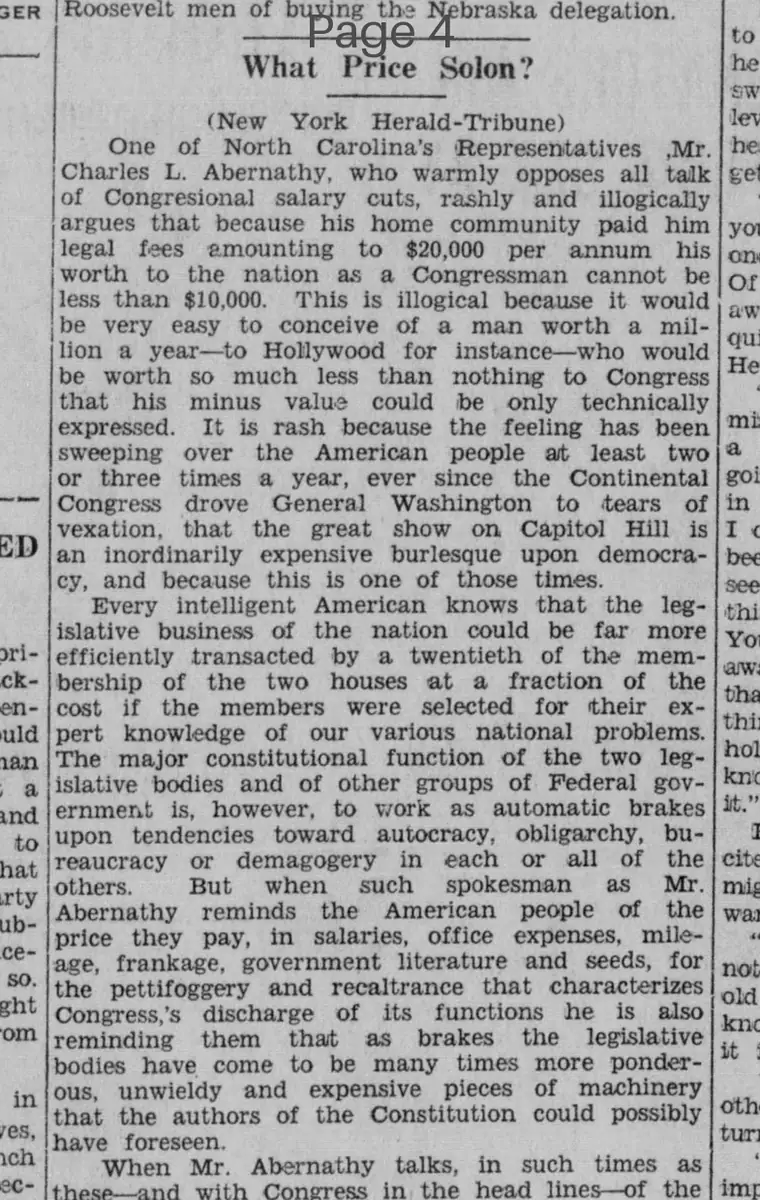
What Price Solon?
(New York Herald-Tribune)
One of North Carolina's Representatives, Mr. Charles L. Abernathy, who warmly opposes all talk of Congressional salary cuts, rashly and illogically argues that because his home community paid him legal fees amounting to $20,000 per annum his worth to the nation as a Congressman cannot be less than $10,000. This is illogical because it would be very easy to conceive of a man worth a million a year—to Hollywood for instance—who would be worth so much less than nothing to Congress that his minus value could be only technically expressed. It is rash because the feeling has been sweeping over the American people at least two or three times a year, ever since the Continental Congress drove General Washington to tears of vexation, that the great show on Capitol Hill is an inordinately expensive burlesque upon democracy, and because this is one of those times.
Every intelligent American knows that the legislative business of the nation could be far more efficiently transacted by a twentieth of the membership of the two houses at a fraction of the cost if the members were selected for their expert knowledge of our various national problems.
The major constitutional function of the two legislative bodies and of other groups of Federal government is, however, to work as automatic brakes upon tendencies toward autocracy, oligarchy, bureaucracy or demagogery in each or all of the others.
But when such spokesman as Mr. Abernathy reminds the American people of the price they pay, in salaries, office expenses, mileage, frankage, government literature and seeds, for the pettifoggery and recalcitrance that characterizes Congress's discharge of its functions he is also reminding them that as brakes the legislative bodies have come to be many times more ponderous, unwieldy and expensive pieces of machinery that the authors of the Constitution could possibly have foreseen.
When Mr. Abernathy talks, in such times as these and with Congress in the headlines, of the specific worth of a Congressman he drives the public to pad, pencil and simple arithmetic; and the legislative Cassius who thinks too much is far less dangerous to his colleagues than the one who starts the people reasoning.
(New York Herald-Tribune)
One of North Carolina's Representatives, Mr. Charles L. Abernathy, who warmly opposes all talk of Congressional salary cuts, rashly and illogically argues that because his home community paid him legal fees amounting to $20,000 per annum his worth to the nation as a Congressman cannot be less than $10,000. This is illogical because it would be very easy to conceive of a man worth a million a year—to Hollywood for instance—who would be worth so much less than nothing to Congress that his minus value could be only technically expressed. It is rash because the feeling has been sweeping over the American people at least two or three times a year, ever since the Continental Congress drove General Washington to tears of vexation, that the great show on Capitol Hill is an inordinately expensive burlesque upon democracy, and because this is one of those times.
Every intelligent American knows that the legislative business of the nation could be far more efficiently transacted by a twentieth of the membership of the two houses at a fraction of the cost if the members were selected for their expert knowledge of our various national problems.
The major constitutional function of the two legislative bodies and of other groups of Federal government is, however, to work as automatic brakes upon tendencies toward autocracy, oligarchy, bureaucracy or demagogery in each or all of the others.
But when such spokesman as Mr. Abernathy reminds the American people of the price they pay, in salaries, office expenses, mileage, frankage, government literature and seeds, for the pettifoggery and recalcitrance that characterizes Congress's discharge of its functions he is also reminding them that as brakes the legislative bodies have come to be many times more ponderous, unwieldy and expensive pieces of machinery that the authors of the Constitution could possibly have foreseen.
When Mr. Abernathy talks, in such times as these and with Congress in the headlines, of the specific worth of a Congressman he drives the public to pad, pencil and simple arithmetic; and the legislative Cassius who thinks too much is far less dangerous to his colleagues than the one who starts the people reasoning.
What sub-type of article is it?
Economic Policy
Constitutional
What keywords are associated?
Congressional Salaries
Government Efficiency
Legislative Costs
Congress Critique
Salary Cuts Opposition
What entities or persons were involved?
Charles L. Abernathy
Congress
New York Herald Tribune
Editorial Details
Primary Topic
Critique Of Congressional Salaries And Efficiency
Stance / Tone
Critical Of Congress's Cost And Inefficiency
Key Figures
Charles L. Abernathy
Congress
New York Herald Tribune
Key Arguments
Abernathy's Argument Linking Local Fees To Congressional Worth Is Illogical
A Person Valuable In One Field May Be Worthless In Congress
Congress Is An Expensive Burlesque On Democracy
Legislative Business Could Be More Efficient With Fewer Expert Members
Congress's Main Function Is To Brake Autocracy But It Has Become Ponderous And Expensive
Abernathy's Talk Prompts Public To Calculate Costs Of Congressional Pettifoggery