Thank you for visiting SNEWPapers!
Sign up free
Literary
February 11, 1795
Gazette Of The United States And Daily Evening Advertiser
Philadelphia, Philadelphia County, Pennsylvania
What is this article about?
An essay praising the planning and symbolic importance of the City of Washington as the federal capital, detailing its location, layout, Capitol, President's house, and allegorical features to represent American unity, liberty, and governance.
Clipping
OCR Quality
95%
Excellent
Full Text
From the New-York Minerva.
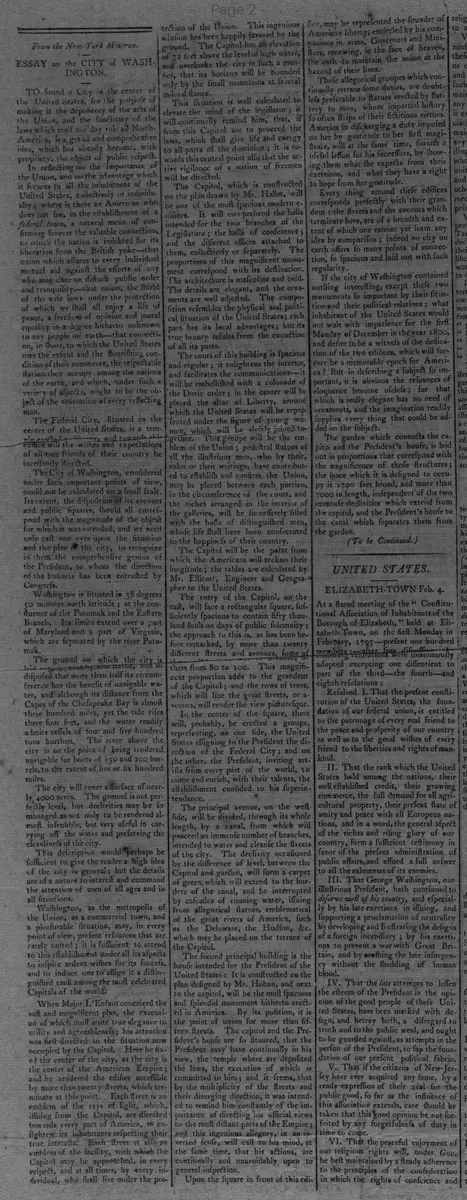
ESSAY on the CITY of WASHINGTON.
TO found a City in the center of the United States, for the purpose of making it the depository of the acts of the Union, and the sanctuary of the laws which must one day rule all North America, is a grand and comprehensive idea, which has already become, with propriety, the object of public respect.
In reflecting on the importance of the Union, and on the advantage which it secures to all the inhabitants of the United States, collectively or individually; where is there an American who does not see, in the establishment of a federal town, a natural means of confirming forever the valuable connection, to which the nation is indebted for its liberation from the British yoke—that union which assures to every individual mutual aid against the efforts of any who may dare to disturb public order and tranquility—that union, the shield of the wise laws under the protection of which we shall all enjoy a life of peace, a freedom of opinion and moral equality in a degree hitherto unknown to any people on earth—that connection, in short, to which the United States owe the extent and the flourishing condition of their commerce, the respectable station they occupy among the nations of the earth, and which, under such a variety of aspects, ought to be the object of the veneration of every reflecting man.
The Federal City, situated in the center of the United States, is a temple erected to unity, and towards this edifice will the wishes and expectations of all true friends of their country be incessantly directed.
The City of Washington, considered under such important points of view, could not be calculated on a small scale. Its extent, the disposition of its avenues and public squares, should all correspond with the magnitude of the object for which it was intended, and we need only cast our eyes upon the situation and the plan of the city, to recognize in them the comprehensive genius of the President, to whom the direction of the business has been entrusted by Congress.
Washington is situated in 38 degrees 50 minutes north latitude; at the confluence of the Potomac and the Eastern Branch. Its limits extend over a part of Maryland and a part of Virginia, which are separated by the river Potomac.
The ground on which the city is laid out is sufficiently ample and fertile, and so disposed that more than half its circumference has the benefit of navigable water, and although its distance from the Capes of the Chesapeake Bay is almost three hundred miles, yet the tide rises there four feet, and the water readily admits vessels of four and five hundred tons burthen. The river above the city is on the point of being rendered navigable for boats of 50 and 200 barrels, to the extent of five or six hundred miles.
The city will cover a surface of nearly 4000 acres. The ground is not perfectly level, but declivities may be so managed as not only to be rendered almost imperceptible, but very useful in carrying off the water and preserving the cleanliness of the city.
This description would perhaps be sufficient to give the reader a high idea of the city in general; but the details are of a nature to interest and command the attention of men of all ages and in all situations.
Washington, as the metropolis of the Union, as a commercial town, and a pleasurable situation, may, in every point of view, present resources that are rarely united; it is sufficient to attend to this establishment under all its aspects to inspire ardent wishes for its success, and to induce one to assign it a distinguished rank among the most celebrated Capitals of the world.
When Major L'Enfant conceived the vast and magnificent plan, the execution of which must unite true elegance to utility and agreeableness; his attention was first directed to the situation now occupied by the Capitol. Here he fixed the center of the city, as the city is the center of the American Empire; and he rendered the edifice accessible by more than twenty streets, which terminate at this point. Each street is an emblem of the rays of light, which issuing from the Capitol, are directed towards every part of America, to enlighten its inhabitants respecting their true interests. Each street is also an emblem of the facility, with which the Capitol may be approached, in every respect, and at all times, by every individual, who shall live under the protection of the Union. This ingenious allusion has been happily favored, by the ground. The Capitol has an elevation of 72 feet above the level of high water, and overlooks the city in such a manner, that its horizon will be bounded only by the small mountains at several miles distance.
This situation is well calculated to elevate the mind of the legislator; it will continually remind him, that, if from this Capitol are to proceed the laws, which shall give life and energy to all parts of the dominion; it is towards this central point also that the active vigilance of a nation of freemen will be directed.
The Capitol, which is constructed on the plan drawn by Mr. Hallet, will be one of the most spacious modern edifices. It will comprehend the halls intended for the two branches of the Legislature; the halls of conference; and the different offices attached to them, collectively or separately. The proportions of this magnificent monument correspond with its destination. The architecture is masculine and bold. The details are elegant, and the ornaments are well adjusted. The composition resembles the physical and political situation of the United States; each part has its local advantages; but its true beauty results from the connection of all its parts.
The court of this building is spacious and regular; it enlightens the interior, and facilitates the communications—It will be embellished with a colonnade of the Doric order: in the center will be placed the altar of Liberty, around which the United States will be represented under the figure of young women, which will be closely joined together. This group will be the emblem of the Union; pedestal statues of all the illustrious men, who by their valor or their writings, have contributed to establish and confirm the Union, may be placed between each portico, in the circumference of the court, and the niches arranged in the interior of the galleries, will be successively filled with the busts of distinguished men, whose life shall have been consecrated to the happiness of their country.
The Capitol will be the point from which the Americans will reckon their longitude; the tables are calculated by Mr. Ellicott, Engineer and Geographer to the United States.
The entry of the Capitol, on the east, will face a rectangular square, sufficiently spacious to contain fifty thousand souls on days of public solemnity; the approach to this is, as has been before remarked, by more than twenty different streets and avenues, some of them from 80 to 100 feet. This magnificent proportion adds to the grandeur of the Capitol; and the rows of trees, which will line the great streets, or avenues, will render the view picturesque.
In the center of the square, there will, probably, be erected a group, representing, on one side, the United States assigning to the President the direction of the Federal City; and on the other, the President, inviting artists from every part of the world, to come and enrich, with their talents, the establishment confided to his superintendence.
The principal avenue, on the west side, will be divided, through its whole length, by a canal, from which will proceed an immense number of branches, intended to water and cleanse the streets of the city. The declivity occasioned by the difference of level, between the Capitol and garden, will form a carpet of green which will extend to the borders of the canal, and be interrupted by cascades of running water, issuing from allegorical statues, emblematical of the great rivers of America, such as the Delaware, the Hudson, &c. which may be placed on the terrace of the Capitol.
The second principal building is the house intended for the President of the United States: It is constructed on the plan designed by Mr. Hoban, and next to the capitol, will be the most spacious and splendid monument hitherto erected in America. By its position, it is the point of union for more than fifteen streets. The capitol and the President's house are so situated, that the President may have continually in his view, the temple where are deposited the laws, the execution of which is committed to him; and it seems, that by the multiplicity of the streets and their diverging direction, it was intended to remind him constantly of the importance of directing his official views to the most distant parts of the Empire; and this ingenious allegory, in an inverted sense, will call to his mind, at the same time, that his actions, are continually and unavoidably open to general inspection.
Upon the square in front of this edifice, may be represented the founder of American liberty, encircled by his companions in arms, Governors and Ministers, renewing, in the face of heaven, the oath to maintain the union at the hazard of their lives.
These allegorical groups which continually retrace some duties, are doubtless preferable to statues erected by flattery to men, whom impartial history so often strips of their fictitious virtues. America in discharging a duty imposed on her by gratitude to her first magistrate, will at the same time, furnish a useful lesson for his successors, by showing them what she expects from their exertions, and what they have a right to hope from her gratitude.
Every thing around these edifices corresponds perfectly with their grandeur: the streets and the avenues which terminate here, are of a breadth and extent of which one cannot yet form any idea by comparison; indeed no city on earth offers so many points of connection, so spacious and laid out with such regularity.
If the city of Washington contained nothing interesting, except these two monuments so important by their situation and their political relations; what inhabitant of the United States would not wait with impatience for the first Monday of December in the year 1800, and desire to be a witness of the dedication of the two edifices, which will forever be a memorable epoch for America? But in describing a subject so important, it is obvious the resources of eloquence become useless; for that which is really elegant has no need of ornaments, and the imagination readily supplies every thing that could be added on the subject.
The garden which connects the capitol and the President's house, is laid out in proportions that correspond with the magnificence of those structures; the space which it is designed to occupy is 1700 feet broad, and more than 7000 in length, independent of the two immense declivities which extend from the capitol, and the President's house to the canal which separates them from the garden.
(To be Continued.)
ESSAY on the CITY of WASHINGTON.
TO found a City in the center of the United States, for the purpose of making it the depository of the acts of the Union, and the sanctuary of the laws which must one day rule all North America, is a grand and comprehensive idea, which has already become, with propriety, the object of public respect.
In reflecting on the importance of the Union, and on the advantage which it secures to all the inhabitants of the United States, collectively or individually; where is there an American who does not see, in the establishment of a federal town, a natural means of confirming forever the valuable connection, to which the nation is indebted for its liberation from the British yoke—that union which assures to every individual mutual aid against the efforts of any who may dare to disturb public order and tranquility—that union, the shield of the wise laws under the protection of which we shall all enjoy a life of peace, a freedom of opinion and moral equality in a degree hitherto unknown to any people on earth—that connection, in short, to which the United States owe the extent and the flourishing condition of their commerce, the respectable station they occupy among the nations of the earth, and which, under such a variety of aspects, ought to be the object of the veneration of every reflecting man.
The Federal City, situated in the center of the United States, is a temple erected to unity, and towards this edifice will the wishes and expectations of all true friends of their country be incessantly directed.
The City of Washington, considered under such important points of view, could not be calculated on a small scale. Its extent, the disposition of its avenues and public squares, should all correspond with the magnitude of the object for which it was intended, and we need only cast our eyes upon the situation and the plan of the city, to recognize in them the comprehensive genius of the President, to whom the direction of the business has been entrusted by Congress.
Washington is situated in 38 degrees 50 minutes north latitude; at the confluence of the Potomac and the Eastern Branch. Its limits extend over a part of Maryland and a part of Virginia, which are separated by the river Potomac.
The ground on which the city is laid out is sufficiently ample and fertile, and so disposed that more than half its circumference has the benefit of navigable water, and although its distance from the Capes of the Chesapeake Bay is almost three hundred miles, yet the tide rises there four feet, and the water readily admits vessels of four and five hundred tons burthen. The river above the city is on the point of being rendered navigable for boats of 50 and 200 barrels, to the extent of five or six hundred miles.
The city will cover a surface of nearly 4000 acres. The ground is not perfectly level, but declivities may be so managed as not only to be rendered almost imperceptible, but very useful in carrying off the water and preserving the cleanliness of the city.
This description would perhaps be sufficient to give the reader a high idea of the city in general; but the details are of a nature to interest and command the attention of men of all ages and in all situations.
Washington, as the metropolis of the Union, as a commercial town, and a pleasurable situation, may, in every point of view, present resources that are rarely united; it is sufficient to attend to this establishment under all its aspects to inspire ardent wishes for its success, and to induce one to assign it a distinguished rank among the most celebrated Capitals of the world.
When Major L'Enfant conceived the vast and magnificent plan, the execution of which must unite true elegance to utility and agreeableness; his attention was first directed to the situation now occupied by the Capitol. Here he fixed the center of the city, as the city is the center of the American Empire; and he rendered the edifice accessible by more than twenty streets, which terminate at this point. Each street is an emblem of the rays of light, which issuing from the Capitol, are directed towards every part of America, to enlighten its inhabitants respecting their true interests. Each street is also an emblem of the facility, with which the Capitol may be approached, in every respect, and at all times, by every individual, who shall live under the protection of the Union. This ingenious allusion has been happily favored, by the ground. The Capitol has an elevation of 72 feet above the level of high water, and overlooks the city in such a manner, that its horizon will be bounded only by the small mountains at several miles distance.
This situation is well calculated to elevate the mind of the legislator; it will continually remind him, that, if from this Capitol are to proceed the laws, which shall give life and energy to all parts of the dominion; it is towards this central point also that the active vigilance of a nation of freemen will be directed.
The Capitol, which is constructed on the plan drawn by Mr. Hallet, will be one of the most spacious modern edifices. It will comprehend the halls intended for the two branches of the Legislature; the halls of conference; and the different offices attached to them, collectively or separately. The proportions of this magnificent monument correspond with its destination. The architecture is masculine and bold. The details are elegant, and the ornaments are well adjusted. The composition resembles the physical and political situation of the United States; each part has its local advantages; but its true beauty results from the connection of all its parts.
The court of this building is spacious and regular; it enlightens the interior, and facilitates the communications—It will be embellished with a colonnade of the Doric order: in the center will be placed the altar of Liberty, around which the United States will be represented under the figure of young women, which will be closely joined together. This group will be the emblem of the Union; pedestal statues of all the illustrious men, who by their valor or their writings, have contributed to establish and confirm the Union, may be placed between each portico, in the circumference of the court, and the niches arranged in the interior of the galleries, will be successively filled with the busts of distinguished men, whose life shall have been consecrated to the happiness of their country.
The Capitol will be the point from which the Americans will reckon their longitude; the tables are calculated by Mr. Ellicott, Engineer and Geographer to the United States.
The entry of the Capitol, on the east, will face a rectangular square, sufficiently spacious to contain fifty thousand souls on days of public solemnity; the approach to this is, as has been before remarked, by more than twenty different streets and avenues, some of them from 80 to 100 feet. This magnificent proportion adds to the grandeur of the Capitol; and the rows of trees, which will line the great streets, or avenues, will render the view picturesque.
In the center of the square, there will, probably, be erected a group, representing, on one side, the United States assigning to the President the direction of the Federal City; and on the other, the President, inviting artists from every part of the world, to come and enrich, with their talents, the establishment confided to his superintendence.
The principal avenue, on the west side, will be divided, through its whole length, by a canal, from which will proceed an immense number of branches, intended to water and cleanse the streets of the city. The declivity occasioned by the difference of level, between the Capitol and garden, will form a carpet of green which will extend to the borders of the canal, and be interrupted by cascades of running water, issuing from allegorical statues, emblematical of the great rivers of America, such as the Delaware, the Hudson, &c. which may be placed on the terrace of the Capitol.
The second principal building is the house intended for the President of the United States: It is constructed on the plan designed by Mr. Hoban, and next to the capitol, will be the most spacious and splendid monument hitherto erected in America. By its position, it is the point of union for more than fifteen streets. The capitol and the President's house are so situated, that the President may have continually in his view, the temple where are deposited the laws, the execution of which is committed to him; and it seems, that by the multiplicity of the streets and their diverging direction, it was intended to remind him constantly of the importance of directing his official views to the most distant parts of the Empire; and this ingenious allegory, in an inverted sense, will call to his mind, at the same time, that his actions, are continually and unavoidably open to general inspection.
Upon the square in front of this edifice, may be represented the founder of American liberty, encircled by his companions in arms, Governors and Ministers, renewing, in the face of heaven, the oath to maintain the union at the hazard of their lives.
These allegorical groups which continually retrace some duties, are doubtless preferable to statues erected by flattery to men, whom impartial history so often strips of their fictitious virtues. America in discharging a duty imposed on her by gratitude to her first magistrate, will at the same time, furnish a useful lesson for his successors, by showing them what she expects from their exertions, and what they have a right to hope from her gratitude.
Every thing around these edifices corresponds perfectly with their grandeur: the streets and the avenues which terminate here, are of a breadth and extent of which one cannot yet form any idea by comparison; indeed no city on earth offers so many points of connection, so spacious and laid out with such regularity.
If the city of Washington contained nothing interesting, except these two monuments so important by their situation and their political relations; what inhabitant of the United States would not wait with impatience for the first Monday of December in the year 1800, and desire to be a witness of the dedication of the two edifices, which will forever be a memorable epoch for America? But in describing a subject so important, it is obvious the resources of eloquence become useless; for that which is really elegant has no need of ornaments, and the imagination readily supplies every thing that could be added on the subject.
The garden which connects the capitol and the President's house, is laid out in proportions that correspond with the magnificence of those structures; the space which it is designed to occupy is 1700 feet broad, and more than 7000 in length, independent of the two immense declivities which extend from the capitol, and the President's house to the canal which separates them from the garden.
(To be Continued.)
What sub-type of article is it?
Essay
What themes does it cover?
Political
Liberty Freedom
Patriotism
What keywords are associated?
Washington City
Federal Capital
Capitol Building
Presidents House
American Union
Liberty Emblems
Urban Planning
Potomac River
Literary Details
Title
Essay On The City Of Washington.
Subject
On The Federal City And Its Symbolic Design
Key Lines
To Found A City In The Center Of The United States, For The Purpose Of Making It The Depository Of The Acts Of The Union, And The Sanctuary Of The Laws Which Must One Day Rule All North America, Is A Grand And Comprehensive Idea, Which Has Already Become, With Propriety, The Object Of Public Respect.
The Federal City, Situated In The Center Of The United States, Is A Temple Erected To Unity, And Towards This Edifice Will The Wishes And Expectations Of All True Friends Of Their Country Be Incessantly Directed.
Each Street Is An Emblem Of The Rays Of Light, Which Issuing From The Capitol, Are Directed Towards Every Part Of America, To Enlighten Its Inhabitants Respecting Their True Interests.
This Group Will Be The Emblem Of The Union; Pedestal Statues Of All The Illustrious Men, Who By Their Valor Or Their Writings, Have Contributed To Establish And Confirm The Union, May Be Placed Between Each Portico, In The Circumference Of The Court.
What Inhabitant Of The United States Would Not Wait With Impatience For The First Monday Of December In The Year 1800, And Desire To Be A Witness Of The Dedication Of The Two Edifices, Which Will Forever Be A Memorable Epoch For America?