Thank you for visiting SNEWPapers!
Sign up free
Editorial
November 3, 1827
Phenix Gazette
Alexandria, Virginia
What is this article about?
An editorial from the National Journal criticizes the Richmond Enquirer and National Palladium for spreading and then altering a slanderous story accusing John Quincy Adams and Daniel Webster of a corrupt bargain, involving a letter and congressional members, while defenses appear in the New York American.
Clipping
OCR Quality
98%
Excellent
Full Text
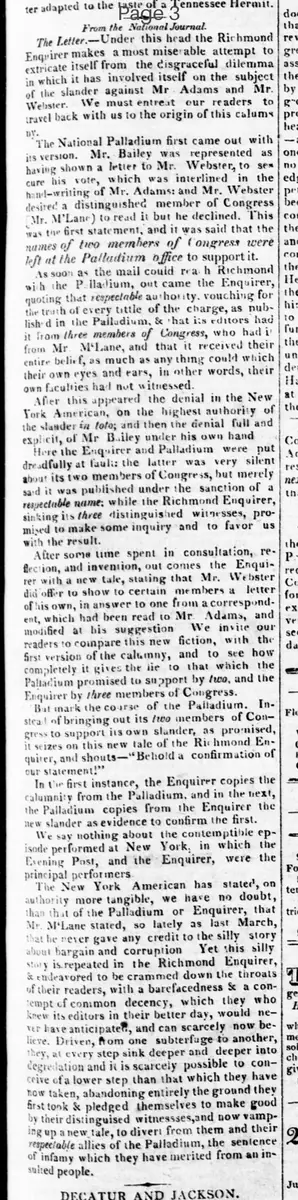
From the National Journal.
The Letter. Under this head the Richmond Enquirer makes a most miserable attempt to extricate itself from the disgraceful dilemma in which it has involved itself on the subject of the slander against Mr. Adams and Mr. Webster. It must entreat our readers to travel back with us to the origin of this calumny.
The National Palladium first came out with its version. Mr. Bailey was represented as having shown a letter to Mr. Webster, to secure his vote, which was interlined in the hand-writing of Mr. Adams: and Mr. Webster desired a distinguished member of Congress (Mr. M'Lane) to read it but he declined. This was the first statement, and it was said that the names of two members of Congress were left at the Palladium office to support it.
As soon as the mail could reach Richmond with the Palladium, out came the Enquirer, quoting that respectable authority, vouching for the truth of every tittle of the charge, as published in the Palladium, & that its editors had it from three members of Congress, who had it from Mr. M'Lane, and that it received their entire belief, as much as any thing could which their own eyes and ears, in other words, their own faculties had not witnessed.
After this appeared the denial in the New York American, on the highest authority of the slander in toto; and then the denial full and explicit, of Mr. Bailey under his own hand. Here the Enquirer and Palladium were put dreadfully at fault: the latter was very silent about its two members of Congress, but merely said it was published under the sanction of a respectable name: while the Richmond Enquirer, sinking its three distinguished witnesses, promised to make some inquiry and to favor us with the result.
After some time spent in consultation, reflection, and invention, out comes the Enquirer with a new tale, stating that Mr. Webster did offer to show to certain members a letter of his own, in answer to one from a correspondent, which had been read to Mr. Adams, and modified at his suggestion. We invite our readers to compare this new fiction, with the first version of the calumny, and to see how completely it gives the lie to that which the Palladium promised to support by two, and the Enquirer by three members of Congress.
But mark the course of the Palladium. Instead of bringing out its two members of Congress to support its own slander, as promised, it seizes on this new tale of the Richmond Enquirer, and shouts- "Behold a confirmation of our statement!"
In the first instance, the Enquirer copies the calumny from the Palladium. and in the next, the Palladium copies from the Enquirer the new slander as evidence to confirm the first.
I say nothing about the contemptible episode performed at New York. in which the Evening Post, and the Enquirer, were the principal performers.
The New York American has stated, on authority more tangible, we have no doubt, than that of the Palladium or Enquirer, that Mr. M'Lane stated, so lately as last March, that he never gave any credit to the silly story about bargain and corruption. Yet this silly story is repeated in the Richmond Enquirer, endeavored to be crammed down the throats of their readers, with a barefacedness & a contempt of common decency, which they who knew its editors in their better day, would never have anticipated, and can scarcely now believe. Driven, from one subterfuge to another, they, at every step sink deeper and deeper into degradation and it is scarcely possible to conceive of a lower step than that which they have now taken, abandoning entirely the ground they first took & pledged themselves to make good by their distinguished witnesses, and now vamping up a new tale, to divert from them and their respectable allies of the Palladium, the sentence of infamy which they have merited from an insulted people.
The Letter. Under this head the Richmond Enquirer makes a most miserable attempt to extricate itself from the disgraceful dilemma in which it has involved itself on the subject of the slander against Mr. Adams and Mr. Webster. It must entreat our readers to travel back with us to the origin of this calumny.
The National Palladium first came out with its version. Mr. Bailey was represented as having shown a letter to Mr. Webster, to secure his vote, which was interlined in the hand-writing of Mr. Adams: and Mr. Webster desired a distinguished member of Congress (Mr. M'Lane) to read it but he declined. This was the first statement, and it was said that the names of two members of Congress were left at the Palladium office to support it.
As soon as the mail could reach Richmond with the Palladium, out came the Enquirer, quoting that respectable authority, vouching for the truth of every tittle of the charge, as published in the Palladium, & that its editors had it from three members of Congress, who had it from Mr. M'Lane, and that it received their entire belief, as much as any thing could which their own eyes and ears, in other words, their own faculties had not witnessed.
After this appeared the denial in the New York American, on the highest authority of the slander in toto; and then the denial full and explicit, of Mr. Bailey under his own hand. Here the Enquirer and Palladium were put dreadfully at fault: the latter was very silent about its two members of Congress, but merely said it was published under the sanction of a respectable name: while the Richmond Enquirer, sinking its three distinguished witnesses, promised to make some inquiry and to favor us with the result.
After some time spent in consultation, reflection, and invention, out comes the Enquirer with a new tale, stating that Mr. Webster did offer to show to certain members a letter of his own, in answer to one from a correspondent, which had been read to Mr. Adams, and modified at his suggestion. We invite our readers to compare this new fiction, with the first version of the calumny, and to see how completely it gives the lie to that which the Palladium promised to support by two, and the Enquirer by three members of Congress.
But mark the course of the Palladium. Instead of bringing out its two members of Congress to support its own slander, as promised, it seizes on this new tale of the Richmond Enquirer, and shouts- "Behold a confirmation of our statement!"
In the first instance, the Enquirer copies the calumny from the Palladium. and in the next, the Palladium copies from the Enquirer the new slander as evidence to confirm the first.
I say nothing about the contemptible episode performed at New York. in which the Evening Post, and the Enquirer, were the principal performers.
The New York American has stated, on authority more tangible, we have no doubt, than that of the Palladium or Enquirer, that Mr. M'Lane stated, so lately as last March, that he never gave any credit to the silly story about bargain and corruption. Yet this silly story is repeated in the Richmond Enquirer, endeavored to be crammed down the throats of their readers, with a barefacedness & a contempt of common decency, which they who knew its editors in their better day, would never have anticipated, and can scarcely now believe. Driven, from one subterfuge to another, they, at every step sink deeper and deeper into degradation and it is scarcely possible to conceive of a lower step than that which they have now taken, abandoning entirely the ground they first took & pledged themselves to make good by their distinguished witnesses, and now vamping up a new tale, to divert from them and their respectable allies of the Palladium, the sentence of infamy which they have merited from an insulted people.
What sub-type of article is it?
Partisan Politics
Press Freedom
What keywords are associated?
Political Slander
Adams Webster Bargain
Newspaper Calumny
Partisan Intrigue
Press Libel
Congressional Denial
What entities or persons were involved?
Mr. Adams
Mr. Webster
Mr. Bailey
Mr. M'lane
Richmond Enquirer
National Palladium
New York American
Evening Post
Editorial Details
Primary Topic
Slander Against Adams And Webster By Partisan Newspapers
Stance / Tone
Strongly Critical Of Enquirer And Palladium For Spreading And Retracting False Accusations
Key Figures
Mr. Adams
Mr. Webster
Mr. Bailey
Mr. M'lane
Richmond Enquirer
National Palladium
New York American
Evening Post
Key Arguments
National Palladium Originated False Story Of Corrupt Letter Involving Adams And Webster
Richmond Enquirer Endorsed And Amplified The Slander Citing Three Congressional Sources
Denials From New York American And Bailey Exposed The Falsehood
Enquirer Shifted To A New Fabricated Version Contradicting Original Claims
Palladium Hypocritically Used Enquirer's New Tale To Support Its Own Slander
Mr. M'lane Denied Crediting The Bargain And Corruption Story
Newspapers' Actions Demonstrate Degradation And Contempt For Decency