Thank you for visiting SNEWPapers!
Sign up free
National Gazette
Philadelphia, Philadelphia County, Pennsylvania
What is this article about?
Mr. Findley's speech in the U.S. House critiques the funding system's irredeemable principal as a breach of original debt contracts, promoting speculation and foreign influence over fair repayment to public creditors.
Merged-components note: This is the continuation of Mr. Findley's speech on the funding system and assumption of state debts, indicated by 'See last Page' at the end of the first part; the second part begins directly with the continuation text. Labeled as story for full narrative article, changing from domestic_news on the continuation part.
Clippings
1 of 2
OCR Quality
Full Text
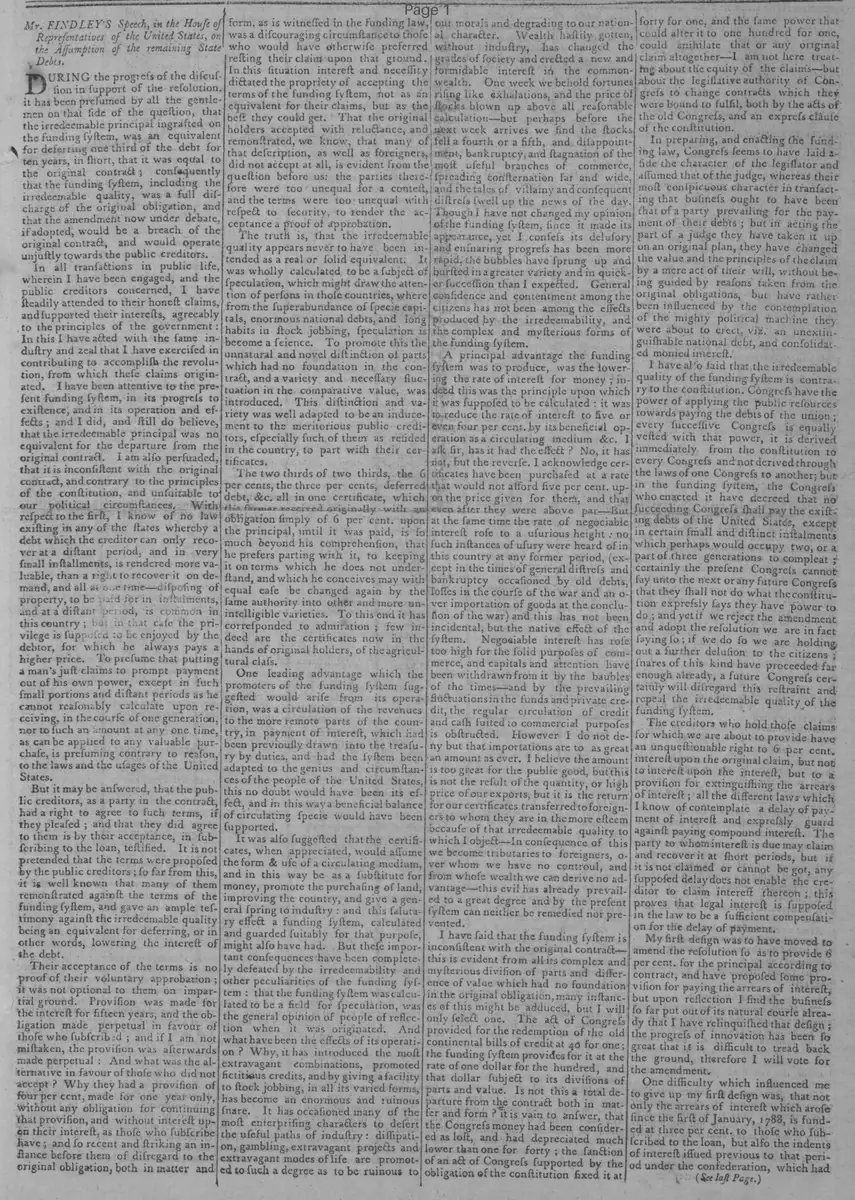
DURING the progress of the discussion in support of the resolution, it has been presumed by all the gentlemen on that side of the question, that the irredeemable principal ingrafted on the funding system, was an equivalent for deferring one third of the debt for ten years, in short, that it was equal to the original contract; consequently that the funding system, including the irredeemable quality, was a full discharge of the original obligation, and that the amendment now under debate, if adopted, would be a breach of the original contract, and would operate unjustly towards the public creditors.
In all transactions in public life, wherein I have been engaged, and the public creditors concerned, I have steadily attended to their honest claims, and supported their interests, agreeably to the principles of the government: In this I have acted with the same industry and zeal that I have exercised in contributing to accomplish the revolution, from which these claims originated. I have been attentive to the present funding system, in its progress to existence, and in its operation and effects; and I did, and still do believe, that the irredeemable principal was no equivalent for the departure from the original contract. I am also persuaded, that it is inconsistent with the original contract, and contrary to the principles of the constitution, and unsuitable to our political circumstances. With respect to the first, I know of no law existing in any of the states whereby a debt which the creditor can only recover at a distant period, and in very small installments, is rendered more valuable, than a right to recover it on demand, and all at one time: disposing of property, to be paid for in installments, and at a distant period, is common in this country; but in that case the privilege is supposed to be enjoyed by the debtor, for which he always pays a higher price. To presume that putting a man's just claims to prompt payment out of his own power, except in such small portions and distant periods as he cannot reasonably calculate upon receiving, in the course of one generation, nor to such an amount at any one time, as can be applied to any valuable purchase, is presuming contrary to reason, to the laws and the usages of the United States.
But it may be answered, that the public creditors, as a party in the contract, had a right to agree to such terms, if they pleased; and that they did agree to them is by their acceptance, in subscribing to the loan, testified. It is not pretended that the terms were proposed by the public creditors; so far from this, it is well known that many of them remonstrated against the terms of the funding system, and gave an ample testimony against the irredeemable quality being an equivalent for deferring, or in other words, lowering the interest of the debt.
Their acceptance of the terms is no proof of their voluntary approbation; it was not optional to them on impartial ground. Provision was made for the interest for fifteen years, and the obligation made perpetual in favour of those who subscribed; and if I am not mistaken, the provision was afterwards made perpetual: And what was the alternative in favour of those who did not accept? Why they had a provision of four per cent, made for one year only, without any obligation for continuing that provision, and without interest upon their interest, as those who subscribe have; and so recent and striking an instance before them of disregard to the original obligation, both in matter and form, as is witnessed in the funding law, was a discouraging circumstance to those who would have otherwise preferred resting their claim upon that ground.
In this situation interest and necessity dictated the propriety of accepting the terms of the funding system, not as an equivalent for their claims, but as the best they could get. That the original holders accepted with reluctance, and remonstrated, we know, that many of that description, as well as foreigners, did not accept at all, is evident from the question before us: the parties therefore were too unequal for a contest, and the terms were too unequal with respect to security, to render the acceptance a proof of approbation.
The truth is, that the irredeemable quality appears never to have been intended as a real or solid equivalent. It was wholly calculated to be a subject of speculation, which might draw the attention of persons in those countries, where from the superabundance of specie capitals, enormous national debts, and long habits in stock jobbing, speculation is become a science. To promote this the unnatural and novel distinction of parts which had no foundation in the contract, and a variety and necessary fluctuation in the comparative value, was introduced. This distinction and variety was well adapted to be an inducement to the meritorious public creditors, especially such of them as resided in the country, to part with their certificates.
The two thirds of two thirds, the 6 per cents, the three per cents, deferred debt, &c. all in one certificate, which the farmer received originally with an obligation simply of 6 per cent. upon the principal, until it was paid, is so much beyond his comprehension, that he prefers parting with it, to keeping it on terms which he does not understand, and which he conceives may with equal ease be changed again by the same authority into other and more unintelligible varieties. To this end it has corresponded to admiration; few indeed are the certificates now in the hands of original holders, of the agricultural class.
One leading advantage which the promoters of the funding system suggested would arise from its operation, was a circulation of the revenues to the more remote parts of the country, in payment of interest, which had been previously drawn into the treasury by duties, and had the system been adapted to the genius and circumstances of the people of the United States, this no doubt would have been its effect, and in this way a beneficial balance of circulating specie would have been supported.
It was also suggested that the certificates, when appreciated, would assume the form & use of a circulating medium, and in this way be as a substitute for money, promote the purchasing of land, improving the country, and give a general spring to industry: and this salutary effect a funding system, calculated and guarded suitably for that purpose, might also have had. But these important consequences have been completely defeated by the irredeemability and other peculiarities of the funding system: that the funding system was calculated to be a field for speculation, was the general opinion of people of reflection when it was originated. And what have been the effects of its operation? Why, it has introduced the most extravagant combinations, promoted fictitious credits, and by giving a facility to stock jobbing, in all its varied forms, has become an enormous and ruinous snare. It has occasioned many of the most enterprising characters to desert the useful paths of industry: dissipation, gambling, extravagant projects and extravagant modes of life are promoted to such a degree as to be ruinous to our morals and degrading to our national character.
Wealth hastily gotten, without industry, has changed the grades of society and erected a new and formidable interest in the commonwealth. One week we behold fortunes rising like exhalations, and the price of stocks blown up above all reasonable calculation—but perhaps before the next week arrives we find the stocks fell a fourth or a fifth, and disappointment, bankruptcy, and stagnation of the most useful branches of commerce, spreading consternation far and wide, and the tales of villainy and consequent distress swell up the news of the day.
Though I have not changed my opinion of the funding system, since it made its appearance, yet I confess its delusive and ensnaring progress has been more rapid, the bubbles have sprung up and bursted in a greater variety and in quicker succession than I expected. General confidence and contentment among the citizens has not been among the effects produced by the irredeemability, and the complex and mysterious forms of the funding system.
A principal advantage the funding system was to produce, was the lowering the rate of interest for money; indeed this was the principle upon which it was supposed to be calculated: it was to reduce the rate of interest to five or even four per cent. by its beneficial operation as a circulating medium &c. I ask, has it had the effect? No, it has not, but the reverse. I acknowledge certificates have been purchased at a rate that would not afford five per cent. upon the price given for them, and that even after they were above par. But at the same time the rate of negotiable interest rose to a usurious height: no such instances of usury were heard of in this country at any former period, (except in the times of general distress and bankruptcy occasioned by old debts, losses in the course of the war and an over importation of goods at the conclusion of the war) and this has not been incidental, but the native effect of the system. Negotiable interest has rose too high for the solid purposes of commerce, and capitals and attention have been withdrawn from it by the baubles of the times—and by the prevailing fluctuations in the funds and private credit, the regular circulation of credit and cash suited to commercial purposes is obstructed. However I do not deny but that importations are to as great an amount as ever. I believe the amount is too great for the public good, but this is not the result of the quantity, or high price of our exports, but it is the return for our certificates transferred to foreigners to whom they are in the more esteem because of that irredeemable quality to which I object—In consequence of this we become tributaries to foreigners, over whom we have no controul, and from whose wealth we can derive no advantage—this evil has already prevailed to a great degree and by the present system can neither be remedied nor prevented.
I have said that the funding system is inconsistent with the original contract—this is evident from all its complex and mysterious division of parts and difference of value which had no foundation in the original obligation, many instances of this might be adduced, but I will only select one. The Act of Congress provided for the redemption of the old continental bills of credit at 40 for one; the funding system provides for it at the rate of one dollar for the hundred, and that dollar subject to its divisions of parts and value. Is not this a total departure from the contract both in matter and form? It is vain to answer, that the Congress money had been considered as lost, and had depreciated much lower than one for forty; the sanction of an act of Congress supported by the obligation of the constitution fixed it at forty for one, and the same power that could alter it to one hundred for one, could annihilate that or any original claim altogether—I am not here treating about the equity of the claims—but about the legislative authority of Congress to change contracts which they were bound to fulfil, both by the acts of the old Congress, and an express clause of the constitution.
In preparing, and enacting the funding law, Congress seems to have laid aside the character of the legislator and assumed that of the judge, whereas their most conspicuous character in transacting that business ought to have been that of a party providing for the payment of their debts; but in acting the part of a judge they have taken it up on an original plan, they have changed the value and the principles of the claim by a mere act of their will, without being guided by reasons taken from the original obligations, but have rather been influenced by the contemplation of the mighty political machine they were about to erect, viz. an unextinguishable national debt, and consolidated monied interest.
I have also said that the irredeemable quality of the funding system is contrary to the constitution. Congress have the power of applying the public resources towards paying the debts of the union; every successive Congress is equally vested with that power, it is derived immediately from the constitution to every Congress and not derived through the laws of one Congress to another; but in the funding system, the Congress who enacted it have decreed that no succeeding Congress shall pay the existing debts of the United States, except in certain small and distant installments which perhaps would occupy two, or a part of three generations to complete; certainly the present Congress cannot say unto the next or any future Congress that they shall not do what the constitution expressly says they have power to do; and yet if we reject the amendment and adopt the resolution we are in fact saying so; if we do so we are holding out a further delusion to the citizens; snares of this kind have proceeded far enough already, a future Congress certainly will disregard this restraint and repeal the irredeemable quality of the funding system.
The creditors who hold those claims for which we are about to provide have an unquestionable right to 6 per cent. interest upon the original claim, but not to interest upon the interest, but to a provision for extinguishing the arrears of interest; all the different laws which I know of contemplate a delay of payment of interest and expressly guard against paying compound interest. The party to whom interest is due may claim and recover it at short periods, but if it is not claimed or cannot be got, any supposed delay does not enable the creditor to claim interest thereon; this proves that legal interest is supposed in the law to be a sufficient compensation for the delay of payment.
My first design was to have moved to amend the resolution so as to provide 6 per cent. for the principal according to contract, and have proposed some provision for paying the arrears of interest, but upon reflection I find the business so far put out of its natural course already that I have relinquished that design; the progress of innovation has been so great that it is difficult to tread back the ground, therefore I will vote for the amendment.
One difficulty which influenced me to give up my first design was, that not only the arrears of interest which arose since the first of January, 1788, is funded at three per cent. to those who subscribed to the loan, but also the indents of interest issued previous to that period under the confederation, which had (See last Page.)
been disposed of and provided for by requisitions as fully as the powers or laws of that government permitted:-
Many, indeed I believe most of the states, had made adequate provision for them to their respective citizens—and those who did not were under the same obligations to do it that they had been people of to do any other part of federal duty in the course of the revolution: even these have been revived again and funded at three per cent. The indents, and about three years interest which became due and since the first of January 1788, making in all above ten millions, have been funded—above seven millions of these, if it was not a debt created by the funding system, received a resurrection by it; this will explain the charge of creating a new debt asserted by one of the gentlemen, and denied by another; here were above seven millions received, which ought to have been considered as redeemed, unless perhaps in a few instances, to such as were not citizens of any state—and above three millions funded at three per cent. for the doing of which there existed no obligation.
If it be answered, that equity required it, I will allege that if the Congress were to act on the general claims of equity which originated in the course of the revolution, a much greater amount must yet be provided for. I never knew a public creditor who expected interest upon his interest, or that expected the indent debt that had been disposed of, to be received or otherwise provided for than by a final settlement between the respective states and the United States. Why should they expect Congress to make provision where an actual obligation did not exist, when in the same act they were destroying ten years interest of one third of the principal, where the most express obligation did exist, and where the claim was also founded in the strictest equity? This increase of the debt, and funding at three per cent, appears not to have been calculated for the profit, nor at the request of the public creditors; for what they gain in the one hand they lose in the other: neither does it operate as a gain to the United States. If we may judge of its object by its effects, we may observe that by receiving the indents redeemed by the states, an increase of revenue becomes necessary, and the states become like pensioners to Congress for the annual amount they are to receive; thus the revenue must be the greater in the hands of those who conduct it, and the individual states must be dependent on the treasury of the United States for the means of their support; foreigners may make reprisals if they are not paid, nor does the support of their government depend upon it; but this is not the case with dependent states. We know several of the states are in this way entitled to a greater annuity than is necessary for the support of their governments, and the people are in the habit of living wholly free of state taxes; while to accomplish this strange state of things, the debt of the union is increased, obnoxious revenues are rendered necessary, ministerial influence, peculation, and consequent depravity are advanced.
With respect to the dangerous effects which the irredeemable principal and unnecessary increase of funded capital will have upon the genius of our government, and the interest of posterity, this subject has been investigated with so much ability by the gentlemen who were up before me in support of the amendment, that I will not now detain the committee with any thoughts upon it, but will conclude with observing that, having proved that the irredeemable principal which the amendment is designed to correct, is not an equivalent for the departure from the terms of the contract, and that being contrary to the constitution cannot be obligatory on any future Congress, but is delusive in its nature, and calculated to promote peculation & a transfer of the debt to foreigners; and that the increase of funded debt created in the funding system, was not necessary from the original obligation, nor profitable to the public creditors, but calculated for dangerous peculating and political purposes. I will sit down with expressing a wish, that, by adopting the amendment, we will prevent the worst effects of the funding system from being further extended.
What sub-type of article is it?
What themes does it cover?
What keywords are associated?
What entities or persons were involved?
Where did it happen?
Story Details
Key Persons
Location
House Of Representatives Of The United States
Story Details
Mr. Findley argues against the funding system's irredeemable principal, claiming it violates original debt contracts, promotes speculation and stock jobbing, transfers debt to foreigners, and contradicts the Constitution, ultimately supporting an amendment for fairer repayment.