Thank you for visiting SNEWPapers!
Sign up free
The Rhode Island Republican
Newport, Newport County, Rhode Island
What is this article about?
Editorial defends Jefferson administration's dignified stance in rejecting Monroe-Pinckney Treaty due to impressment issues and British violations via Orders in Council, countering opposition claims of U.S. yielding to Britain and highlighting British perfidy.
Merged-components note: Continuation of 'Political Miscellany' across pages 2 and 3, as the text flows directly into the discussion of historical treaty and government dispositions.
Clippings
1 of 2
OCR Quality
Full Text
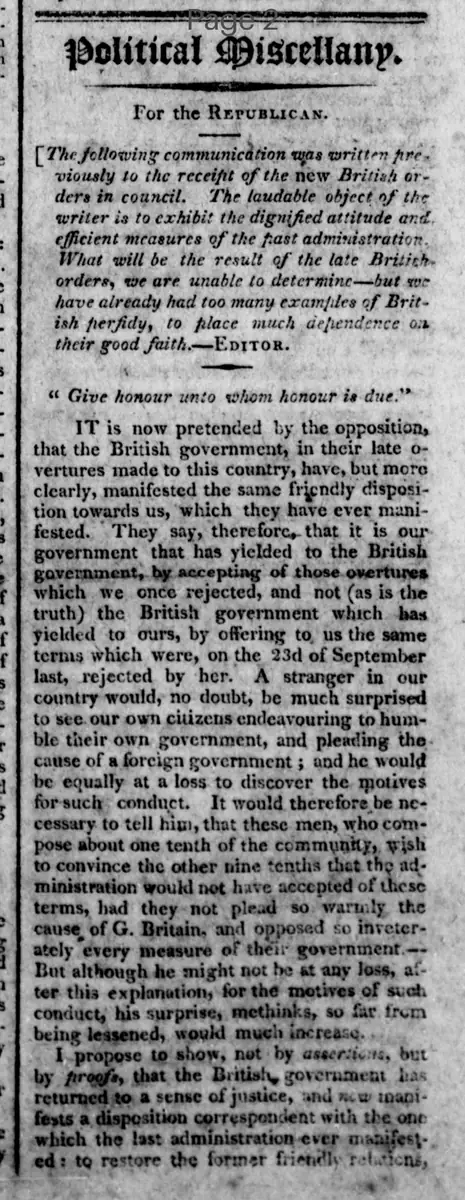
For the Republican.
The following communication was written previously to the receipt of the new British orders in council. The laudable object of the writer is to exhibit the dignified attitude and efficient measures of the last administration. What will be the result of the late British orders, we are unable to determine-but we have already had too many examples of British perfidy, to place much dependence on their good faith.-Editor.
" Give honour unto whom honour is due."
IT is now pretended by the opposition, that the British government, in their late overtures made to this country, have, but more clearly, manifested the same friendly disposition towards us, which they have ever manifested. They say, therefore,-that it is our government that has yielded to the British government, by accepting of those overtures which we once rejected, and not (as is the truth) the British government which has yielded to ours, by offering to us the same terms which were, on the 23d of September last, rejected by her. A stranger in our country would, no doubt, be much surprised to see our own citizens endeavouring to humble their own government, and pleading the cause of a foreign government ; and he would be equally at a loss to discover the motives for such conduct. It would therefore be necessary to tell him, that these men, who compose about one tenth of the community, wish to convince the other nine tenths that the administration would not have accepted of these terms, had they not plead so warmly the cause of G. Britain, and opposed so inveterately every measure of their government.--
But although he might not be at any loss, after this explanation, or the motives of such conduct, his surprise, methinks, so far from being lessened, would much increase.
I propose to show, not by assertions, but by proofs, that the British, government has returned to a sense of justice, and now manifests a disposition correspondent with the one which the last administration ever manifested : to restore the former friendly relations,
which have been, so unfortunately for both countries, interrupted. I undertake this, not for the Sake of triumphing over G. Britain, but because it has become necessary, on account of the unwarrantable misrepresentations of the opposition, to show to the people the dignified attitude of their own government; which must be so gratifying to the just and honest pride of every uncontaminated American. To do this, a retrospect will be necessary, from whence we shall be able to discover the dispositions of both governments towards each other. I shall begin as far back as the year 1806, in the close of which, that treaty was signed which Mr. Jefferson has been so much abused for refusing to ratify; with how much reason and candour we shall soon see.
The instructions of our government to Mr. Monroe, at first our sole minister, and afterwards in conjunction with Mr. Pinckney, have been published, together with the correspondence which passed upon the subject of this treaty, between the British commissioners and our own. From these we learn, that our ministers were instructed to form no treaty which did not contain an article that would secure our seamen from impressment. The treaty signed by our ministers contained no such article or provision: it therefore was not made in pursuance of their instructions. But, moreover, we learn, that our ministers at the time of signing this treaty, notified the British commissioners of the nature of their instructions, told them they had exceeded their powers, and that their government could not be considered as in any measure pledged to confirm their acts. One reason why such a provision with respect to impressment was considered as indispensable by the President, was, no doubt, that a resolution had passed the Senate to that effect, for which Mr. Pickering himself voted. The President, therefore, was not bound even to submit the treaty to the Senate, as it was not made in pursuance of the instructions given, which were so specifick; but there was another great objection. After this treaty was thus signed, a note was affixed to it by the British commissioners, Holland and Auckland, the purport of which was:--that if France should carry her Berlin decree into execution against us, and we should not take (in the judgment of his Majesty) necessary measures to resist it, his Majesty would not consider himself as prevented by the treaty, from taking such retaliatory measures as he should deem proper. This was, in effect, binding us and leaving them at liberty. This note was thus affixed without the consent or approbation of our ministers; and such a treaty, coming in such a questionable shape, the President did not hesitate to send back, as in act it could not be considered as any treaty at all. The President has been much censured by the opposition, for sending these propositions back.; and, it has been said, had this treaty (as it is charitably called) been ratified by us, we should have had no differences with G. Britain. How false this assertion is will fully appear from the following undeniable fact. This treaty was signed in England on the 31st of December, 1806, and, on the 7th of January, 1807, but seven days afterwards, before the treaty could have got half way to this country, a British order in council was issued, professing to be a retaliation upon the French Berlin decree; which order in council prohibited us from going from port to port, not only of France, but also of all countries belonging to enemies of G. Britain. This was not only a direct violation of the treaty which they had signed, but even contrary to the note which was unauthorisedly affixed to it; for, by this note, G. Britain claimed the right of issuing such orders only in case France should endeavour to execute her decree against us, and we should submit to it; and it cannot be pretended, that seven days could have produced such a state of things as is here contemplated; and which, according to their own admission, could only have justified them in issuing such an order. Here we see the disposition of the British government, which could not have been effected by any knowledge of the disposition of ours. We also see what a dilemma we should have been in, had our President and Senate ratified this treaty with its accompanying note; inasmuch as we should have precluded and estopped ourselves from remonstrating against this order, upon the strong ground of principle; and also against the orders of 11th November following; which, Mr. Canning says, are "an extension in operation but not in principle" of the order of the 7th January. Thus far our government appears upright and honourable.--But, as a further evidence of the disposition and candour of the British government, when this treaty was returned to our ministers, with the President's objections; together with instructions to them to endeavour to adjust the unsettled points, it seems a change had taken place in the British ministry, and the said Mr. Canning was now Secretary of State; the British ministry therefore rejected the treaty in toto, and refused even to make it the basis of any further negotiations, or in act to negotiate at all.--But in order to fix the odium of having altogether rejected the treaty, upon our government, and to do away the objection that our ministers had exceeded their instructions, which was known to the British commissioners, Mr. Canning, notwithstanding he had before him the declarations of our ministers upon this subject, and their express stipulations when they signed the treaty, that their government should not be considered as in any measure compromitted by it; notwithstanding all this, Mr. Canning had the impudence to tell our ministers, that whether they had exceeded their instructions or not, was a question solely between them and their own government; a fact, of which the British government could take no cognizance, and therefore could not be taken into consideration by his majesty as furnishing a reason to our government for refusing to ratify the treaty. Such a mixture of sophistry and false insinuation can only be accounted for by the fact, that there had been (a change of ministry) a change unfavourable to this country, and that they seized the slightest pretext to destroy altogether a treaty which was made by a former ministry and which they, when in the opposition, had censured as being too favourable to this country.
From such a ministry, therefore, the Chesapeake attack, and the Orders in council of the 11th November were to have been expected.
(To be continued.)
What sub-type of article is it?
What keywords are associated?
What entities or persons were involved?
Editorial Details
Primary Topic
Defense Of Jefferson Administration's Handling Of British Treaty And Orders In Council
Stance / Tone
Supportive Of Last Administration, Critical Of British Government And Opposition
Key Figures
Key Arguments