Thank you for visiting SNEWPapers!
Sign up free
Story
September 13, 1873
The Ottawa Free Trader
Ottawa, La Salle County County, Illinois
What is this article about?
Young couple Bob Lovell and Edith May debate his horse racing. Bob risks fortune on 'Eclipse'. Edith uncovers sabotage by rival Lawrence Black, enables victory, and Bob quits racing forever.
Clipping
OCR Quality
95%
Excellent
Full Text
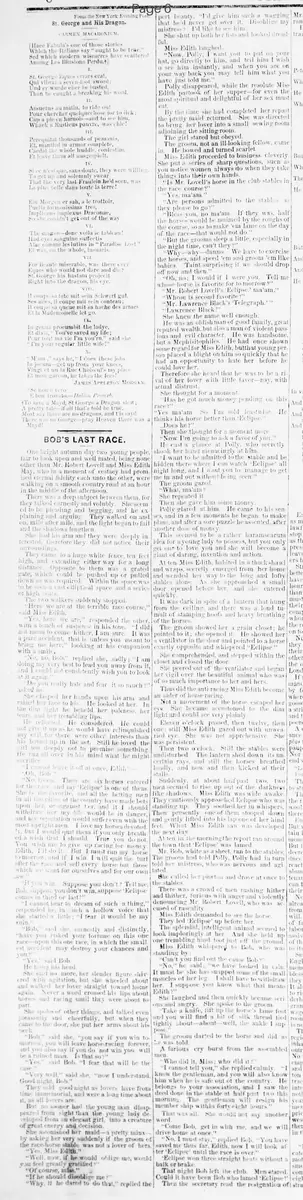
BOB'S LAST RACE.
One bright autumn day two young people
fair to look upon and well mated, being none
other than Mr. Robert Lovell and Miss Edith
May, who in a moment of ecstasy had promised
eternal fidelity each unto the other, were
walking on a smooth country road at an hour
in the middle of the afternoon.
There was a deep subject between them, for
they talked earnestly and volubly. She seemed
to be pleading and begging, and he explaining
and arguing. They walked on and
on, mile after mile, and the light began to fail
and the shadows lengthen.
She had his arm and they were deeply interested,
though therefore they did not notice their
surroundings.
They came to a huge white fence, ten feet
high, and extending either way for a long
distance. Opposite to them was a grated
gate, which could be pushed up or pulled
down as was required. Within the space was
to be seen a vast elliptical space and a series
of high seats.
The two walkers suddenly stopped.
"Here we are at the terrible race course,"
said Miss Edith.
"Yes, here we are," responded the other,
with a touch of suspense in his tone. "I did
not mean to come hither, I am sure. It was
a pure accident, that is unless you meant to
bring me here," looking at his companion
with a smile.
"No, no, Bob," replied she, sadly; "I am
doing my very best to lead you away from it,
and I could not consistently wish you to look
at it again."
"Do you really hate and fear it so much?"
She clasped her hands upon his arm and
raised her face to his. He looked at her. In
the dying light he beheld her paleness, her
tears, and her trembling lips.
He relented. He considered. He could
not give it up as he would have relinquished
any evil, for there were other interests than
his bound up in the act. Still he loved her
too deeply not to promise something.
He ran all over in his mind what he might
settle.
"I cannot leave it off at once, Edith."
"Oh, Bob!"
"No, listen. There are six horses entered
for this race and my 'Eclipse' is one of them.
She is the favorite, and all the betting men
in all the cities of the country have made bets
upon her, or against her, and if I should
withdraw her my life would be in danger
and my reputation would suffer even with the
most upright men. I love my horses devoted-
ly but I would quit them if you only breathed
a wish that I should. True you do not
wish me to give up racing for money
Edith, I will do it. But I must run my horse
tomorrow and if I win I will quit the turf
after the race and sell every horse but those
which we want for ourselves and for our own
use.
"If you win. Suppose you don't? Tell me,
Bob suppose you don't win, suppose 'Eclipse
comes in third or last"
"I cannot bear to dream of such a thing,"
responded he, in such a hollow voice that
she started a little; "I fear it would be my
ruin."
"Bob!" said she, earnestly and distinctly,
"have you risked your fortune on this one
race—upon this one race, in which the smallest
accident may destroy your chances and
you?"
"Yes," said Bob.
He hung his head.
She said no more, her slender figure shivered
with agitation, but she wheeled about
and walked her lover straight toward home
again. Never a word crossed his lips about
horses and racing until they were about to
part.
She spoke of other things, and talked even
pleasantly and cheerfully, but when they
came to the door, she put her arms about his
neck.
"Bob," said she, "you say if you win to-
morrow, you will leave horse-racing forever,
and you also say if you do not win you will
be a ruined man. Is that so?"
"Yes," said Bob, "I fear that will be the
case."
"Very well," said she. "Now I understand.
Good night, Bob."
They said good night as lovers have from
time immemorial, and were a long time about
it, as all lovers are.
But no sooner had the young man disappeared
from sight than the young lady developed
from an elegant girl into a creature
of great energy and decision.
She astonished her maid—a pretty minx—
by asking her very suddenly if the groom of
the race-horse stable was not a lover of hers.
"Yes, Miss Edith."
"Well, now, if he would oblige me, would
you feel greatly gratified?"
"Of course, miss."
"If he should disoblige me—"
"Why, if he dared to do that," replied the
pert beauty, "I'd give him such a wagging
that he'd never get over it. Disoblige my
mistress? I'd like to see him."
She shut up both her fists and looked dreadful.
Miss Edith laughed.
"Now, Polly, I want you to put on your
hat, go directly to him, and tell him I wish
to see him instantly, and when you are on
your way back you may tell him what you
have just told me."
Polly disappeared, while the resolute Miss
Edith partook of her supper—for even the
most spiritual and delightful of her sex must
eat.
By the time she had completed her repast
the pretty maid returned. She was directed
to bring her lover into a small sewing room
adjoining the sitting-room.
The girl stared but obeyed.
The groom, not an ill-looking fellow, came
in. He bowed and turned scarlet.
Miss Edith proceeded to business cleverly.
She put a series of sharp questions, such as
you notice women always do when they take
things into their own hands.
"Is Mr. Lovell's horse in the club stables in
the race course?"
"Yes, ma'am."
"Are persons admitted to the stables as
they please to go?"
"Bless you, no ma'am. If they was, half
the horses would be maimed by the roughs of
the course, so as to make 'em lame on the day
of the race—that would not do."
"But the grooms sleep a little, especially in
the night time, can't they?"
"Why—why—dunno." We have to exercise
the horses, and speed 'em and groom 'em like
babies. "Taint surprising if we should drop
off now and then."
"Oh, no; I would if I were you. Tell me
whose horse is favorite for tomorrow?"
"Mr. Robert Lovell's 'Eclipse,' ma'am."
"Whose is second favorite?"
"Mr. Lawrence Black's 'Telegraph.'"
"Lawrence Black!"
She knew the name well enough.
He was an oldish man of good family, great
reputed wealth, but also a man of violent passions
and evil character. He was handsome,
but a Mephistopheles. He had once shown
some regard for Miss Edith, but that young person
placed a blight on him so quickly that he
had an opportunity to hate her before he
could love her.
Therefore she heard that he was to be a rival
of her lover with little favor—nay, with
actual distrust.
She thought for a moment.
"Has he got much money pending on this
race?"
"Yes ma'am. So I'm told leastwise.
He
thinks his horse better than 'Eclipse.'"
"Does he?"
Then she thought for a moment more.
"Now I'm going to ask a favor of you."
He cast a glance at Polly, who secretly
shook her hand menacingly at him.
"I want to be admitted to the stable and be
hidden there where I can watch 'Eclipse' all
night long, and I want you to manage to get
me in and out without being seen."
The groom gazed.
"What, ma'am?"
She repeated it.
Then she gave him some money.
Polly glared at him. He came to his senses,
and in a few moments he began to make
plans, and after a sore puzzle he assented, after
another dose of money.
This seemed to be a rather harum-scarum
idea for a young lady to possess, but you only
get one to love you and she will become a
giant of daring, invention and action.
At ten Miss Edith, habited in a thick shawl
and wraps, secretly emerged from her home
and wended her way to the long and lofty
stables alone. As she approached a small
door opened before her, and she entered
quickly.
It was dark in spite of a lantern that hung
from the ceiling, and there was a loud tumult
of stamping hoofs and heavy breathing
of the horses.
The groom showed her a grain closet; he
pointed to it, she opened it. He showed her
a ventilator in the door and pointed to a horse
exactly opposite and whispered "Eclipse."
She comprehended, and stepped within the
closet and closed the door.
She peered out of the ventilator and began
her vigil over the beautiful animal who was
of so much importance to her and hers.
Thus did the anti-racing Miss Edith become
an aider of horse racing.
Not a movement of the horse escaped her
eye. She became accustomed to the dim
light and could see very plainly.
Eleven o'clock passed, then twelve, then
one. Still Miss Edith gazed out with unwearied
eye. She was not apprehensive. She
was persistent.
Then two o'clock. Still the stables were
undisturbed. The lantern shed down its uncertain
rays, and still the horses breathed
loudly, and now and then kicked at their
stall.
Suddenly, at about half past two, two
men seemed to rise up out of the darkness
like shadows. Miss Edith was wide awake.
They cautiously approached Eclipse who was
standing up. They soothed her in whispers.
Then presently one of them stooped down
and gently lifted into his lap one of her hind
feet. What Miss Edith saw was developed
the next day.
At ten in the morning the report ran around
the town that 'Eclipse' was lamed.
Mr. Bob, white as a sheet, ran to the stables.
The groom had told Polly. Polly had in turn
told her mistress, who was nervous and agitated.
She called her phaeton and drove at once to
the stables.
There was a crowd of men rushing hither
and thither, furious with anger and violently
denouncing Mr. Robert Lovell, who was accused
of rascality.
Miss Edith demanded to see the horse.
They led 'Eclipse' up before her.
The splendid, intelligent animal seemed to
look imploringly at her. And she held up
one trembling hind foot just off the ground.
Miss Edith whispered to Bob, who was
standing by:
"Can't you find out the cause Bob?"
"No," he said, "we have looked in vain.
It must be she has snapped some of the small
muscles of her leg. I shall have to withdraw
her. I suppose you know what that means
Edith?"
She laughed and then quickly became serious
and angry. She spoke to the groom:
"Take a knife, lift up the horse's lame foot
and you will find a bit of silk thread tied
tightly about—about—well, the ankle I suppose."
The groom darted to the horse and did as
he was told.
A furious cry burst from the assembled
men.
"Who did it, Miss: who did it!"
"I cannot tell you," she replied calmly. "I
know the gentleman, and you will also know
him when he is safe out of the country. He
belongs to your association, and I saw the
deed done in the stable at half past two this
morning. The gentleman will resign his
membership within forty-eight hours."
That was all. She would not say another
word.
"Come Bob, get in with me, and we will
drive home at once."
"No, I must stay," replied Bob. "You have
saved me thus far, Edith, now I will look after
'Eclipse' until the race is over."
Eclipse won three straight heats without a
balk or break.
That night Bob left the club. Men stared.
Could it have been Bob who lamed 'Eclipse'?
Then the secretary read the resignation of
Lawrence Black.
One bright autumn day two young people
fair to look upon and well mated, being none
other than Mr. Robert Lovell and Miss Edith
May, who in a moment of ecstasy had promised
eternal fidelity each unto the other, were
walking on a smooth country road at an hour
in the middle of the afternoon.
There was a deep subject between them, for
they talked earnestly and volubly. She seemed
to be pleading and begging, and he explaining
and arguing. They walked on and
on, mile after mile, and the light began to fail
and the shadows lengthen.
She had his arm and they were deeply interested,
though therefore they did not notice their
surroundings.
They came to a huge white fence, ten feet
high, and extending either way for a long
distance. Opposite to them was a grated
gate, which could be pushed up or pulled
down as was required. Within the space was
to be seen a vast elliptical space and a series
of high seats.
The two walkers suddenly stopped.
"Here we are at the terrible race course,"
said Miss Edith.
"Yes, here we are," responded the other,
with a touch of suspense in his tone. "I did
not mean to come hither, I am sure. It was
a pure accident, that is unless you meant to
bring me here," looking at his companion
with a smile.
"No, no, Bob," replied she, sadly; "I am
doing my very best to lead you away from it,
and I could not consistently wish you to look
at it again."
"Do you really hate and fear it so much?"
She clasped her hands upon his arm and
raised her face to his. He looked at her. In
the dying light he beheld her paleness, her
tears, and her trembling lips.
He relented. He considered. He could
not give it up as he would have relinquished
any evil, for there were other interests than
his bound up in the act. Still he loved her
too deeply not to promise something.
He ran all over in his mind what he might
settle.
"I cannot leave it off at once, Edith."
"Oh, Bob!"
"No, listen. There are six horses entered
for this race and my 'Eclipse' is one of them.
She is the favorite, and all the betting men
in all the cities of the country have made bets
upon her, or against her, and if I should
withdraw her my life would be in danger
and my reputation would suffer even with the
most upright men. I love my horses devoted-
ly but I would quit them if you only breathed
a wish that I should. True you do not
wish me to give up racing for money
Edith, I will do it. But I must run my horse
tomorrow and if I win I will quit the turf
after the race and sell every horse but those
which we want for ourselves and for our own
use.
"If you win. Suppose you don't? Tell me,
Bob suppose you don't win, suppose 'Eclipse
comes in third or last"
"I cannot bear to dream of such a thing,"
responded he, in such a hollow voice that
she started a little; "I fear it would be my
ruin."
"Bob!" said she, earnestly and distinctly,
"have you risked your fortune on this one
race—upon this one race, in which the smallest
accident may destroy your chances and
you?"
"Yes," said Bob.
He hung his head.
She said no more, her slender figure shivered
with agitation, but she wheeled about
and walked her lover straight toward home
again. Never a word crossed his lips about
horses and racing until they were about to
part.
She spoke of other things, and talked even
pleasantly and cheerfully, but when they
came to the door, she put her arms about his
neck.
"Bob," said she, "you say if you win to-
morrow, you will leave horse-racing forever,
and you also say if you do not win you will
be a ruined man. Is that so?"
"Yes," said Bob, "I fear that will be the
case."
"Very well," said she. "Now I understand.
Good night, Bob."
They said good night as lovers have from
time immemorial, and were a long time about
it, as all lovers are.
But no sooner had the young man disappeared
from sight than the young lady developed
from an elegant girl into a creature
of great energy and decision.
She astonished her maid—a pretty minx—
by asking her very suddenly if the groom of
the race-horse stable was not a lover of hers.
"Yes, Miss Edith."
"Well, now, if he would oblige me, would
you feel greatly gratified?"
"Of course, miss."
"If he should disoblige me—"
"Why, if he dared to do that," replied the
pert beauty, "I'd give him such a wagging
that he'd never get over it. Disoblige my
mistress? I'd like to see him."
She shut up both her fists and looked dreadful.
Miss Edith laughed.
"Now, Polly, I want you to put on your
hat, go directly to him, and tell him I wish
to see him instantly, and when you are on
your way back you may tell him what you
have just told me."
Polly disappeared, while the resolute Miss
Edith partook of her supper—for even the
most spiritual and delightful of her sex must
eat.
By the time she had completed her repast
the pretty maid returned. She was directed
to bring her lover into a small sewing room
adjoining the sitting-room.
The girl stared but obeyed.
The groom, not an ill-looking fellow, came
in. He bowed and turned scarlet.
Miss Edith proceeded to business cleverly.
She put a series of sharp questions, such as
you notice women always do when they take
things into their own hands.
"Is Mr. Lovell's horse in the club stables in
the race course?"
"Yes, ma'am."
"Are persons admitted to the stables as
they please to go?"
"Bless you, no ma'am. If they was, half
the horses would be maimed by the roughs of
the course, so as to make 'em lame on the day
of the race—that would not do."
"But the grooms sleep a little, especially in
the night time, can't they?"
"Why—why—dunno." We have to exercise
the horses, and speed 'em and groom 'em like
babies. "Taint surprising if we should drop
off now and then."
"Oh, no; I would if I were you. Tell me
whose horse is favorite for tomorrow?"
"Mr. Robert Lovell's 'Eclipse,' ma'am."
"Whose is second favorite?"
"Mr. Lawrence Black's 'Telegraph.'"
"Lawrence Black!"
She knew the name well enough.
He was an oldish man of good family, great
reputed wealth, but also a man of violent passions
and evil character. He was handsome,
but a Mephistopheles. He had once shown
some regard for Miss Edith, but that young person
placed a blight on him so quickly that he
had an opportunity to hate her before he
could love her.
Therefore she heard that he was to be a rival
of her lover with little favor—nay, with
actual distrust.
She thought for a moment.
"Has he got much money pending on this
race?"
"Yes ma'am. So I'm told leastwise.
He
thinks his horse better than 'Eclipse.'"
"Does he?"
Then she thought for a moment more.
"Now I'm going to ask a favor of you."
He cast a glance at Polly, who secretly
shook her hand menacingly at him.
"I want to be admitted to the stable and be
hidden there where I can watch 'Eclipse' all
night long, and I want you to manage to get
me in and out without being seen."
The groom gazed.
"What, ma'am?"
She repeated it.
Then she gave him some money.
Polly glared at him. He came to his senses,
and in a few moments he began to make
plans, and after a sore puzzle he assented, after
another dose of money.
This seemed to be a rather harum-scarum
idea for a young lady to possess, but you only
get one to love you and she will become a
giant of daring, invention and action.
At ten Miss Edith, habited in a thick shawl
and wraps, secretly emerged from her home
and wended her way to the long and lofty
stables alone. As she approached a small
door opened before her, and she entered
quickly.
It was dark in spite of a lantern that hung
from the ceiling, and there was a loud tumult
of stamping hoofs and heavy breathing
of the horses.
The groom showed her a grain closet; he
pointed to it, she opened it. He showed her
a ventilator in the door and pointed to a horse
exactly opposite and whispered "Eclipse."
She comprehended, and stepped within the
closet and closed the door.
She peered out of the ventilator and began
her vigil over the beautiful animal who was
of so much importance to her and hers.
Thus did the anti-racing Miss Edith become
an aider of horse racing.
Not a movement of the horse escaped her
eye. She became accustomed to the dim
light and could see very plainly.
Eleven o'clock passed, then twelve, then
one. Still Miss Edith gazed out with unwearied
eye. She was not apprehensive. She
was persistent.
Then two o'clock. Still the stables were
undisturbed. The lantern shed down its uncertain
rays, and still the horses breathed
loudly, and now and then kicked at their
stall.
Suddenly, at about half past two, two
men seemed to rise up out of the darkness
like shadows. Miss Edith was wide awake.
They cautiously approached Eclipse who was
standing up. They soothed her in whispers.
Then presently one of them stooped down
and gently lifted into his lap one of her hind
feet. What Miss Edith saw was developed
the next day.
At ten in the morning the report ran around
the town that 'Eclipse' was lamed.
Mr. Bob, white as a sheet, ran to the stables.
The groom had told Polly. Polly had in turn
told her mistress, who was nervous and agitated.
She called her phaeton and drove at once to
the stables.
There was a crowd of men rushing hither
and thither, furious with anger and violently
denouncing Mr. Robert Lovell, who was accused
of rascality.
Miss Edith demanded to see the horse.
They led 'Eclipse' up before her.
The splendid, intelligent animal seemed to
look imploringly at her. And she held up
one trembling hind foot just off the ground.
Miss Edith whispered to Bob, who was
standing by:
"Can't you find out the cause Bob?"
"No," he said, "we have looked in vain.
It must be she has snapped some of the small
muscles of her leg. I shall have to withdraw
her. I suppose you know what that means
Edith?"
She laughed and then quickly became serious
and angry. She spoke to the groom:
"Take a knife, lift up the horse's lame foot
and you will find a bit of silk thread tied
tightly about—about—well, the ankle I suppose."
The groom darted to the horse and did as
he was told.
A furious cry burst from the assembled
men.
"Who did it, Miss: who did it!"
"I cannot tell you," she replied calmly. "I
know the gentleman, and you will also know
him when he is safe out of the country. He
belongs to your association, and I saw the
deed done in the stable at half past two this
morning. The gentleman will resign his
membership within forty-eight hours."
That was all. She would not say another
word.
"Come Bob, get in with me, and we will
drive home at once."
"No, I must stay," replied Bob. "You have
saved me thus far, Edith, now I will look after
'Eclipse' until the race is over."
Eclipse won three straight heats without a
balk or break.
That night Bob left the club. Men stared.
Could it have been Bob who lamed 'Eclipse'?
Then the secretary read the resignation of
Lawrence Black.
What sub-type of article is it?
Romance
Crime Story
Personal Triumph
What themes does it cover?
Love
Deception
Triumph
What keywords are associated?
Horse Racing
Sabotage
Romance
Betting Fortune
Eclipse Horse
Lawrence Black
What entities or persons were involved?
Robert Lovell
Edith May
Lawrence Black
Where did it happen?
Race Course Stables
Story Details
Key Persons
Robert Lovell
Edith May
Lawrence Black
Location
Race Course Stables
Event Date
Bright Autumn Day
Story Details
Bob risks fortune on horse 'Eclipse' in race. Edith, opposing racing, secretly watches stables, witnesses sabotage by Lawrence Black's men using silk thread to lame horse. She reveals it, Eclipse wins, Bob quits racing.