Thank you for visiting SNEWPapers!
Sign up free
Literary
October 2, 1788
The Daily Advertiser
New York, New York County, New York
What is this article about?
An essay critiquing the folly of parents raising children in luxury beyond their future means, leading to ruin upon inheritance. It contrasts vain ostentation with solid comforts like conscience, health, and moderation, illustrated by a family's downfall.
Clipping
OCR Quality
96%
Excellent
Full Text
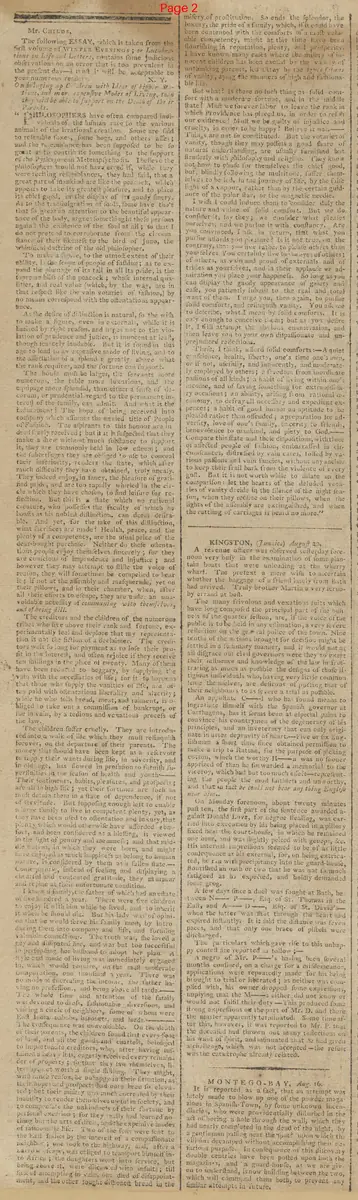
Mr. CHILDS,
The following ESSAY, which is taken from the first volume of Winter Evenings; or Lucubrations on Life and Letters, contains some judicious observations on an error that is too prevalent in the present day—it will be acceptable to your numerous readers.
X. Y.
On bringing up Children with Ideas of higher Stations, and more expensive Modes of Living, than they will be able to support on the Death of their Parents.
PHILOSOPHERS have often compared individuals of the human race to the various animals of the irrational creation. Some are said to resemble foxes, some hogs, and others males; and the resemblance has been supposed to be so great as to contribute something to the support of the Pythagorean Metempsychosis. I believe the philosophers would not have erred if, while they were reciting resemblances, they had said, that a great part of mankind are like the peacock, which appears to take its greatest pleasure, and to place its chief good, in the display of its gaudy finery.
As to the transmigration of souls, some have thought that so great an attention to the beautiful appearance of the body, argues something in these persons hostile to the existence of the soul at all: to that I do not pretend to corroborate from the circumstance of their likeness to the bird of Juno, the whimsical doctrine of the old philosopher.
To make a figure, to the utmost extent of their ability, is the scope of people of fashion; as to expand the plumage of its tail in all its pride, is the supreme bliss of the peacock; whose internal qualities, and real value (which, by the way, are in that respect like the vain votaries of fashion,) by no means correspond with the ostentatious appearance.
As the desire of distinction is natural, so the wish to make a figure, even in externals, while it is limited by right reason, and urges not to the violation of prudence and justice, is innocent at least, though scarcely laudable. But it is found in this age to lead to an expensive mode of living, and to the affectation of a splendor greatly above what the rank requires, and the fortune can support.
The house must be larger, the servants more numerous, the table more luxurious, and the equipage more splendid, than either a sense of decorum, or prudential regard to the permanent interest of the family, can admit. And what is the inducement: The hope of being received into company which assumes the envied title of People of Fashion. The aspirants to this honour are indeed freely received; but if it is suspected that they make a show without much substance to support it, they are commonly held in low esteem; and the subterfuges they are obliged to use to conceal their inferiority, renders the state, which after much difficulty they have obtained, truly uneasy.
They indeed enjoy, in fancy, the pleasure of gratified pride, and are too rapidly whirled in the circle which they have chosen, to find leisure for reflection. But this is a state which no rational creature, who possesses the faculty of which he boasts as his noblest distinction, can deem desirable. And yet, for the sake of this distinction, what sacrifices are made? Health, peace, and the plenty of a competency, are the usual price of the dear-bought purchase. Neither do these ostentatious people enjoy themselves sincerely; for they are conscious of imprudence and injustice; and however they may attempt to stifle the voice of reason, they will sometimes be compelled to hear it; if not at the assembly and masquerade, yet on their pillows, and in their chamber, when, after all their efforts to escape, they are made an unavoidable necessity of communing with themselves, and of being still.
The creditors and the children of the numerous tribes who live above their rank and fortune, experimentally feel and deplore that my representation is not the fiction of a declaimer. The creditors wait so long for payment as to lose their profit in the interest, and often rejoice if they receive ten shillings in the place of twenty. Many of them have been reduced to beggary, by supplying the vain with the necessaries of life; for it so happens that those who supply the vanities of life, are often paid with ostentatious liberality and alacrity; while he who sells bread, meat, and raiment, is obliged to take out a commission of bankrupt, or sue in vain, by a tedious and vexatious process of the law.
The children suffer cruelly. They are introduced into a walk of life which they must relinquish forever, on the departure of their parents. The money that should have been kept as a reservoir to supply their wants during life, in adversity, and in old age, has flowed in profusion to furnish superfluities in the season of health and youth— Their sentiments, habits, pleasures, and prospects; are all in high life; yet their fortunes are such as must detain them in a state of dependence, if not of servitude. But supposing enough left to enable a large family to live in competent plenty, yet, as they have been used to ostentation and luxury, that plenty which would otherwise have afforded comfort, and been considered as a blessing, is viewed in the light of penury and meanness; and that middle station, in which they were born, and might have enjoyed as much happiness as belong to human nature, is considered by them as a fallen state.— Consequently, instead of feeling and displaying a cheerful and contented gratitude, they murmur and repine at their unfortunate condition.
I knew a family, the father of which had an estate of five hundred a year. There were five children to enjoy it with him while he lived, and to inherit it when he should die. But his lady was of opinion that he would serve his family most, by introducing them into company and life, and forming valuable connections. The truth was, she loved a gay and dissipated life, and was but too successful in persuading her husband to adopt her plan. A new style and mode of living was immediately engaged in, which would require, on the most moderate computation, one thousand a year. There was no mode of increasing the income, the father having no profession., and being above all trade.— The whole time and attention of the family was devoted to dress, fashionable diversions, and visiting a circle of neighbors, some of whom were East India nabobs, baronets, and lords.— The consequence was unavoidable. On the death of their parents, the children found that every foot of land, and all the goods and chattels, belonged to importunate creditors, who, after having sustained a heavy loss, eagerly received every remainder of property; so that they saw themselves, literally, not worth a single shilling. They might, with much reason, be unhappy in their situation, as their hopes and prospects had once been so elevated; but their misery was much increased by their inability to render themselves useful in society, and to compensate the unkindness of their fortune by personal exertion; for they really had learned nothing but the arts of dress, and the expensive modes of fashionable life. Two of the sons were sent to the East Indies by the interest of a compassionate neighbor; one took to the highway, and, after a narrow escape, was obliged to transport himself into Africa; the daughters went into service, but being above it, were dismissed with insults; till sick of attempting in vain, one died of disappointment, and the other sought dishonest bread in the misery of prostitution. So ends the splendor, the luxury, the pride of a family, which, if it could have been contented with the comforts of a most valuable competency, might at this time have been flourishing in reputation, plenty, and prosperity.
I have known many cases where the misery of innocent children has been caused by the vanity of unthinking parents, led astray by the gaudy lures of vanity, aping the manners of high and fashionable life.
But what? is there no such thing as solid comfort with a moderate fortune, and in the middle state? Must we forever labor to leave the rank in which Providence has placed us, in order to relish our existence? Must we be guilty of injustice and cruelty, in order to be happy? Believe it not,— Things are not so constituted. But the votaries of vanity, though they may possess a good share of natural understanding, are usually furnished but slenderly with philosophy and religion. They know not how to choose for themselves the chief good, but, blindly following the multitude, suffer themselves to be led, in the journey of life, by the false light of a vapour, rather than by the certain guidance of the polar star, or the magnetic needle.
I wish I could induce them to consider duly the nature and value of solid comfort. But we do consider it, say they; we consider what pleases ourselves, and we pursue it with constancy. Are you convinced, I ask in return, that what you pursue affords you pleasure? Is it not true, on the contrary, that you live rather to please others than yourselves You certainly live in the eyes of others; of others, as vain and proud of externals and of trifles as yourselves, and in their applause or admiration you place your happiness. So long as you can display the gaudy appearance of gaiety and ease, you patiently submit to the real and total want of them. I urge you, then again, to pursue solid comforts, and relinquish vanity. You ask me to describe, what I mean by solid comforts. It is easy enough to conceive them; but as you desire it, I will attempt the obvious enumeration, and then leave you to your own dispassionate and unprejudiced reflections.
These, I think, afford solid comforts: A quiet conscience, health, liberty, one's time one's own or if not, usefully, and innocently, and moderately employed by others; a freedom from inordinate passions of all kinds; a habit of living within one's income, and of saving something for extraordinary occasions; an ability, arising from rational economy, to defray all necessary and expedient expenses; a habit of good humor an aptitude to be pleased rather than offended; a preparation for adversity, love of one's family, sincerity to friends, benevolence to mankind, and piety to God.—
Compare this state and these dispositions, with those of affected people of fashion, embarrassed in circumstances, distressed by vain cares, tossed by various passions and vain fancies, without any anchor to keep their frail bark from the violence of every gust. But it is not worth while to dilate on the comparison: let the hearts of the deluded votaries of vanity decide in the silence of the night season, when they recline on their pillows, when the lights of the assembly are extinguished, and when the rattling of carriages is heard no more.
The following ESSAY, which is taken from the first volume of Winter Evenings; or Lucubrations on Life and Letters, contains some judicious observations on an error that is too prevalent in the present day—it will be acceptable to your numerous readers.
X. Y.
On bringing up Children with Ideas of higher Stations, and more expensive Modes of Living, than they will be able to support on the Death of their Parents.
PHILOSOPHERS have often compared individuals of the human race to the various animals of the irrational creation. Some are said to resemble foxes, some hogs, and others males; and the resemblance has been supposed to be so great as to contribute something to the support of the Pythagorean Metempsychosis. I believe the philosophers would not have erred if, while they were reciting resemblances, they had said, that a great part of mankind are like the peacock, which appears to take its greatest pleasure, and to place its chief good, in the display of its gaudy finery.
As to the transmigration of souls, some have thought that so great an attention to the beautiful appearance of the body, argues something in these persons hostile to the existence of the soul at all: to that I do not pretend to corroborate from the circumstance of their likeness to the bird of Juno, the whimsical doctrine of the old philosopher.
To make a figure, to the utmost extent of their ability, is the scope of people of fashion; as to expand the plumage of its tail in all its pride, is the supreme bliss of the peacock; whose internal qualities, and real value (which, by the way, are in that respect like the vain votaries of fashion,) by no means correspond with the ostentatious appearance.
As the desire of distinction is natural, so the wish to make a figure, even in externals, while it is limited by right reason, and urges not to the violation of prudence and justice, is innocent at least, though scarcely laudable. But it is found in this age to lead to an expensive mode of living, and to the affectation of a splendor greatly above what the rank requires, and the fortune can support.
The house must be larger, the servants more numerous, the table more luxurious, and the equipage more splendid, than either a sense of decorum, or prudential regard to the permanent interest of the family, can admit. And what is the inducement: The hope of being received into company which assumes the envied title of People of Fashion. The aspirants to this honour are indeed freely received; but if it is suspected that they make a show without much substance to support it, they are commonly held in low esteem; and the subterfuges they are obliged to use to conceal their inferiority, renders the state, which after much difficulty they have obtained, truly uneasy.
They indeed enjoy, in fancy, the pleasure of gratified pride, and are too rapidly whirled in the circle which they have chosen, to find leisure for reflection. But this is a state which no rational creature, who possesses the faculty of which he boasts as his noblest distinction, can deem desirable. And yet, for the sake of this distinction, what sacrifices are made? Health, peace, and the plenty of a competency, are the usual price of the dear-bought purchase. Neither do these ostentatious people enjoy themselves sincerely; for they are conscious of imprudence and injustice; and however they may attempt to stifle the voice of reason, they will sometimes be compelled to hear it; if not at the assembly and masquerade, yet on their pillows, and in their chamber, when, after all their efforts to escape, they are made an unavoidable necessity of communing with themselves, and of being still.
The creditors and the children of the numerous tribes who live above their rank and fortune, experimentally feel and deplore that my representation is not the fiction of a declaimer. The creditors wait so long for payment as to lose their profit in the interest, and often rejoice if they receive ten shillings in the place of twenty. Many of them have been reduced to beggary, by supplying the vain with the necessaries of life; for it so happens that those who supply the vanities of life, are often paid with ostentatious liberality and alacrity; while he who sells bread, meat, and raiment, is obliged to take out a commission of bankrupt, or sue in vain, by a tedious and vexatious process of the law.
The children suffer cruelly. They are introduced into a walk of life which they must relinquish forever, on the departure of their parents. The money that should have been kept as a reservoir to supply their wants during life, in adversity, and in old age, has flowed in profusion to furnish superfluities in the season of health and youth— Their sentiments, habits, pleasures, and prospects; are all in high life; yet their fortunes are such as must detain them in a state of dependence, if not of servitude. But supposing enough left to enable a large family to live in competent plenty, yet, as they have been used to ostentation and luxury, that plenty which would otherwise have afforded comfort, and been considered as a blessing, is viewed in the light of penury and meanness; and that middle station, in which they were born, and might have enjoyed as much happiness as belong to human nature, is considered by them as a fallen state.— Consequently, instead of feeling and displaying a cheerful and contented gratitude, they murmur and repine at their unfortunate condition.
I knew a family, the father of which had an estate of five hundred a year. There were five children to enjoy it with him while he lived, and to inherit it when he should die. But his lady was of opinion that he would serve his family most, by introducing them into company and life, and forming valuable connections. The truth was, she loved a gay and dissipated life, and was but too successful in persuading her husband to adopt her plan. A new style and mode of living was immediately engaged in, which would require, on the most moderate computation, one thousand a year. There was no mode of increasing the income, the father having no profession., and being above all trade.— The whole time and attention of the family was devoted to dress, fashionable diversions, and visiting a circle of neighbors, some of whom were East India nabobs, baronets, and lords.— The consequence was unavoidable. On the death of their parents, the children found that every foot of land, and all the goods and chattels, belonged to importunate creditors, who, after having sustained a heavy loss, eagerly received every remainder of property; so that they saw themselves, literally, not worth a single shilling. They might, with much reason, be unhappy in their situation, as their hopes and prospects had once been so elevated; but their misery was much increased by their inability to render themselves useful in society, and to compensate the unkindness of their fortune by personal exertion; for they really had learned nothing but the arts of dress, and the expensive modes of fashionable life. Two of the sons were sent to the East Indies by the interest of a compassionate neighbor; one took to the highway, and, after a narrow escape, was obliged to transport himself into Africa; the daughters went into service, but being above it, were dismissed with insults; till sick of attempting in vain, one died of disappointment, and the other sought dishonest bread in the misery of prostitution. So ends the splendor, the luxury, the pride of a family, which, if it could have been contented with the comforts of a most valuable competency, might at this time have been flourishing in reputation, plenty, and prosperity.
I have known many cases where the misery of innocent children has been caused by the vanity of unthinking parents, led astray by the gaudy lures of vanity, aping the manners of high and fashionable life.
But what? is there no such thing as solid comfort with a moderate fortune, and in the middle state? Must we forever labor to leave the rank in which Providence has placed us, in order to relish our existence? Must we be guilty of injustice and cruelty, in order to be happy? Believe it not,— Things are not so constituted. But the votaries of vanity, though they may possess a good share of natural understanding, are usually furnished but slenderly with philosophy and religion. They know not how to choose for themselves the chief good, but, blindly following the multitude, suffer themselves to be led, in the journey of life, by the false light of a vapour, rather than by the certain guidance of the polar star, or the magnetic needle.
I wish I could induce them to consider duly the nature and value of solid comfort. But we do consider it, say they; we consider what pleases ourselves, and we pursue it with constancy. Are you convinced, I ask in return, that what you pursue affords you pleasure? Is it not true, on the contrary, that you live rather to please others than yourselves You certainly live in the eyes of others; of others, as vain and proud of externals and of trifles as yourselves, and in their applause or admiration you place your happiness. So long as you can display the gaudy appearance of gaiety and ease, you patiently submit to the real and total want of them. I urge you, then again, to pursue solid comforts, and relinquish vanity. You ask me to describe, what I mean by solid comforts. It is easy enough to conceive them; but as you desire it, I will attempt the obvious enumeration, and then leave you to your own dispassionate and unprejudiced reflections.
These, I think, afford solid comforts: A quiet conscience, health, liberty, one's time one's own or if not, usefully, and innocently, and moderately employed by others; a freedom from inordinate passions of all kinds; a habit of living within one's income, and of saving something for extraordinary occasions; an ability, arising from rational economy, to defray all necessary and expedient expenses; a habit of good humor an aptitude to be pleased rather than offended; a preparation for adversity, love of one's family, sincerity to friends, benevolence to mankind, and piety to God.—
Compare this state and these dispositions, with those of affected people of fashion, embarrassed in circumstances, distressed by vain cares, tossed by various passions and vain fancies, without any anchor to keep their frail bark from the violence of every gust. But it is not worth while to dilate on the comparison: let the hearts of the deluded votaries of vanity decide in the silence of the night season, when they recline on their pillows, when the lights of the assembly are extinguished, and when the rattling of carriages is heard no more.
What sub-type of article is it?
Essay
Satire
What themes does it cover?
Moral Virtue
Social Manners
What keywords are associated?
Vanity
Social Class
Parenting
Luxury
Moral Lesson
Prudence
Ostentation
Family Ruin
What entities or persons were involved?
X. Y.
Literary Details
Title
On Bringing Up Children With Ideas Of Higher Stations, And More Expensive Modes Of Living, Than They Will Be Able To Support On The Death Of Their Parents.
Author
X. Y.
Subject
Observations On An Error That Is Too Prevalent In The Present Day
Form / Style
Prose Reflection On Vanity And Prudence
Key Lines
To Make A Figure, To The Utmost Extent Of Their Ability, Is The Scope Of People Of Fashion; As To Expand The Plumage Of Its Tail In All Its Pride, Is The Supreme Bliss Of The Peacock;
The Children Suffer Cruelly. They Are Introduced Into A Walk Of Life Which They Must Relinquish Forever, On The Departure Of Their Parents.
These, I Think, Afford Solid Comforts: A Quiet Conscience, Health, Liberty, One's Time One's Own Or If Not, Usefully, And Innocently, And Moderately Employed By Others;